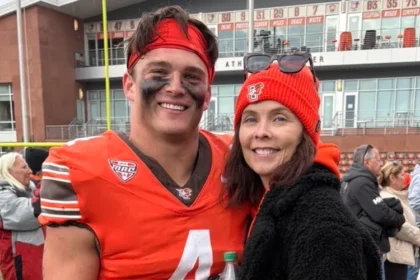
Twelve years ago, Joe Martinez’s life changed forever. Late one night, he received a call no parent ever wants to get — his 21-year-old son, Paul, had been struck by a car while crossing a street near his home in Fresno, California.
Less than two hours later, Martinez stood in the emergency room, staring in disbelief at his son’s body, covered by a sheet.
“It looked like he was asleep,” Martinez recalls. “All I wanted to do was wake him up and say, ‘Let’s go home.’”
In the months that followed, the 59-year-old nonprofit consultant turned his grief into action. He began advocating for pedestrian safety — first in Fresno, which analysts have ranked among the deadliest U.S. cities for pedestrians, and eventually at state and national levels. “Otherwise, my grief would have consumed me,” he says.
Martinez joined forces with advocacy organizations such as Families for Safe Streets, which channels the pain and determination of crash victims’ families into campaigns for safer roads. He soon discovered that his son’s death was part of a devastating national trend.
According to the Governors Highway Safety Association, pedestrian fatalities are now at a near 40-year high — up 48% from just a decade ago. Data from the Centers for Disease Control and Prevention (CDC) shows that while many developed countries in Europe and Asia have reduced road deaths, the U.S. continues to see alarming increases.
:max_bytes(150000):strip_icc():focal(742x365:744x367):format(webp)/Families-for-Safe-Streets-World-Day-of-Remembrance-for-Road-Traffic-Victims-new-york-2023-110425-be4d1d72bfd448cd83e3617b13d392b8.jpg)
Experts point to several factors behind the surge — beyond distracted driving from phones and touchscreens. The growing popularity of large, heavy vehicles like SUVs and America’s sprawling, high-speed roadway designs are also major contributors, according to the CDC.
While most U.S. traffic victims are killed in vehicles, pedestrian deaths are rising even faster. In 2024 alone, 7,148 pedestrians lost their lives after being struck by cars, and tens of thousands more were hospitalized.
“We prioritize driving — and driving fast — much more than we value pedestrian safety,” says Wes Marshall, a professor of civil engineering at the University of Colorado Denver. “The problem is solvable,” he adds, “but it’s not going to be easy.”
Still, some communities have proven that progress is possible. In Hoboken, New Jersey, the 2015 death of an 89-year-old resident who was hit by a van prompted then–city councilman Ravi Bhalla to take action.
“It could have been avoided,” says Bhalla, now the city’s mayor, “if we had taken some very basic measures.”
Since implementing lower speed limits and high-visibility crosswalks, Hoboken hasn’t seen a single traffic-related death in eight years — a remarkable achievement that offers a roadmap for other cities.
“These are low-cost solutions that can make a huge difference,” Bhalla says.
Back in Fresno, where an average of 25 pedestrians are killed each year, Martinez remains cautiously hopeful. Small but meaningful changes — like adding reflective strips around traffic lights to make them more visible — have already started to make a difference.
“My pain,” he says, “has become my purpose.”