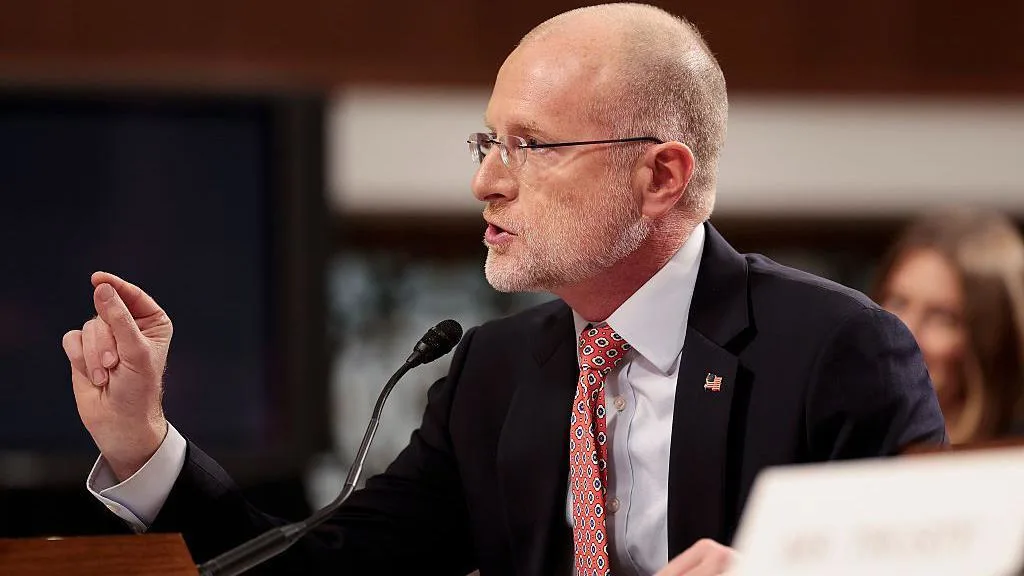

Brendan Carr, Chairman of the Federal Communications Commission (FCC), has issued a stark warning to U.S. broadcasters, suggesting that their federal licenses could be revoked following high-level criticism of their coverage regarding the U.S.-Israel war with Iran.
The threat marks a significant escalation in the Trump administration’s friction with mainstream media. Speaking with CBS News, Carr challenged the long-held industry perception that broadcast licenses are permanent assets.
“People have gotten used to the idea that licenses are some sort of property right,” Carr stated. “I try to reorient people that, no, there is a public interest, and broadcast is different.”
The “Public Interest” Ultimatum
The Chairman’s remarks follow accusations he leveled against various outlets for “running hoaxes and news distortions.” Carr suggested that stations still have a window to “correct course” before their mandatory license renewal cycles.
The regulatory warning gained momentum Saturday after President Donald Trump criticized media outlets on social media, claiming “Lowlife ‘Papers’ and Media actually want us to lose the War.” Carr amplified this sentiment, noting that the law is “clear” regarding the requirement for broadcasters to operate in the public interest or face the loss of their airwaves.
Constitutional Pushback and Legal Limits
Legal experts and Democratic lawmakers have moved quickly to label the threats as an overreach of executive and regulatory power. Critics argue that using the FCC to discipline outlets over editorial content violates the First Amendment.
- Senator Elizabeth Warren (D-MA): Termed the move “illegal,” asserting the government cannot censor speech simply because it is critical of the administration’s war efforts.
- Governor Gavin Newsom (D-CA): Described the threat as “flagrantly unconstitutional.”
- Senator Mark Kelly (D-AZ): Characterized the stance as an attempt to avoid accountability and public scrutiny.
Understanding FCC Jurisdiction
Despite the aggressive rhetoric, the FCC’s actual authority contains specific legal guardrails:
| Feature | FCC Regulatory Scope |
| Licensing Target | Individual broadcast stations (Radio/TV) |
| Non-Licensed Entities | National cable and broadcast networks (e.g., ABC, CBS, NBC) |
| Duration | Licenses are typically issued for eight-year terms |
| Censorship Prohibitions | The Communications Act expressly prohibits the FCC from censoring broadcast matter |
While the FCC does not license the networks themselves, many networks own and operate the individual local stations that do require federal licenses to stay on the air.
A Pattern of Media Confrontation
This is not Chairman Carr’s first foray into content-related disputes. He recently called for the suspension of ABC late-night host Jimmy Kimmel following the comedian’s criticism of Republican reactions to the Charlie Kirk assassination. While Kimmel’s program briefly left the air, it returned within a week.
The administration’s broader strategy has included multiple lawsuits against major publications, including The Wall Street Journal and The New York Times, over perceived bias. However, the FCC’s own website continues to state that the commission’s role in overseeing on-air content remains “very limited” due to First Amendment protections.