
The U.S. Justice Department has publicly released thousands more documents from the estate of registered sex offender and disgraced financier Jeffrey Epstein. The latest batch—dubbed the Epstein files—was made public last week and includes roughly three million pages, about 180,000 images, more than 2,000 videos, and references to high-profile figures such as Bill Clinton, Bill Gates, and Elon Musk.
But digging through massive data releases can be slow and frustrating, even when the material is of intense public interest. A new web tool aims to simplify that process by letting people explore the files in a familiar, email-style interface.
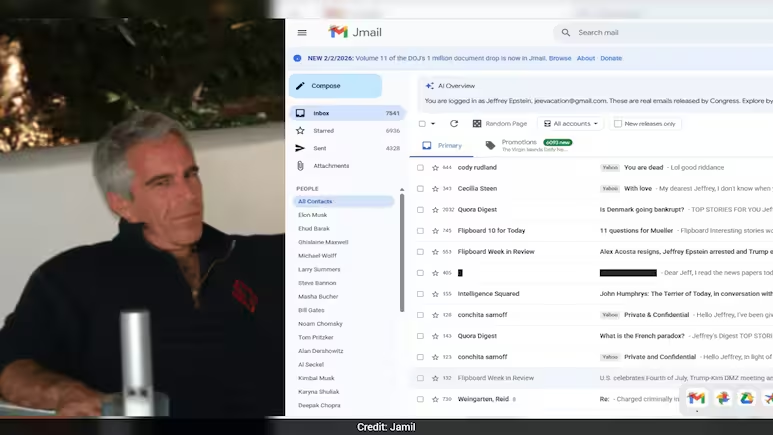
Called Jmail, the website resembles Google’s Gmail—down to the layout—except the branding features a small hat perched on the “M,” and the profile image in the top-right corner shows a smiling Epstein. The site also includes other tabs styled as parody services, with icons labeled JPhotos, JDrive, and JFlight.
JPhotos opens a gallery that organizes images released by the Justice Department connected to the case. JDrive provides access to millions of pages of documents, while JFlights offers flight-tracking information related to Epstein’s travel. There’s also a “more” menu that expands into additional sections such as Jotify—a Spotify-like page hosting hours of audio recordings released by the Justice Department—and Jamazon, a similar spoof interface that tracks Epstein’s Amazon orders.
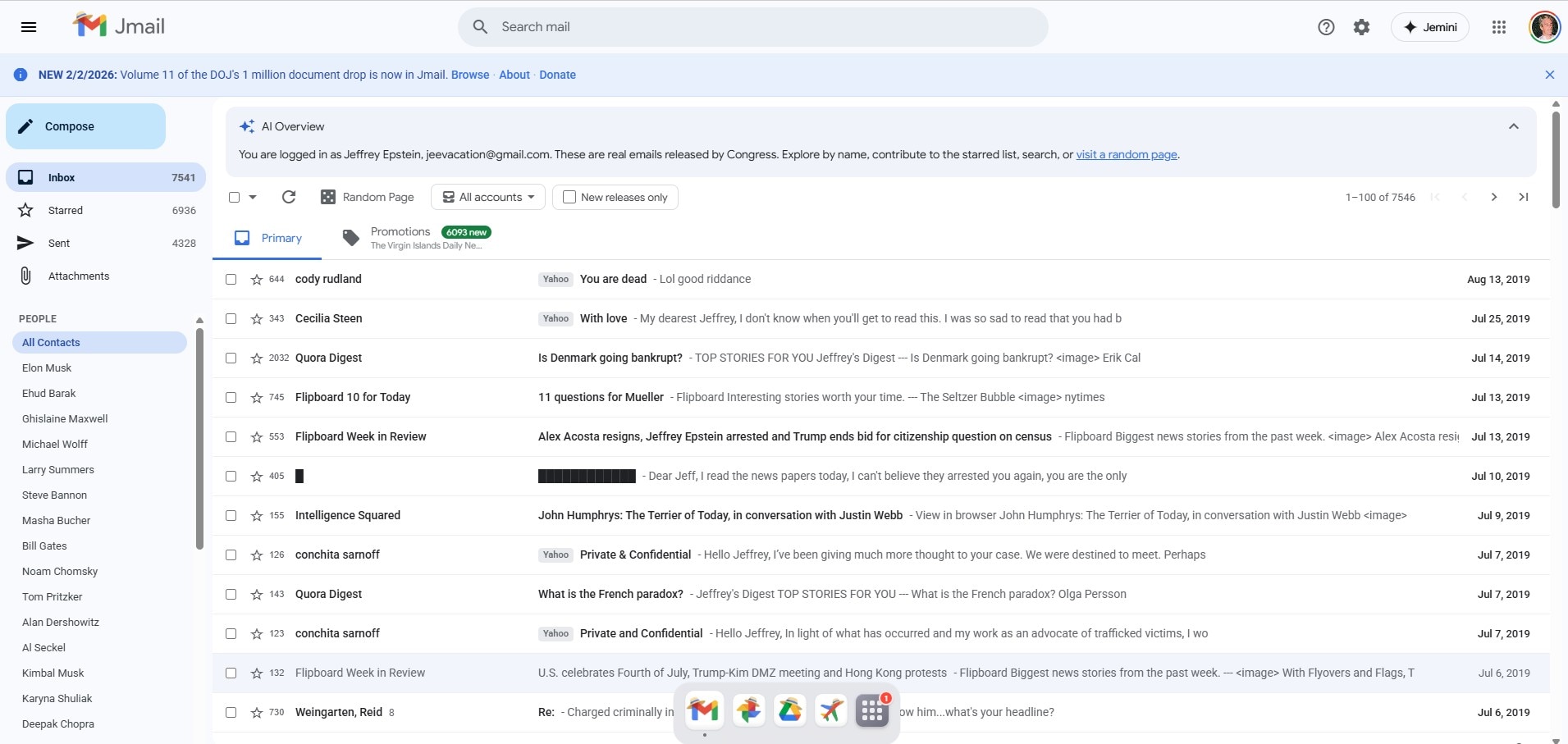
Inside Jmail, users can click through thousands of emails presented to look like ordinary messages. A left-hand sidebar mimics standard mailbox filters, allowing sorting into categories such as Inbox, Starred, and Sent. Below that, the interface lists the people who exchanged correspondence with Epstein.
Jmail was created by internet artist Riley Walz and web developer Luke Igel. Walz unveiled the project in late November 2025 after the first batch of Epstein files was released, sharing it via an X post with the line: “We cloned Gmail, except you’re logged in as Epstein and can see his emails.”
In an older interview, Igel told Wired that he pitched the concept to Walz, and the pair built the site using Cursor in a single night.
“The emails were just so hard to read,” Igel said.
“It felt like so much of the shock would’ve come if you saw actual screenshots of the actual inbox, but what you were seeing was these really low-quality, poorly scanned PDFs. You have to do a few steps of imagination to remind yourself that this is indeed a real email,” he added.