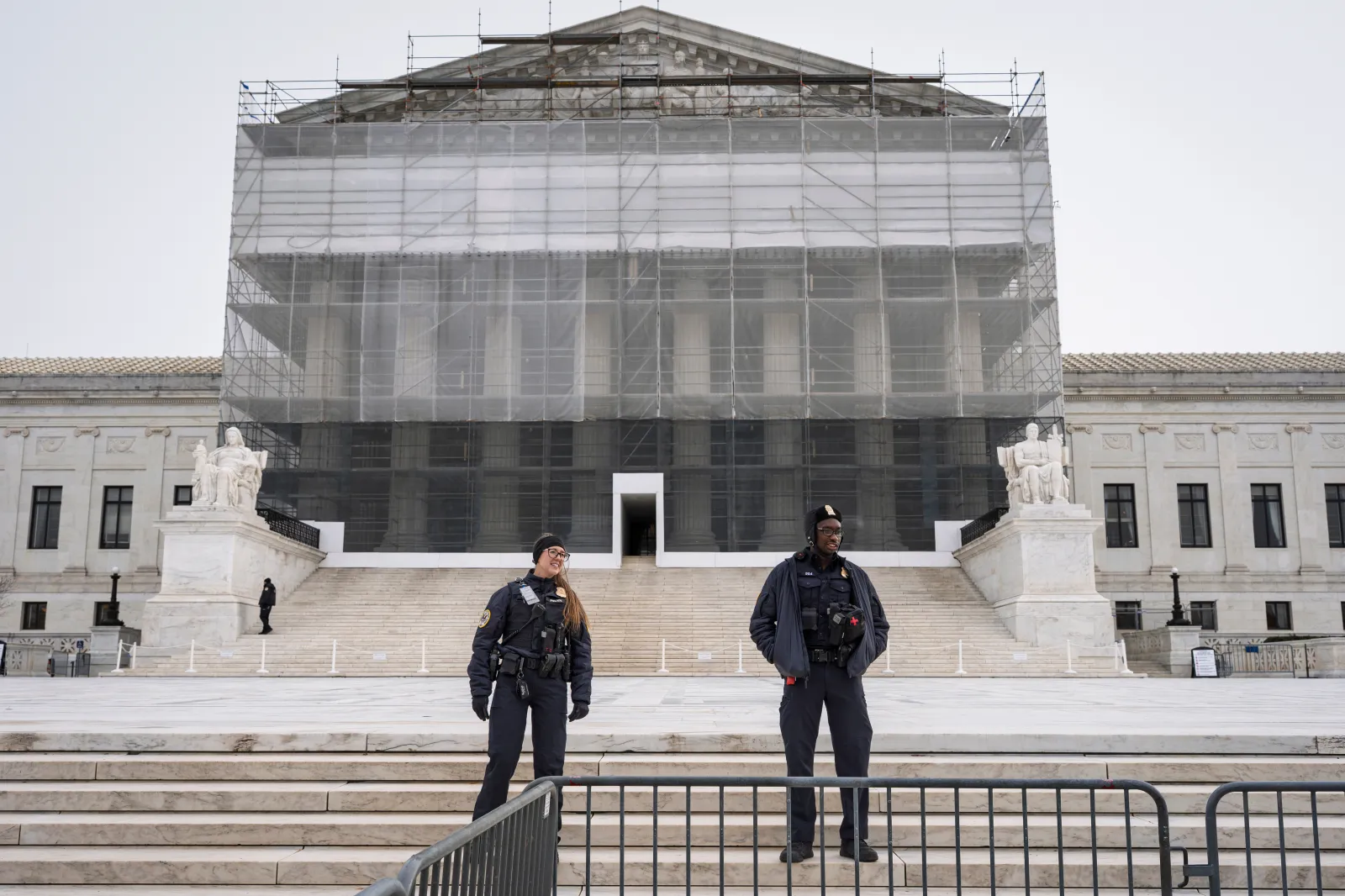

The Supreme Court is preparing to hear — or deliver decisions in — several high-impact cases that could reshape U.S. policy across trade, immigration, federal agency independence, and election administration.
From the scope of presidential authority to impose emergency tariffs, to challenges that could redefine birthright citizenship, to disputes over asylum processing and the handling of mail-in ballots, the issues span some of the most contested areas of American law. The Court is expected to issue rulings in the coming months.
Emergency tariffs
One major case asks whether President Donald Trump properly relied on the International Emergency Economic Powers Act (IEEPA) to impose tariffs on countries including China, Canada, and Mexico — a statute that allows such action only in a declared “national emergency.”
At the center of the dispute is the administration’s justification that the tariffs were “necessary to rectify America’s country-killing trade deficits and to stem the flood of fentanyl across our border,” according to court filings.
The Supreme Court heard oral arguments in November on the challenge to Trump’s authority to impose the tariffs without congressional approval. A decision has not yet been issued. If the Court sides with the administration, the ruling could significantly broaden the president’s ability to use emergency powers to set trade policy.
On December 23, Trump publicly urged the Court to back the tariffs on Truth Social, saying they were “responsible for the GREAT USA Economic Numbers JUST ANNOUNCED…AND THEY WILL ONLY GET BETTER!”
His post followed new Commerce Department data reporting that U.S. economic growth in the third quarter came in stronger than expected.
Birthright citizenship
Another closely watched matter is Trump vs. Washington, which challenges Trump’s executive order 14160, titled “Protecting the Meaning and Value of American Citizenship.”
The January 2025 order directs federal agencies not to recognize citizenship for children born in the U.S. to “temporary visitors and illegal aliens” if the birth occurs more than 30 days after the order takes effect.
A ruling could carry sweeping consequences for immigration policy and for how the country applies jus soli — “right of the soil” — the longstanding principle that birth on U.S. territory confers citizenship.
That principle has been anchored for more than a century in the 14th Amendment, adopted in part to overturn the legal regime that denied citizenship to Black Americans. The amendment states: “All persons born or naturalized in the United States, and subject to the jurisdiction thereof, are citizens of the United States and of the state wherein they reside.”
After the order was issued, one district judge wrote that “U.S. citizenship is a right no less precious than life or liberty,” and said the policy “conflicts with the plain language of the 14th Amendment, contradicts 125-year-old binding Supreme Court precedent and runs counter to our nation’s 250-year history of citizenship by birth.”
Legal scholars remain divided, however, over the precise meaning of the amendment’s “subject to the jurisdiction” language — with some arguing birth in the U.S. is a clear entitlement to citizenship, while others contend that birth alone is not sufficient.
Harold Krent, a law professor at Chicago-Kent College of Law, said in a Bloomberg Law podcast on December 27 that he expects the Supreme Court to “deal the Trump administration a blow” and conclude the order is inconsistent with the 14th Amendment.
Lisa Cook firing and control of independent agencies
The Court is also weighing disputes that could affect the independence of key federal institutions.
Trump attempted to remove Federal Reserve Governor Lisa Cook ahead of the Fed’s September meeting — a move that, if successful, would have marked the first time a president fired a sitting Fed governor in the central bank’s 112-year history.
The Supreme Court has said Cook will remain in her role until it hears arguments from both her and the administration in January.
Trump’s push to remove Cook centered on allegations of potential mortgage fraud, including claims that she listed two properties as “primary residences” in July 2021 — allegations Cook has denied. Reuters has reported that documents it reviewed challenged Trump’s claims.
Krent said in the same Bloomberg Law podcast that he believes the Court may “deviate from Trump” and rule against him in Cook’s case.
Separately, the Supreme Court is also hearing Trump vs. Slaughter, a case that could allow presidents to fire the heads of independent agencies more freely — potentially revisiting a policy framework that has stood for roughly 90 years.
Asylum metering
In November, the Court said it will review a first Trump administration immigration policy known as “metering,” which turned away some undocumented migrants seeking to cross from Mexico without assessing their asylum claims.
Between 2016 and 2021, the Department of Homeland Security used metering to send migrants back while they were still on the Mexican side of the border, relying on the idea that a person “arrives” only once they enter U.S. territory. Under that logic, stopping someone just short of crossing — even if only a few feet from the border — was treated as a way to regulate arrivals and avoid triggering asylum processing requirements.
Although the policy was later rescinded, the current Trump administration is asking the Supreme Court to clarify whether metering is lawful — a step that could open the door to bringing the policy back.
“I think the Trump administration might win on the narrow ground that if you’re 2 feet away from a border, you’re 2 feet away from a border and immigration agents can apply force to prevent somebody from applying for asylum,” Krent said in the Bloomberg Law podcast. He added that this was “just a guess,” but said the administration may have a stronger position here than in the birthright citizenship dispute.
Mail-in ballots and Election Day deadlines
Another case the Court is expected to decide concerns whether states must count mail-in ballots that arrive after Election Day.
Currently, about 14 states, along with the District of Columbia and other territories, count mailed ballots that arrive after Election Day as long as they are postmarked on or before a specified deadline, according to the National Conference of State Legislatures.
If the Supreme Court requires all mail ballots to be received by Election Day, it could lead to large-scale ballot rejections. In 2024, 725,000 ballots postmarked by Election Day arrived within legally permitted post-election windows, according to The New York Times.