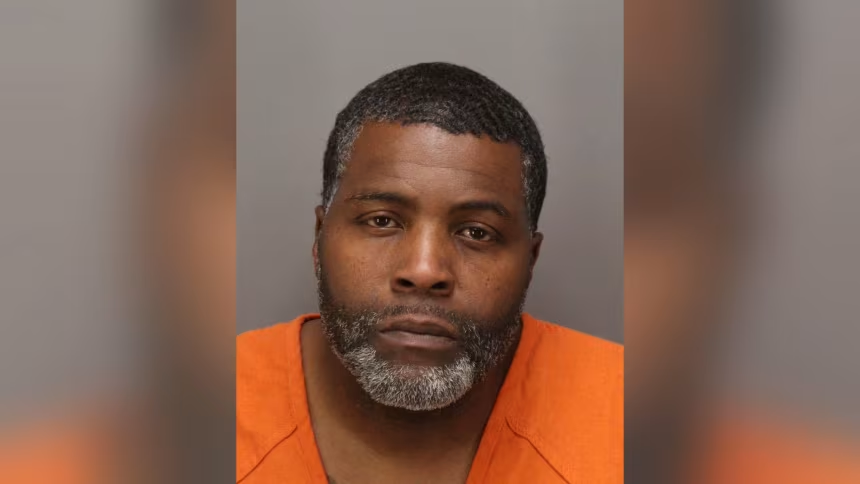

Oscar Freemond Fowler III walked out of federal prison on February 19, 2026, a free man for the first time in years. His release was the result of a last-minute commutation by the outgoing Biden administration.
That freedom lasted exactly four days.
On February 23, 2026, Florida authorities arrested the 50-year-old career criminal on state charges that mirror the exact federal offenses for which he was just granted clemency. The move by the Florida Attorney General’s Office signals a calculated legal maneuver to circumvent federal executive power, utilizing a constitutional loophole known as the “dual-sovereignty doctrine.”
The Legal Loophole: Two Sovereigns, One Crime
The rearrest of Fowler is not a violation of double jeopardy, despite the charges being virtually identical to his previous federal conviction. Under the Fifth Amendment, an individual cannot be tried twice for the same “offense.” However, the U.S. Supreme Court reaffirmed in the 2019 case $Gamble \text{ v. } \text{United States}$ that a state and the federal government are separate “sovereigns.”
- Federal Authority: Article II of the Constitution grants the President power to pardon or commute sentences for federal crimes only.
- State Authority: The Tenth Amendment preserves the “police power” of individual states, allowing them to prosecute the same conduct under state statutes.
“It is completely plausible to be arrested for the same underlying acts on the state level as on the federal,” says Bernadette Meyler, a law professor and associate dean at Stanford University. “A presidential pardon cannot touch a state-level liability.”
A Political Flashpoint: The “Autopen” Controversy
Florida Attorney General James Uthmeier has turned the Fowler case into a broader indictment of the previous administration’s clemency protocols. In a press release, Uthmeier specifically targeted the use of an “autopen”—a mechanical device used to sign the president’s signature—to execute the commutation orders.
“The Biden administration’s use of the autopen is putting Floridians at risk by allowing dangerous felons back on the street, but we won’t put up with it,” Uthmeier stated.
Uthmeier has directed the Office of Statewide Prosecution to review every “auto-penned” commutation affecting Florida, vowing to bring state-level charges whenever viable. Fowler now faces up to 45 years in the Florida Department of Corrections if convicted on the new state charges of drug trafficking and firearm possession.
The Case Against Oscar Fowler
Fowler’s criminal history in Pinellas County spans over three decades and includes more than 60 cases. His federal sentence of 12 years and six months, handed down in 2024, followed a raid on his home that uncovered:
- A 9mm pistol and 29 rounds of ammunition.
- Quantities of cocaine and methamphetamine.
- Documented evidence of intent to distribute.
Federal prosecutors originally pushed for a 150-month sentence, citing Fowler’s “violent career criminal” status. Critics of the clemency program, including the conservative Oversight Project, argue that Fowler’s inclusion in the list of 2,500 commuted individuals contradicts the administration’s stated goal of focusing on non-violent offenders.
Precedent for Prosecution
This strategy of “second-bite” prosecution has gained traction in high-profile political spheres:
- Steve Bannon: Pardoned by Donald Trump for federal fraud charges, only to be indicted by New York State for the same underlying conduct.
- Tina Peters: Despite a symbolic federal pardon gesture by Trump, the former Colorado clerk remains incarcerated for state-level election interference convictions that a president has no legal authority to erase.
For Fowler, the legal battle now shifts to Florida’s state courts. While his attorney, Lee Pearlman, has declined to comment on the active case, legal analysts suggest any double-jeopardy defense will face a steep uphill battle against established Supreme Court precedent.