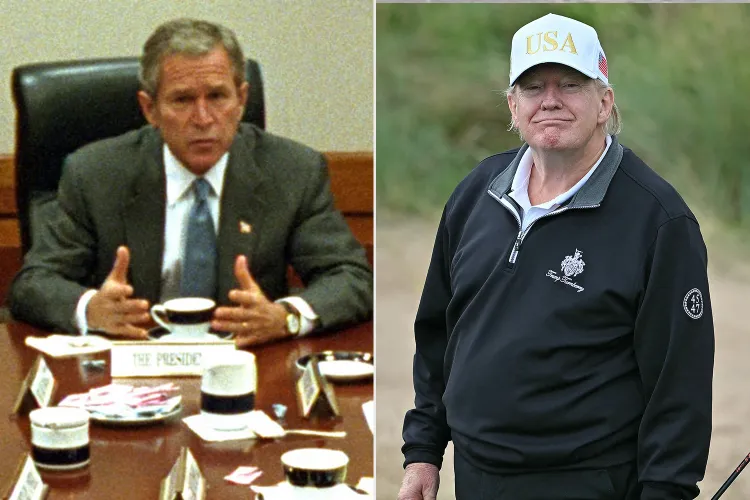

As the United States military grapples with a widening conflict in the Middle East, a nearly two-decade-old interview with former President George W. Bush has resurfaced, casting a sharp spotlight on President Donald Trump’s decision to maintain his habitual golf schedule despite mounting American casualties.
The contrast in wartime optics has ignited a fresh debate over the “signal” sent by a Commander-in-Chief on the links while service members are in harm’s way.
A Vow of Solidarity: The Bush Precedent
The resurfaced 2008 interview with Politico details Bush’s decision to abandon his golf clubs in August 2003. The pivot occurred following the bombing of the United Nations headquarters in Baghdad, an attack that claimed the life of Sergio Vieira de Mello, the top U.N. official in Iraq.
“I remember when de Mello… got killed in Baghdad,” Bush told the outlet at the time. “I was playing golf—I think I was in central Texas—and they pulled me off the golf course and I said, ‘It’s just not worth it anymore to do.'”
Bush argued that continuing the hobby during a period of national sacrifice was inappropriate for the office. “I don’t want some mom whose son may have recently died to see the commander in chief playing golf,” he continued. “I feel I owe it to the families to be in solidarity as best as I can with them.”
:max_bytes(150000):strip_icc():focal(599x0:601x2):format(webp)/george-w-bush-golf-031026-b448c9ee93ad4098b82e5258fa40b0b3.jpg)
“Some People Will Die”: The Current Conflict
The revival of Bush’s comments follows a weekend where President Trump was seen golfing on Sunday, March 8. The outing occurred just three days after Time magazine released a cover story titled “Trump’s War,” detailing the unfolding hostilities involving Iran, Israel, and the U.S.
In that interview, conducted by correspondent Eric Cortellessa, Trump addressed the grim realities of the escalation with a bluntness that has characterized his second term. When asked if American citizens should fear retaliatory attacks on domestic soil, Trump responded, “I guess.”
“We think about it all the time… But yeah, you know, we expect some things,” Trump told Time. Regarding the potential for U.S. loss of life, the 79-year-old President added: “Like I said, some people will die. When you go to war, some people will die.”
The Human and Financial Cost
The optics of the President’s weekend leisure are being measured against a backdrop of increasing military attrition. On March 9, just one day after Trump’s golf outing, a Pentagon official confirmed to The Washington Post that seven U.S. service members have been killed in the conflict with Iran.
Additionally, approximately 140 U.S. troops have been wounded. While the Pentagon reports that the majority of these injuries are minor, eight service members remain in critical condition, requiring “the highest level of medical care.”
The administration is also facing scrutiny over the fiscal impact of the President’s routine. During a House subcommittee hearing on government efficiency, Rep. Jasmine Crockett (D-TX) challenged the administration’s spending priorities, specifically targeting the cost of presidential security and travel to golf properties.
“If we are gonna talk about efficiency… let’s talk about the fact that, as of March 30, Trump’s golfing has cost us approximately $26 million,” Crockett testified. “He has decided that he wanted to play games while the rest of us are really trying to make sure that we can serve the American people.”