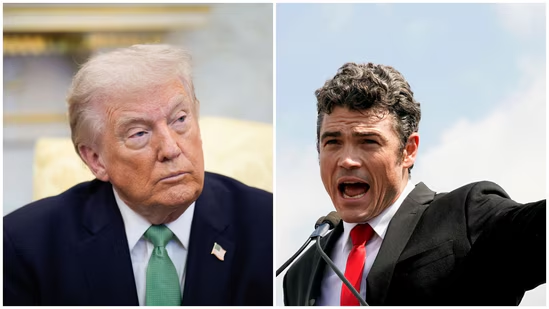

President Donald Trump on Tuesday welcomed the resignation of Joe Kent, the nation’s anti-terrorism chief, labeling the departure a “good thing” for national security. The high-profile exit follows a sharp internal rift over the administration’s military posture toward Tehran and Kent’s assessment that Iran posed no immediate danger to the United States.
The President’s forceful reaction underscores a deepening divide within the intelligence community regarding the “Operation Epic Fury” campaign and the threshold for preemptive military action.
A Clash of Threat Assessments
The friction centered on Kent’s formal evaluation that Iran did not present an “imminent threat” to U.S. interests. President Trump dismissed this conclusion, characterizing Kent as a “nice guy” who lacked the necessary resolve for the role.
“When I read his statement, I realized that it’s a good thing that he’s out because he said that Iran was not a threat,” Trump stated. “I always thought he was weak on security.”
The President asserted that Iran’s status as a global adversary is a matter of international consensus, suggesting that other nations recognize the danger even if they hesitate to act.
White House Rebuts Resignation Claims
White House Press Secretary Karoline Leavitt issued a scathing rebuttal to Kent’s resignation letter, which reportedly urged the President to “reflect” on the current trajectory toward war. Leavitt categorized Kent’s assertions as “false claims” echoed by political detractors.
In a detailed statement on X, Leavitt emphasized three primary pillars of the administration’s stance:
- Actionable Intelligence: The White House maintains it possesses “strong and compelling evidence” that Iran intended to strike the U.S. first.
- Moral Imperative: Leavitt labeled the Iranian regime “evil,” citing its history as a state sponsor of terrorism and its role in American casualties.
- Executive Authority: The administration argued that the Commander-in-Chief holds the sole constitutional prerogative to define national threats.
“The American people went to the ballot box and entrusted him and him alone to make such final judgments,” Leavitt wrote, dismissing allegations that foreign influence played a role in the President’s decision-making.
Context of ‘Operation Epic Fury’
The departure of the anti-terror chief comes at a critical juncture for U.S. foreign policy. While Kent’s resignation letter reportedly questioned the necessity of the current escalation, the White House continues to point toward Iran’s nuclear ambitions as a “red line” that has remained consistent in Trump’s rhetoric for decades.
The administration’s “Active Voice” on the matter suggests no intention of scaling back military readiness, despite the loss of a top counter-terrorism official.