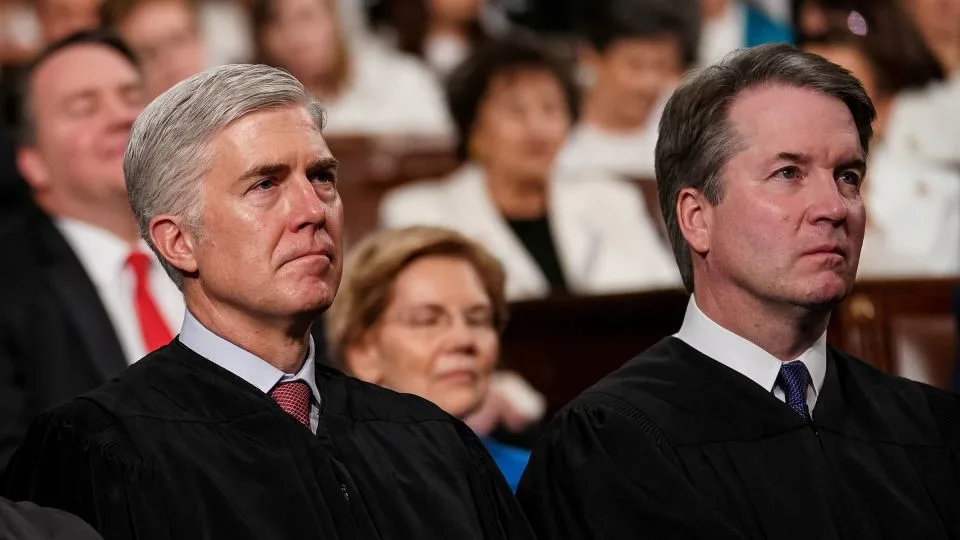

In President Donald Trump’s ongoing battles with the judiciary, two members of the Supreme Court are sending a message to lower courts: follow precedent, or face rebuke.
Frustration with certain district and appellate judges has surfaced in a series of recent opinions from the court’s conservative justices. Their criticism at times echoes Trump’s own rhetoric, as they weigh a steady stream of emergency cases tied to his second term.
“Lower court judges may sometimes disagree with this court’s decisions, but they are never free to defy them,” Justice Neil Gorsuch wrote last week in an opinion involving the administration’s cancellation of nearly $800 million in research grants. Justice Brett Kavanaugh joined his statement.
The opinion flipped the usual narrative. Trump has often been portrayed as the one pushing constitutional boundaries through his executive orders and sharp attacks on the judiciary. But here, conservative justices themselves called out judges for ignoring Supreme Court precedent.
“This is now the third time in a matter of weeks this court has had to intercede in a case ‘squarely controlled’ by one of its precedents,” Gorsuch wrote. “When this court issues a decision, it constitutes a precedent that commands respect in lower courts.”
Justice Samuel Alito delivered similar criticism earlier this year, accusing a federal judge in a Trump-related case of committing an “act of judicial hubris.”
The Supreme Court has repeatedly sided with Trump on emergency matters ranging from immigration to federal spending to independent agency leadership. Even when Trump’s administration was accused of defying lower courts, the justices often backed the White House.
CNN Supreme Court analyst Steve Vladeck noted that Gorsuch’s opinion may be the clearest explanation yet of the justices’ priorities. “The court seems more concerned with lower courts correctly reading the tea leaves in their rulings than with the executive branch behaving properly before the rest of the judiciary,” he said.
Not everyone agreed. In a sharp dissent, Justice Ketanji Brown Jackson likened the ruling to “Calvinball jurisprudence,” referencing the comic strip where the only rule is that there are no rules. “We seem to have two: that one, and this administration always wins,” Jackson wrote.
Although Trump has toned down his direct attacks on judges since spring, his allies continue to claim courts are driven by politics. “We will not fall to rogue judges,” Trump’s former attorney Alina Habba told Fox News after losing a recent case.
Debate Over Judicial Authority
Critics argue that Trump himself created much of the friction between the branches — not just through rhetoric, but through how the Justice Department has handled major cases. Justice Sonia Sotomayor has warned that siding with Trump repeatedly risks “rewarding lawlessness.”
Sotomayor and Jackson, both with experience on district courts, often push back on the majority. In her dissents, Sotomayor has accused the court of undermining respect for the rule of law.
Meanwhile, conservatives like Gorsuch have accused lower courts of going too far. Former Trump official James Burnham argued that the justices’ frustration is warranted: “The defiance of the Supreme Court’s emergency orders by some lower courts is unprecedented, extraordinary, and the Supreme Court must deal with it decisively.”
Carrie Severino of the Judicial Crisis Network echoed the sentiment, saying judges need to be reminded not to “flout orders of the Supreme Court.”
But questions remain about how exactly judges should interpret emergency orders, which often come with little or no explanation. Unlike full rulings, these orders are usually brief, lack oral arguments, and don’t directly resolve the underlying legal issues.
Vladeck called it “hubris” to expect lower courts to anticipate reasoning the Supreme Court hasn’t provided. “If the court wants lower courts to treat its analyses as precedent, it should, you know, provide them,” he said.
High Court’s Recent Rulings
Just last week, a 5-4 majority overturned a decision by US District Judge William Young requiring the administration to reinstate nearly $800 million in National Institutes of Health research grants. The justices pointed to an earlier emergency order in a similar case about teacher shortage grants.
The Supreme Court has also limited the power of lower courts to issue nationwide injunctions, curbing a tool that had been used to block policies by both Republican and Democratic presidents.
In another case, the court upheld Trump’s authority to remove members of the Consumer Product Safety Commission, again citing an earlier emergency order.
Kavanaugh’s Warning
Speaking this summer, Justice Kavanaugh emphasized that judges must respect their role. Without naming names, he reminded his audience that members of the judiciary are not policymakers.
“Members of the judiciary have an important responsibility … to get it right, to do our hard work, to understand our role in the constitutional democracy,” he said. “We’re not the policymakers.”