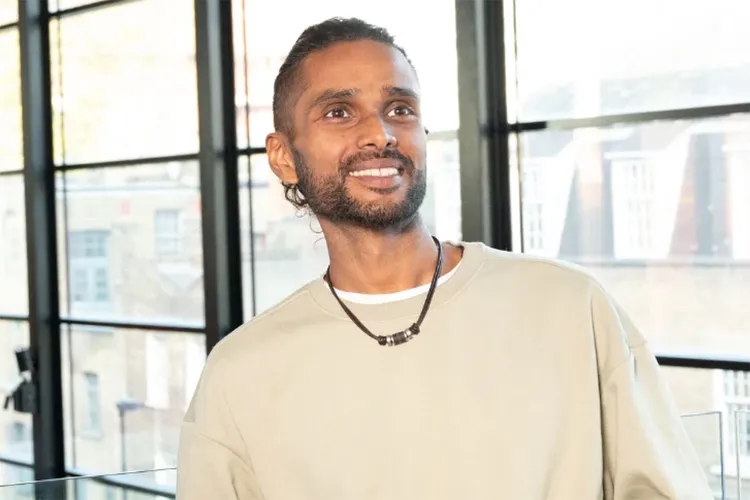

A British father of two is sharing his journey after receiving a life-changing diagnosis—one that began with an unusual and seemingly harmless symptom: randomly smelling bleach.
Sam Suriakumar, now 40, learned he had a glioma in February 2020 after suffering a seizure on the London Underground while commuting home from work, according to the Brain Tumor Research website.
As defined by the Cleveland Clinic, a glioma is a type of tumor that develops in the brain or spinal cord. These tumors can vary in type and severity, including astrocytomas, ependymomas, and oligodendrogliomas. Treatment typically involves a combination of surgery, radiation, and chemotherapy.
Suriakumar described his experience to Brain Tumor Research, noting that in the days leading up to his diagnosis, he began experiencing odd symptoms. “I’d been smelling a strange smell and feeling really unwell,” he wrote. “It was a smell like ammonia or bleach, and it felt like a cleaning agent was filling up my mouth. I now know this as a symptom or a warning sign called an ‘aura.’”
:max_bytes(150000):strip_icc():focal(1038x739:1040x741):format(webp)/Sam-Suriakumar-Brain-Tumor-Research-080125-04-91636da163b34113a91c94a3e461800d.jpg)
At first, he assumed the scent was due to household cleaning, possibly by his wife, Sindhu. “I felt like I needed to lean against the wall to stand. I felt very strange but didn’t think much of it,” he recalled, according to the Daily Mail.
The following day, while lifting weights at the gym, he experienced the same sensation. “I felt like I was going to collapse and had to put the weight down,” he shared via Brain Tumor Research. “I didn’t know it was a trigger warning that something was going on in my brain.”
Back at his office in central London, he still didn’t feel right. He struggled to sit in front of his computer screen and decided to head home. While riding the subway, he closed his eyes—and when he opened them, just minutes later, he realized he’d had a seizure.
“I had a full tonic-clonic seizure on the tube,” he said. “It was so severe that I fell off my seat, and the contractions were so violent that I dislocated my shoulder.”
Suriakumar, who shares daughters Avaana, 10, and Arya, 8, with Sindhu, recalled how a bystander pulled the emergency lever and staff at Balham station called an ambulance. “Later, I was told I’d had another seizure in the ambulance,” he wrote.
At St. George’s Hospital, doctors initially couldn’t explain the seizures—he had no prior symptoms. After undergoing scans and a lumbar puncture, a second scan revealed a mass on his brain.
“When they told me, I was devastated,” Suriakumar said. “I didn’t even understand those words. To me they just meant death with a zero percent chance of fighting this. Suddenly, my life changed.”
:max_bytes(150000):strip_icc():focal(948x847:950x849):format(webp)/Sam-Suriakumar-Brain-Tumor-Research-080125-01-53baf32b7fd344e98284e34e9a530457.jpg)
He lost the ability to work or drive, and his future felt uncertain. “It felt like life had stopped and I was in a dark tunnel with no light. I couldn’t speak, hear or understand what was going on.”
As the COVID lockdown followed shortly after, he was able to spend meaningful time with his family. His diagnosis—glioma—was described as “growing like a cobweb,” making surgery particularly risky. Doctors told him only about 40% of the tumor could safely be removed.
Suriakumar later learned that his tumor had grown again while he was attending a wedding in Brazil in July 2023, after two years of stability. He underwent surgery upon returning to the U.K.
“In August 2023, I had a biopsy followed by a course of radiotherapy at the Royal Marsden in Sutton. I then underwent a year-long course of chemotherapy which finished in September 2024,” he said, adding that the treatment made him “really sick” and caused him to lose around 44 pounds.
Today, he’s focused on rebuilding his strength. He competed in a fitness event in Belgium in April and recently marked his 40th birthday on July 26.
“I now have check-up scans every six months. My most recent one was in May, and it was stable—which is exactly what I’m hoping for,” he told Brain Tumor Research. “When I was first diagnosed, my oncologist gave me a poor prognosis… I didn’t think I’d get to see my 40th. That’s the crude reality of living with a brain [tumor].”
He added, “When I was first diagnosed, I didn’t even think I’d see the end of the week. Forty was always a big benchmark because of the poor survival statistics. So getting to celebrate it has been a massive dream for me.”