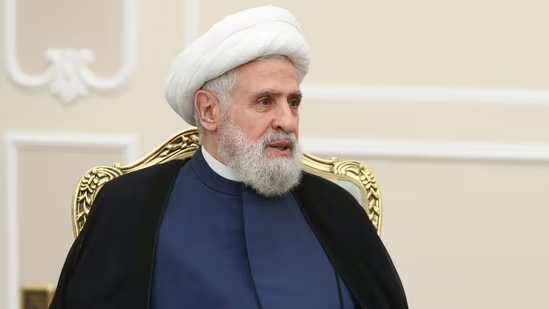

Hezbollah’s new leader, Naim Qassem, delivered a fiery speech on Sunday rejecting calls to disarm, just a day before a high-level U.S. diplomatic visit to Beirut aimed at pressing Lebanese authorities to dismantle the Iran-backed militant group by the end of the year.
“This Israeli threat will never force us to surrender,” Qassem declared during an Ashura address to thousands of black-clad supporters in southern Beirut, a Hezbollah stronghold.
The comments come ahead of a scheduled Monday visit by U.S. envoy Thomas Barrack, who is expected to push Lebanese officials for a formal response to Washington’s demand that Hezbollah disband its armed wing, according to a Lebanese official who spoke anonymously.
Qassem took over leadership of Hezbollah after Hassan Nasrallah was killed in an Israeli airstrike in September, amid escalating clashes that followed last year’s war between Israel and the group. That conflict left Hezbollah significantly weakened and spurred Lebanese politicians to renew calls for the state to regain a monopoly on weapons.
Despite a November ceasefire agreement, Israeli forces have continued to strike targets in Lebanon, claiming they are Hezbollah positions. On Sunday, Israel’s military confirmed new strikes on Hezbollah facilities in the Bekaa Valley and southern Lebanon, shortly after Lebanese authorities reported that at least one person was killed and six wounded in Israeli raids.
“No Disarmament – Not Now, Not Ever”
Under the terms of the ceasefire, Hezbollah was required to pull its forces north of the Litani River, about 30 kilometers from the Israeli border. In return, Israel was to withdraw from Lebanese territory, though it has maintained positions in five strategic areas.
Qassem insisted that Israel must first meet its own obligations before any disarmament could be discussed.
“Israel must withdraw from occupied Lebanese territory, stop its aggression, release all prisoners, and allow reconstruction to begin,” he said. “Only then can we talk about a national defense strategy that includes our arms.”
Many of Qassem’s supporters echoed his stance. Hussein Jaber, 28, who traveled from southern Lebanon for the speech, said, “Hezbollah’s weapons are not up for negotiation. Anyone who believes otherwise is delusional.”
Demonstrators waved Hezbollah, Lebanese, Palestinian, and Iranian flags, with many holding portraits of Nasrallah, the group’s late leader.
Tensions Around Normalization Talks
Qassem also rejected recent statements from Israeli Foreign Minister Gideon Saar, who hinted at possible normalization with Lebanon and Syria.
“We will never accept normalization with the Zionist enemy,” Qassem stated.
While Lebanon remains technically at war with Israel, it has not publicly responded to the Israeli overture. Syria, which has seen significant political shifts since the overthrow of Bashar al-Assad by Sunni Islamist groups last December, dismissed the suggestion as “premature.”
Ashura Observed Amid Rising Regional Tensions
Sunday also marked Ashura, the solemn Shiite commemoration of the martyrdom of Imam Hussein, grandson of the Prophet Muhammad. The largest gatherings took place in Iraq’s holy cities of Najaf and Karbala.
In southern Lebanon’s Nabatiyeh, hundreds took part in processions — even as the region remains a frequent target of Israeli airstrikes.
In Syria, Shiite worshippers gathered at the Sayyida Zeinab shrine near Damascus under heavy security. But unlike in previous years, no foreign pilgrims from countries like Iran, Iraq, or Lebanon were present.
“The Syrian state has increased protection this year,” said Jaafar al-Amine, an official at the shrine. “But with the war and Assad gone, the dynamic here has changed. The processions have stopped.”
As the region grapples with overlapping conflicts and shifting alliances, Hezbollah’s refusal to disarm ensures that Lebanon’s fragile security and political landscape remains under strain — with U.S. pressure now adding a new layer of urgency.