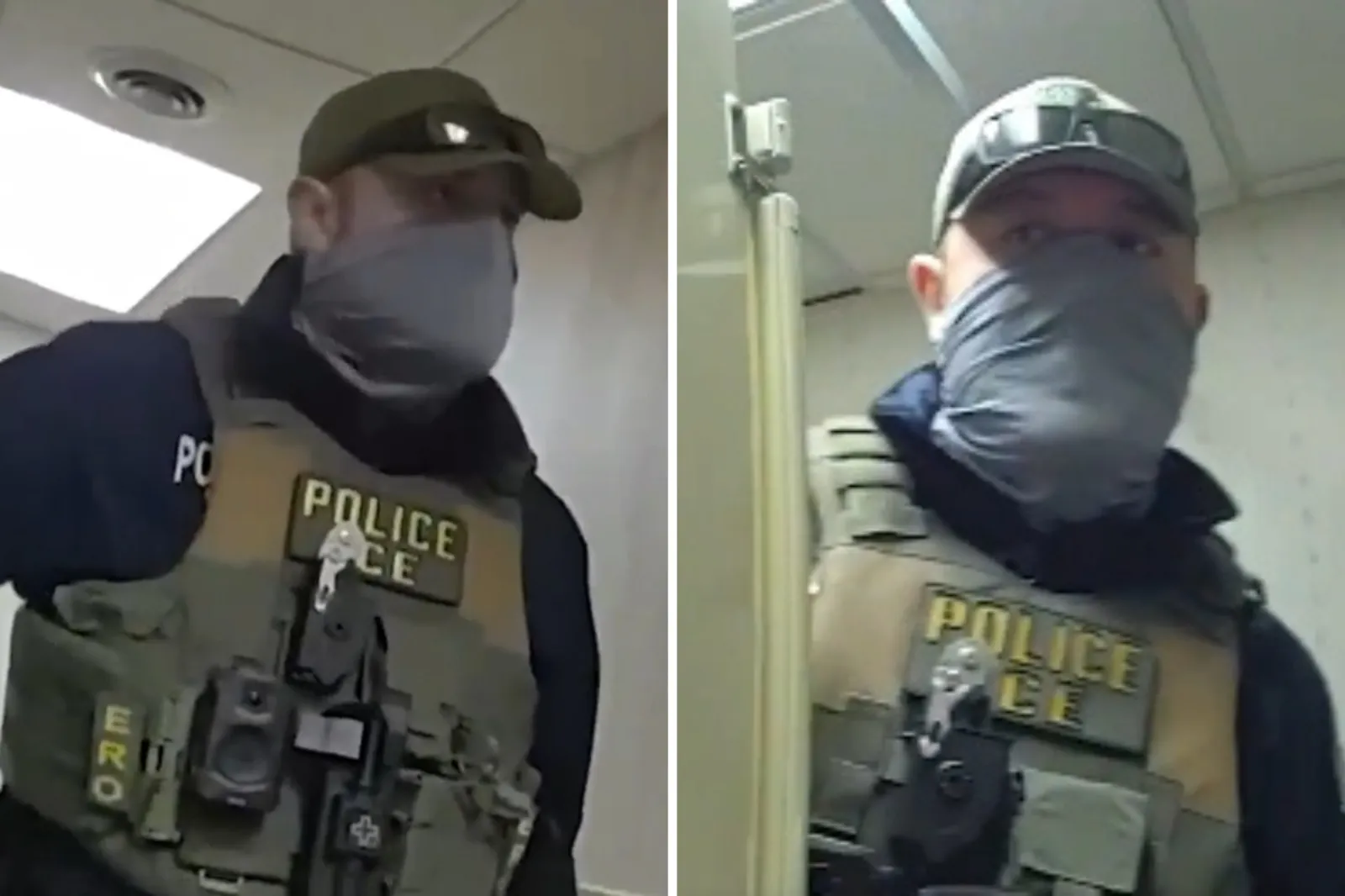

Federal immigration agents forced their way into a women’s bathroom during a workplace raid at a New York manufacturing plant and told someone inside to “pull up your pants and come out,” according to newly released body-camera footage.
The enforcement operation took place on September 4 at Nutrition Bar Confectioners, a nutrition bar manufacturing plant in Cato, Cayuga County, according to court documents reviewed by Newsweek.
Why It Matters
Under the Trump administration, U.S. Immigration and Customs Enforcement (ICE) and Customs and Border Protection (CBP)—two key components of the Department of Homeland Security—have been central to the government’s mass deportation strategy. Both agencies have faced heightened scrutiny over how enforcement actions are carried out, with critics alleging misconduct and due process violations.
What To Know
Body-worn camera footage released in connection with ongoing legal proceedings shows agents moving through the facility and directing employees into hallways.
At one point, agents tried to open a locked women’s restroom door. When it did not open, the footage shows them forcing entry and issuing the directive to the person inside.
During the raid, federal authorities detained 57 workers, according to government documents reviewed by Newsweek.
Those detained included people with different immigration statuses. Legal representatives for some detainees say at least one person with a valid work permit was deported despite authorization to work.
According to government documents, the Department of Homeland Security’s Homeland Security Investigations (HSI) office in Syracuse received information alleging that Nutrition Bar Confectioners—a granola bar manufacturer located at 12351 State Route 34 in Cato, New York—may have employed individuals without legal authorization and used fraudulent immigration documents.
Authorities also cited internal documents that raised concerns about potential financial irregularities at the facility. HSI Syracuse, working with IRS Syracuse, Oswego Border Patrol, and Enforcement and Removal Operations (ERO) Syracuse, opened an investigation based on those allegations.
Attorneys and immigration advocates have criticized agents’ conduct during the operation, questioning whether certain actions were legally justified under the warrants used. ICE and federal prosecutors, meanwhile, have maintained the raid was lawful and part of routine immigration enforcement.
Legal Challenge and Judge’s Ruling
Paul Tuck, an attorney for detainee Argentina Juarez-Lopez, provided body-camera footage from the raid to U.S. District Judge Brenda Sannes.
Tuck asked the court to suppress evidence collected during the operation, arguing the raid violated the Fourth Amendment, which prohibits unreasonable searches and seizures without probable cause. Juarez-Lopez, who faces a felony immigration charge, said agents blocked break-room exits for about an hour and that agents were armed.
She said she was questioned for nine seconds, asked for a lawyer, and was then handcuffed and taken to the Oswego Border Patrol facility. Tuck’s motion says two agents later recorded that she is from Guatemala and unlawfully present in the United States.
Tuck argues that detaining Juarez-Lopez without probable cause—or at minimum, reasonable suspicion—violated her constitutional rights.
A federal judge in Syracuse ruled in her favor last week.
U.S. District Court Judge Brenda K. Sannes found that Juarez-Lopez’s Fourth Amendment rights were violated when immigration agents entered the Cato facility. The Fourth Amendment’s protections apply to everyone in the United States, including citizens and non-citizens.
On September 9, 2025, Acting U.S. Attorney John Sarcone III said all 57 people detained during the raid were unlawfully present in the United States. By that date, 52 had been returned to their alleged countries of origin. The remaining five individuals, including Juarez-Lopez, were charged with illegally reentering the United States following a prior removal.
What People Are Saying
Tuck wrote in court documents: “The Fourth Amendment does not permit such a ‘shoot first, ask questions later’ approach.”
Perry Grossman, a lawyer for the ACLU in New York, said: “The aggressive tactics used on Sept. 4 are incongruous with the limits courts to date have placed on the executive of administrative search warrants and raise serious concerns about the representations made to the magistrate judge in applying for the warrants.”
Cato Institute Director of Immigration Studies David Bier (no connection with the location of the raid) wrote in a post on X: “The agents only had a warrant to review employer documents. They didn’t have a warrant to search for, detain, or arrest anyone there.”