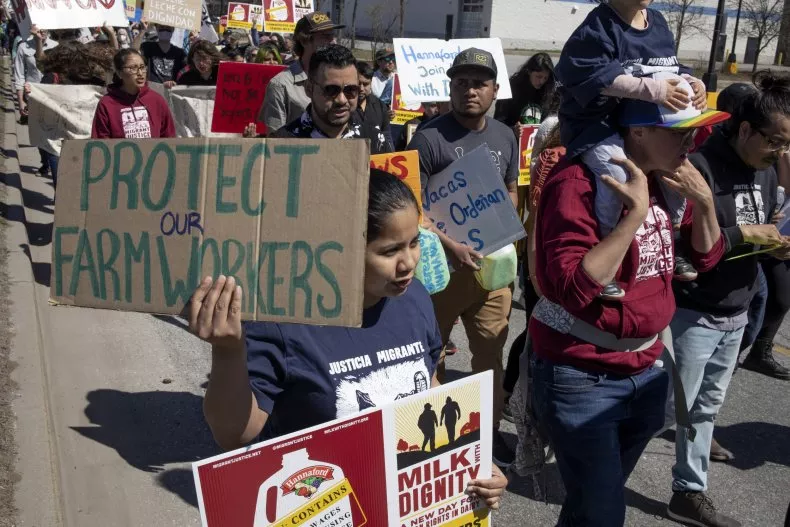

Widespread immigration enforcement on farms across major agricultural states—including California, Texas, and Pennsylvania—has triggered severe labor shortages, with up to 70% of farm workers abandoning their jobs following Immigration and Customs Enforcement (ICE) operations. As a result, crops are rotting in the fields, production has stalled, and farm owners are warning of a deepening crisis in the nation’s food supply chain.
“We simply do not have enough people in the U.S. willing to do this kind of manual labor,” said Alexandra Sossa, CEO of the Farmworker and Landscaper Advocacy Project, in an interview with Newsweek. “It’s not just farms. We’re also seeing a shortage of workers in meatpacking plants and food production facilities. This is food we eat every day, and it’s not getting made.”
Why It Matters
The labor disruption arrives amid President Donald Trump’s promise to launch the largest mass deportation operation in U.S. history. That promise has already begun reshaping the agricultural sector, which relies heavily on immigrant labor—much of it undocumented. Despite calls from industry leaders for reform and protections for essential workers, Congress has yet to pass any new legislation.
While some immigration hardliners argue that U.S. citizens or legal immigrants should take over these jobs, farmers and economists alike say that’s not realistic. The U.S. Department of Agriculture estimates that nearly half of the country’s agricultural workforce lacks legal status. Many of these workers have now vanished from farms, leaving fields unharvested and equipment idle.
What to Know
- Widespread Walkouts: In areas like California’s Central Valley and Texas’ Rio Grande Valley, farm operators report that up to 75% of workers failed to show up for shifts after ICE operations intensified in June.
- Food Supply Risks: California grows over one-third of America’s vegetables and three-quarters of its fruits and nuts. The Pennsylvania Farm Bureau has warned that ongoing disruptions could lead to higher prices, reduced food availability, and permanent farm closures.
- Economic Fallout: Frank Knapp of the Secure Growth Initiative told Newsweek, “Farmers who depend on undocumented labor—most of them—are suffering major losses. When immigrants disappear from the workforce, entire communities suffer economically.”
- No Clear Solution: Trump’s messaging has fluctuated. While he recently said he was considering a solution for farm labor shortages, his administration has yet to issue formal policy changes. ICE raids on farms are still underway.
- Proposed Legislation: A bipartisan group in Congress has reintroduced the Farm Workforce Modernization Act, initially passed twice by the House in prior sessions. The bill aims to stabilize the status of farm workers and modernize the visa system. However, it remains stalled.
Reactions
White House spokesperson Anna Kelly told Newsweek:
“President Trump has always stood up for America’s farmers by negotiating better trade deals and cutting red tape. He will continue to strengthen our agricultural economy while fulfilling his promise to enforce immigration laws and remove the millions of unvetted illegals who entered under Joe Biden.”
Alexandra Sossa, farmworker advocate:
“This isn’t just hurting workers—it’s hurting the economy. These are people who pay taxes, contribute to their communities, and now they’re sitting in detention centers.”
Frank Knapp, Secure Growth Initiative:
“No small business—farmer or otherwise—can survive when employees are suddenly ripped away. Immigration enforcement without reform punishes everyone.”
Rep. Zoe Lofgren (D-CA), in support of the Farm Workforce Modernization Act:
“As chaos continues across the agricultural sector, we must act to stabilize the workforce. This legislation is overdue and essential for protecting our farms and our food supply.”
What’s Next
ICE worksite raids are continuing across the country, and the Trump administration has yet to unveil the promised relief plan for farm labor. In the meantime, growers are scaling back operations, some are looking to automation, and others are bracing for another season of spoiled crops and deepening financial losses.
Without swift action, farmers warn that the disruptions could turn into a full-scale crisis—affecting not just agriculture, but food security for millions of Americans.