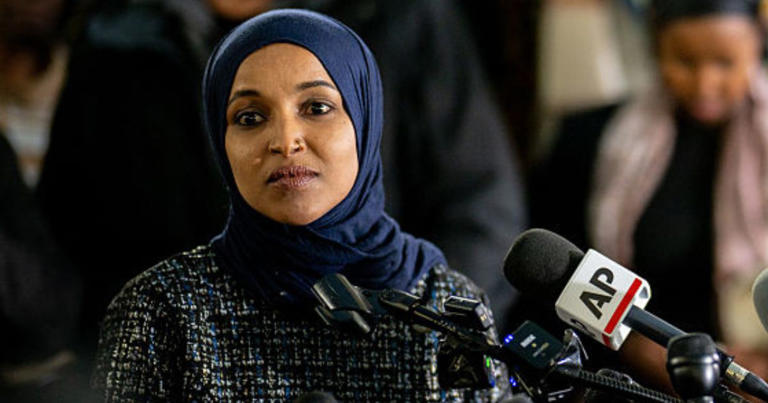

Democratic Rep. Ilhan Omar of Minnesota is facing renewed questions about her credibility.
Those questions intensified after a disruption at a town hall Tuesday, when a man seated in the front row stood up and sprayed Omar with a syringe containing apple cider vinegar. The episode quickly became the basis for a broader political message — and a fresh round of attacks on President Donald Trump.
In a clip posted Wednesday on the social media platform X, Omar argued that Trump is responsible for her security situation.
“I wouldn’t be where I am at today — having to pay for security, having the government to think about providing me security — if Donald Trump wasn’t in office, and if he wasn’t so obsessed with me,” she said at a news conference, where she appeared alongside protesters opposed to Immigration and Customs Enforcement.
“It is ironic,” she added, “that, just last night, he was on stage, moments before I was attacked, talking about me. And then, when asked about my attack, he said, ‘I don’t think about her.’ Does he not remember? Is he suffering from dementia?”
After the incident — which some have been cautious about labeling as an “attack” — ABC News correspondent Rachel Scott asked Trump about what happened.
According to Scott, the president responded by calling Omar a “fraud” who “probably had herself sprayed, knowing her.”
Omar’s name has also surfaced in broader political debates tied to Minnesota’s ongoing scrutiny of alleged fraud involving members of the Somali community. That context has fueled speculation online about whether Tuesday’s incident was meant to shift attention away from those issues — and from ICE’s operations in Minnesota.
Republican Sen. Tommy Tuberville of Alabama suggested as much in a clip posted to X from an interview with conservative podcaster Benny Johnson.
“Of course she is under big-time investigation,” Tuberville said. “She’s trying to get the heat off of her.”
Moments later, he added that Omar “needs to be in jail.”
Other X users echoed similar claims, with some comparing Omar to former actor Jussie Smollett. In 2019, Smollett falsely claimed that two white men — whom he described as Trump supporters — attacked him in Chicago.
Even setting aside online speculation, there is no clear basis for blaming Trump for what occurred at the town hall. Political criticism on social media is not the same thing as inciting someone to spray a public official with vinegar. Neither is investigating alleged wrongdoing or enforcing federal immigration law.
At the same time, political rhetoric has consequences. Years of framing opponents as “Nazis” or “fascists,” coupled with calls to “resist,” can inflame unstable individuals — and sometimes lead to violence.