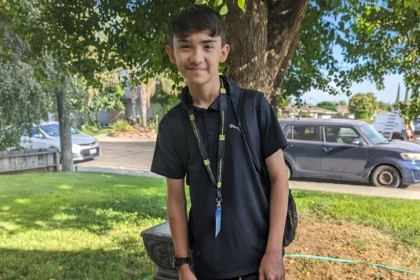

Three days after 9-year-old Nadir Gavarrete was struck and killed by a driver in an RV while crossing a Koreatown street, Los Angeles resident Bianca Cockrell knew her volunteer group had a mission.
“We’d been planning on painting a different intersection in another part of town,” she says. “But when I heard about that boy being hit, I said, ‘We have to get over there. We have to paint there.’ And everyone agreed.”
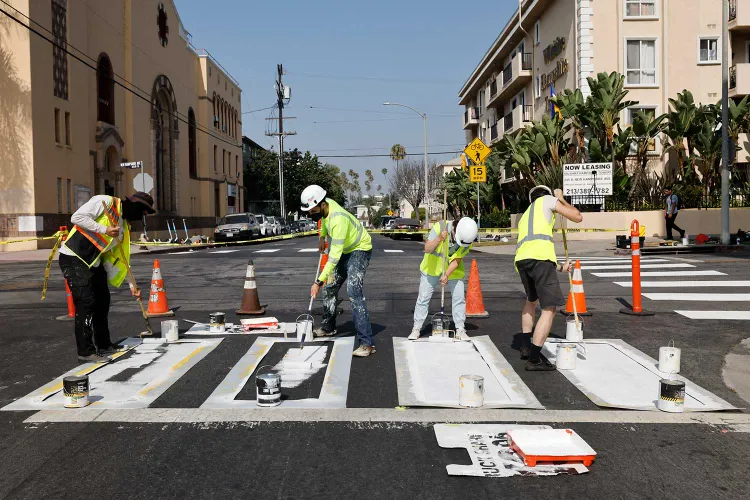
On Aug. 2, Cockrell and fellow volunteers from Crosswalk Collective LA — a group that secretly paints makeshift crosswalks on city streets — added white stripes to the intersection, including a message in tribute: “En Memoria De Nadir Gavarrete.”
It wasn’t lost on them that residents had raised concerns about that dangerous crossing as far back as 2021, with no visible action taken.
Crosswalk Collective LA formed out of deep frustration with what community members describe as a slow and bureaucratic process to make streets safer — a local reflection of a nationwide crisis.
:max_bytes(150000):strip_icc():focal(745x688:747x690):format(webp)/koreatown-crosswalk-before-after-2-110425-068968f46a504055ab1fc3ee65ccbcd5.jpg)
“Going through the proper channels can take years, and your request can still get rejected,” says Cockrell, a 30-year-old documentary filmmaker and bookstore employee. “So we started asking ourselves: Why not protect our neighborhoods ourselves? That’s how we began painting.”
A Community Response to a National Crisis
The group’s DIY approach mirrors a growing movement of street-safety advocates confronting rising roadway deaths — especially in Los Angeles, which has some of the country’s highest fatality rates.
Pedestrian deaths are rising faster than any other road-user group. In 2024, 7,148 pedestrians were killed by vehicles, and tens of thousands more were seriously injured. According to the Governors Highway Safety Association, those deaths are now near a 40-year high — up 48 percent from a decade ago — even as fatality rates have fallen in many other developed nations.
Experts cite multiple causes: distracted driving, the popularity of large and heavy vehicles, and roadway designs that encourage high speeds.
:max_bytes(150000):strip_icc():focal(748x331:750x333):format(webp)/crosswalk-collective-koreatown-2025-3-110525-696396a19f5f40268573e9ea78f96952.jpg)
“We prioritize driving — and driving fast — far more than pedestrian safety,” says Wes Marshall, a civil engineering professor at the University of Colorado Denver. “The problem is solvable. But it’s not going to be easy.”
A Small Budget With Big Impact
Crosswalk Collective launched in 2022 and has since painted more than a hundred unofficial crosswalks at four-way intersections across L.A. The work, done with simple hardware-store materials, costs around $60 per site and takes several hours.
They first assumed they would work only under cover of darkness — until they learned the paint needs sunlight to dry properly. So now, the crew often sets alarms for dawn.
Cockrell says the group has received “hundreds and hundreds” of requests through its website from residents desperate for safer streets.
Pushback From the City
City officials aren’t exactly applauding. The group has been cited multiple times and accumulated roughly $1,000 in fines for illegal street markings.
Colin Sweeney, a spokesperson for the Los Angeles Department of Transportation (LADOT), encourages residents to request improvements through the city’s 311 system and notes that nearly 1,500 crosswalks have been installed since 2024. The city, he says, continues to look for ways to speed up that process.
But Cockrell believes some of those improvements may have been inspired by her group’s work. She says that after LADOT removes a portion of their painted crossings — sometimes leaving nothing behind — they later install official markings or traffic-calming features.
“When the city replaces ours with something safer and permanent, that’s a win,” she says. “We’re not trying to embarrass anyone. We just want people to feel protected where they walk.”
For Crosswalk Collective LA, every sanctioned crosswalk replacing a homemade one is proof that community-driven action can lead to life-saving change.