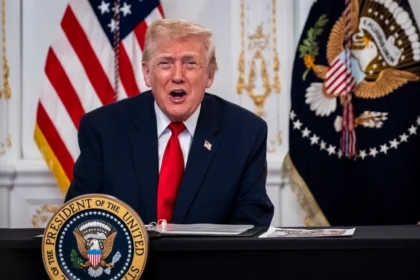
Last month, the US bombed three nuclear sites in Iran, and US President Donald Trump had claimed that the American military had caused “total obliteration”. However, a senior Israeli official said that Iran could retrieve the uranium buried underground.
Last month, the United States launched airstrikes on three Iranian nuclear facilities, with President Donald Trump declaring that the operation had resulted in the “total obliteration” of Iran’s nuclear program. However, that assessment is now being questioned by both U.S. intelligence agencies and Israeli officials.
Speaking to reporters on Wednesday, a senior Israeli official—speaking on condition of anonymity—acknowledged that while the strikes inflicted serious damage, Iran may still be able to recover enriched uranium stored underground at its Isfahan site.
“The uranium is deeply buried. It would be difficult for Iran to access it without being detected,” the official said. “If they try, we will know, and Israel will strike again.” He emphasized that the majority of Iran’s enriched uranium is believed to be stored at the Isfahan facility.
Israel estimates the U.S. strikes have set back Iran’s nuclear program by approximately two years. Tehran, however, continues to insist its enrichment efforts are for peaceful purposes only and has consistently denied pursuing nuclear weapons. Just before the U.S. attacks, Iranian Foreign Minister Abbas Araghchi defended the program, saying, “This is an achievement of our own scientists. It’s a question of national pride and dignity.”
The White House, meanwhile, is standing by President Trump’s assertion that the facilities were completely destroyed. “As President Trump has said many times, Operation Midnight Hammer totally obliterated Iran’s nuclear facilities,” said White House spokeswoman Anna Kelly in a statement. “The entire world is safer thanks to his decisive leadership.”
But U.S. intelligence agencies have offered a more measured assessment, warning that while the facilities were significantly damaged, they were not entirely destroyed. Rafael Grossi, head of the International Atomic Energy Agency (IAEA), told CBS News that although the damage was “substantial,” key infrastructure remained.
“Frankly speaking, one cannot claim that everything has disappeared, and there is nothing there,” Grossi said.
Iranian President Mahmoud Pezeshkian, speaking to Tucker Carlson, confirmed that the nuclear sites were “severely damaged,” adding that the extent of the damage has made it impossible for Iranian officials to fully assess the situation. “We currently have no access to those sites,” he said.
As international observers await more definitive evidence, the situation remains clouded by competing narratives—one of decisive destruction and another of potential recovery. What is clear is that Iran’s nuclear ambitions, long a flashpoint in Middle East tensions, are once again at the center of a high-stakes geopolitical standoff.