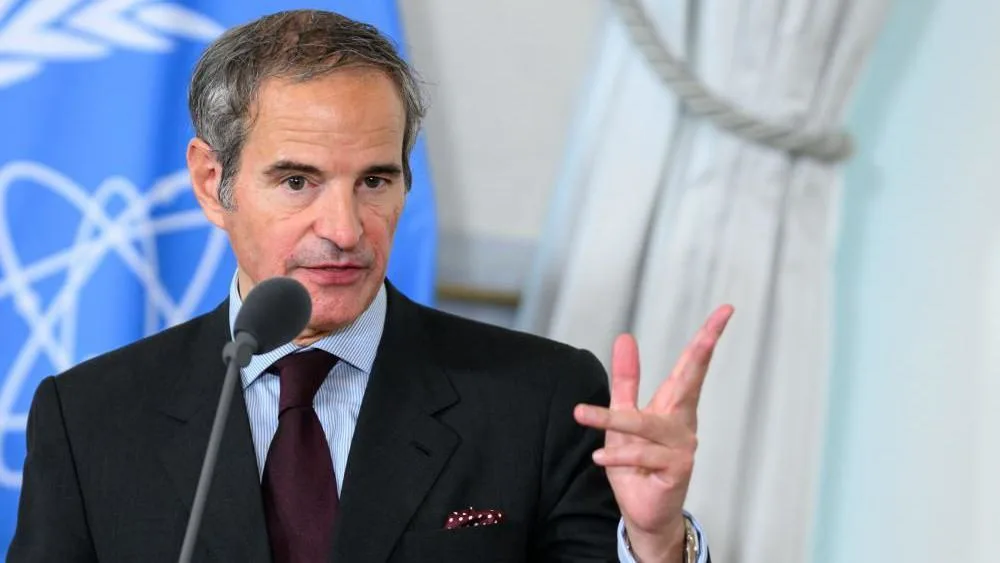

Iran could resume enriching uranium for a potential nuclear weapon within just a few months, the head of the United Nations nuclear watchdog has warned — casting doubt on former President Donald Trump’s claim that recent military strikes “totally obliterated” Iran’s nuclear program.
Rafael Grossi, director of the International Atomic Energy Agency (IAEA), told CBS News on Saturday that while U.S. and Israeli airstrikes caused severe damage to key Iranian facilities, they did not destroy them completely.
“Frankly speaking, one cannot claim that everything has disappeared and there is nothing there,” Grossi said.
On June 13, Israel launched coordinated attacks on Iranian nuclear and military facilities, accusing Tehran of nearing nuclear weapons capability. The United States later joined the offensive, targeting Iran’s Fordo, Natanz, and Isfahan nuclear sites with airstrikes.
Though the true extent of the destruction has remained murky, Grossi said Iran retains the technical and industrial capacity to resume uranium enrichment quickly.
“In a matter of months, they could have a few cascades of centrifuges spinning and producing enriched uranium again,” Grossi noted, warning that while damage was “serious,” Iran’s ability to restart its program remains intact if it chooses to do so.
Trump, Iran, and Conflicting Narratives
President Trump, speaking after the attacks, declared that Iran’s nuclear capability had been “completely destroyed,” and denounced media reports questioning that claim as efforts to downplay “one of the most successful military strikes in history.”
A leaked Pentagon assessment released earlier this week paints a different picture, indicating the strikes likely delayed Iran’s nuclear program by several months — not years.
Iran Responds: Ceasefire, Skepticism, and Confusion
Although a ceasefire is currently in place between Iran and Israel, tensions remain high. Iranian military chief Gen. Abdolrahim Mousavi warned on Sunday that Tehran doubts Israel will honor the agreement and is prepared to retaliate forcefully if attacked again.
Meanwhile, Iranian officials have sent mixed messages about the strike’s impact.
- Supreme Leader Ayatollah Ali Khamenei downplayed the effect, claiming the attacks achieved “nothing significant.”
- In contrast, Foreign Minister Abbas Araghchi called the damage “excessive and serious.”
Iran’s strained relationship with the IAEA has also worsened. On Wednesday, the Iranian parliament voted to suspend cooperation with the UN nuclear watchdog, accusing it of bias toward the U.S. and Israel.
Tehran has refused to grant the IAEA access to inspect the bombed facilities. On Friday, Araghchi dismissed Grossi’s request for entry as “meaningless” and possibly “malign in intent.”
Fallout From the 2015 Nuclear Deal Collapse
Iran’s current nuclear activity traces back to the unraveling of the 2015 Iran nuclear deal. That agreement limited Iran to enriching uranium at no higher than 3.67% — suitable only for civilian energy use — and prohibited enrichment at Fordo for 15 years.
But after Trump unilaterally withdrew from the deal in 2018 and reimposed sanctions, Iran began breaching its commitments. It resumed enrichment at Fordo in 2021 and, by the IAEA’s estimate, has since stockpiled enough uranium enriched to 60% to potentially make nine nuclear bombs.
Despite the breakdown in cooperation, Grossi said diplomacy remains the only long-term solution.
“At the end of the day, after these military strikes, this will require a lasting solution — and that cannot be anything but a diplomatic one,” he said.