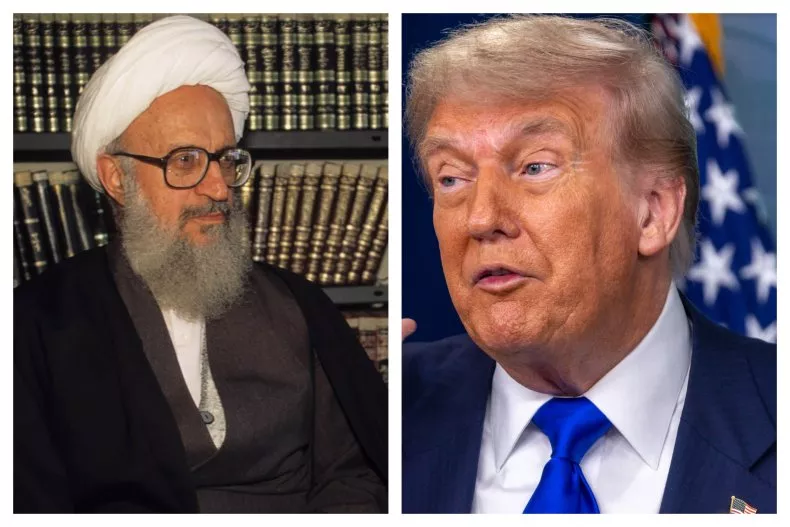

A senior Iranian cleric has issued a religious decree stating that anyone who threatens Supreme Leader Ayatollah Ali Khamenei should be considered “an enemy of God,” according to state media reports.
Grand Ayatollah Naser Makarem Shirazi issued the fatwa in response to a question about recent threats reportedly made by U.S. President Donald Trump and Israeli leaders, including Prime Minister Benjamin Netanyahu.
A fatwa is a religious ruling used to interpret Islamic law, issued by a recognized clerical authority. While not legally binding on its own, such rulings can influence legal and political decisions in countries where Islamic law has judicial standing.
Why It Matters
Though symbolic in nature, fatwas carry weight in Iran’s theocratic system and can have real-world consequences. Shirazi’s declaration places those who threaten Khamenei—including Trump—in the same category of religious condemnation as past fatwas issued against figures like author Salman Rushdie.
Khosro K. Isfahani, a senior research analyst at the National Union for Democracy in Iran, noted on X (formerly Twitter) that the fatwa recalls the infamous 1989 order calling for Rushdie’s death, which led to decades of assassination attempts.
Details of the Fatwa
According to Iran’s Mehr News Agency, Shirazi’s fatwa extends to anyone—individual or regime—who issues threats against Khamenei or other senior Shiite religious leaders known as Marja.
“Any person or regime that threatens the Leader or Marja (May God forbid) is considered an enemy of God,” Shirazi said in the ruling.
He further called on Muslims worldwide to make “these enemies regret their words and mistakes,” adding that it would be haram (religiously forbidden) to support or align with those who issue such threats.
Context and Background
The fatwa comes amid escalating tensions between Iran, Israel, and the United States. During the recent 12-day conflict between Iran and Israel, Israeli Defense Minister Yoav Gallant and other officials openly discussed targeting Khamenei. Trump added to the rhetoric, claiming that he knew the supreme leader’s whereabouts and referred to him as an “easy target.”
While the former president also noted that Khamenei was “safe for now,” his remarks, along with Israel’s threats, appear to have triggered the religious response.
Isfahani noted the significance of the fatwa, writing that unlike Iran’s often-cited but undocumented nuclear fatwa, this one is “real,” signed, and publicly issued in response to a formal Estefta (a legal question seeking religious guidance).
What People Are Saying
- Grand Ayatollah Shirazi: “It is necessary for all Muslims around the world to make these enemies regret their words and mistakes.”
- Khosro K. Isfahani (NUFDI): “A second Grand Ayatollah just issued a murder fatwa against POTUS Trump… The regime will pursue terror, chaos, and assassinations as long as it remains in power.”
- National Union for Democracy in Iran: “The only path to peace and stability is helping Iranians reclaim their country.”
What Happens Next
The fatwa comes at a politically sensitive moment for Iran. The country is still reeling from the recent war with Israel, and its leadership is facing mounting internal and international pressure. According to Hamidreza Azizi, a visiting fellow at the German Institute for International and Security Affairs, the Islamic Republic is at “a highly precarious moment.”
Azizi told Newsweek last week that the regime may resort to a crackdown on dissidents and opposition groups—both domestic and abroad—to reassert control and avoid challenges to its legitimacy.