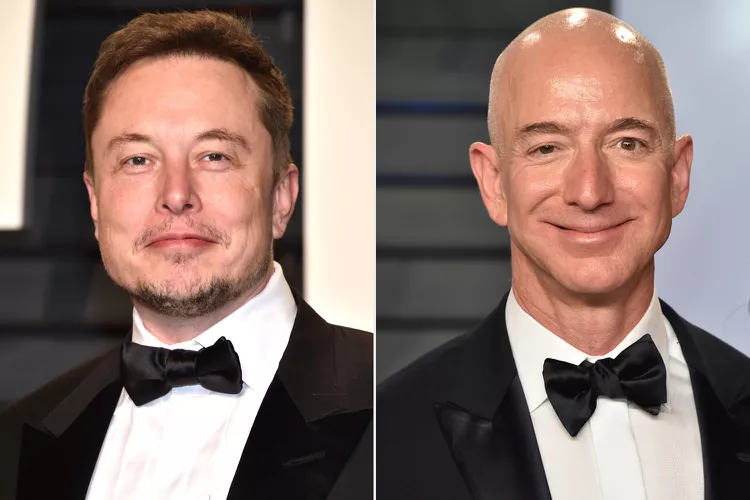

Tech billionaires Jeff Bezos and Elon Musk are reportedly gearing up for a new kind of space race — this time, to build AI-powered data centers in orbit.
According to The Wall Street Journal, Bezos’ Blue Origin and Musk’s SpaceX are both exploring ways to deploy artificial intelligence computing infrastructure in space. Blue Origin has allegedly been developing technology for space-based data centers for more than a year, while SpaceX is said to be planning an upgraded generation of Starlink satellites designed to carry AI computing payloads.
This push comes in the middle of a global AI surge that is dramatically increasing demand for computing power. There are already around 4,000 data centers in the United States either operating or under construction, according to a recent Pew Research Center report. Management consulting firm McKinsey estimates that data centers worldwide could spend as much as $6.7 trillion by 2030 to meet growing AI and cloud computing needs.
Launching AI-capable satellites and operating data centers in orbit presents major technical and financial hurdles, the Journal noted. Rockets, satellite hardware, cooling, maintenance and connectivity all become more complex in space. Still, advocates say shifting some of this “heavy” computing infrastructure off-planet could reduce the immense amount of energy currently drawn from Earth-based power grids to train and run AI models.
In the U.S., communities near large data centers are already seeing higher electricity costs and heavier demand on local utilities. A 2024 report from the U.S. Department of Energy found that data centers used about 4.4% of total U.S. electricity in 2023, and are projected to consume between 6.7% and 12% by 2028.
“Taking resource-intensive infrastructure off Earth has been an idea for years, but it has required launch and satellite costs to come down. We are nearing that point,” Will Marshall, co-founder of satellite imaging company Planet Labs, told the Journal.
The idea isn’t just theoretical. In November, Google announced a partnership with Planet Labs to launch two prototype satellites that will test “how an interconnected network of solar-powered satellites, equipped with our Tensor Processing Unit (TPU) AI chips, could harness the full power of the Sun.” The companies aim to launch these satellites in early 2027, marking an early step toward a future where some of the world’s most advanced AI systems may run far above Earth’s surface.