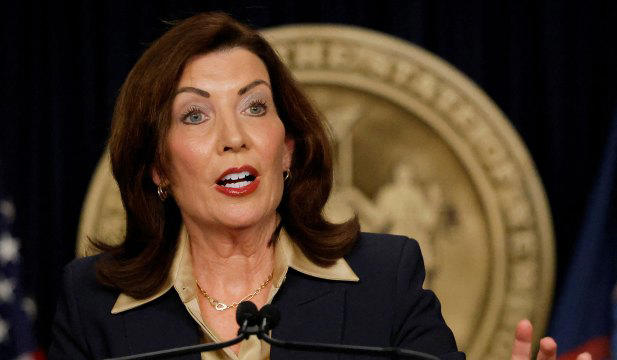

After months of public uncertainty, New York Governor Kathy Hochul says she plans to sign legislation legalizing medically assisted suicide in the state, once a handful of minor changes are made to the version passed by the legislature. The announcement, critics argue, lands as a final slight to outgoing Cardinal Timothy Dolan, who spent significant time urging the governor to reject the measure. More broadly, they contend it will put the state’s most vulnerable residents at greater risk.
Opponents describe Hochul’s move as a capitulation to ideological activists rather than a response to broad public demand. They argue there is no major grassroots push for assisted suicide and that the governor would have faced little political fallout for vetoing the bill. In their view, she is choosing to sign it because she wants the policy enacted.
In a sharply worded Albany Times-Union op-ed, Hochul framed her position as consistent with a restrained view of government: “In the true spirit of this country, government has a responsibility to protect, not interfere, with an individual’s deeply personal decisions.” Critics call that rationale inconsistent with her broader record and point to the state’s past vaccine mandate, which resulted in the dismissal of more than 10,000 health care workers who declined the Covid vaccine. They also object to her argument that the measure “does not have to be about shortening life but rather about shortening dying,” describing the phrasing as euphemistic.
Hochul maintains that New York will avoid the pattern seen in other places where assisted-suicide regimes, critics say, have generated pressure—subtle or overt—from institutions, insurers, clinicians, or even relatives to end costly end-of-life care. Opponents argue the incentives are built into the system, especially in a state with extensive public health subsidies. They also contend that the bill’s safeguards will do little more than slow the development of such pressures. And they warn that requiring physicians to sign off does not prevent harm so much as enlist the medical profession more deeply in intentionally ending life—a role they say is fundamentally at odds with medicine’s core ethic.
For critics, however, the dispute is not mainly about incentives, procedures, government scope, or professional norms. It is about the moral status of human life. They argue that political support for assisted suicide often aligns with strong support for taxpayer-funded abortion, and that both reflect a utilitarian willingness to treat some lives as disposable. They insist that human beings possess inherent worth and an inalienable right to life—and that public policy should reflect that conviction.