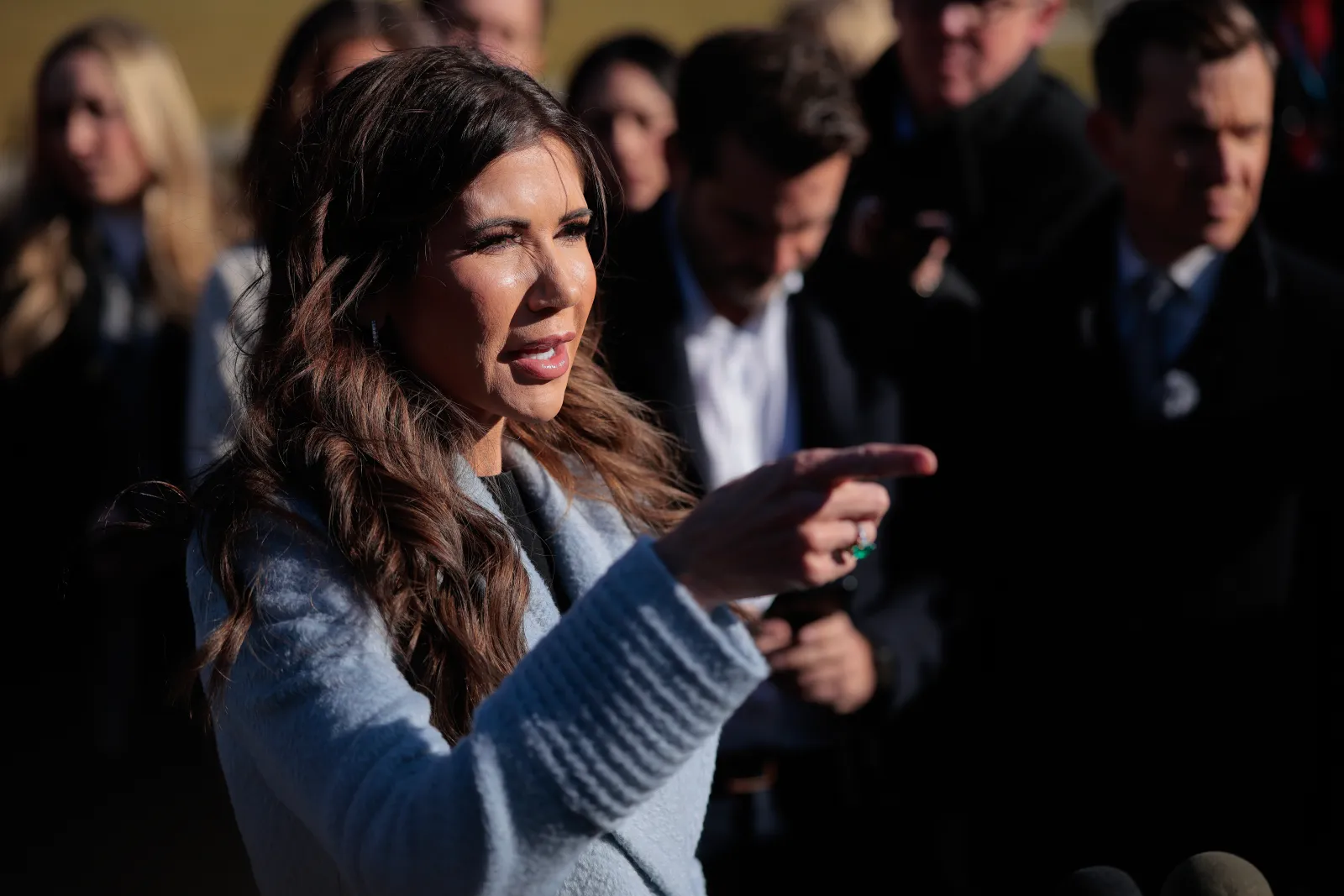

Department of Homeland Security Secretary Kristi Noem said Thursday that Immigration and Customs Enforcement (ICE) officers may ask some Americans to verify who they are during enforcement actions—particularly when agents believe they are dealing with people gathered around an identified target.
“In every situation we are doing targeted enforcement,” Noem told reporters outside the White House. Asked why some Americans in Minnesota have reportedly been asked to provide proof of citizenship, she added: “If we are on a target, there may be individuals surrounding that criminal that we may be asking who they are and why they’re there and having them validate their identity.”
Why It Matters
Noem’s remarks come as tensions have risen around ICE enforcement activity, especially in places where demonstrators and “legal observers” have shown up to monitor or protest operations. The friction intensified after the fatal shooting of Renee Nicole Good, who city leaders have said was present during an ICE-related incident as a legal observer.
The Trump administration has disputed that characterization, insisting Good was an agitator and labeling her a “deranged lunatic,” among other descriptions.
What To Know
In Minneapolis and other areas, some protesters and observers have reported being asked for identification by federal agents—either to move them away from an enforcement scene or after being temporarily detained. Videos circulating online show some citizens objecting to such requests, arguing they are not required to prove who they are.
Last January, President Donald Trump signed an executive order emphasizing that immigrants must carry documentation of lawful status—such as a visa, green card, or other identification—under the Alien Registration Act. While versions of that law have existed for decades (with amendments), critics say enforcement has varied over time.
As demonstrations have grown and legal-observer groups have become more visible, U.S. citizens have also been drawn into close proximity with federal agents—raising questions about when officers can demand identification, and what happens when people refuse.
When the rule was highlighted, some civil-liberties advocates warned that broad enforcement of “carry your papers” requirements for immigrants could, in practice, pressure everyone to carry identification to avoid being misidentified.
What Is the Fourth Amendment?
The Fourth Amendment is designed to protect people from unreasonable searches and seizures by the government. Federal agencies—including ICE and the Border Patrol—are bound by those constitutional limits.
In general, law enforcement officers cannot require someone to produce identification without a lawful basis to stop them—such as reasonable suspicion of a crime, or circumstances tied to issuing a citation or making an arrest. However, legal rules can vary by jurisdiction and situation, and a person’s refusal or inability to provide ID can sometimes escalate an encounter if an officer claims it contributes to suspicion.
Some scholars and experts argue that Fourth Amendment protections apply to everyone in the United States, including immigrants targeted by enforcement actions, and that warrantless searches or arrests can violate constitutional rights depending on the circumstances.
What Is a Legal Observer?
Some civilians who attend ICE actions and related protests describe themselves as legal observers—people trained to watch, document, and record interactions between law enforcement and the public, ideally from a safe distance. Supporters say the role can help deter overreach, excessive force, or rights violations.
Federal officials, however, have said that some people claiming to be legal observers have interfered with operations. Authorities have argued this is one reason agents may ask for identification in certain situations, and some individuals have been arrested for allegedly impeding ICE or Border Patrol agents.
What People Are Saying
Joshua Windham, a senior attorney at the Institute for Justice, told Newsweek that Noem’s explanation raises serious constitutional concerns.
“Secretary Noem was asked why DHS officers are asking Americans on the street for proof of citizenship,” Windham said. He argued that DHS is not always conducting narrowly “targeted enforcement,” pointing to “countless reports and videos” of officers stopping people without prior information or reasonable suspicion. “Suspicion-less stops—when the person is not free to leave—are flatly unconstitutional,” he said.
Windham also said Americans are not required to carry proof of citizenship in daily life. “We do not live in a ‘show your papers’ society,” he said.
Avi Meyerstein, founder of The Alliance for Middle East Peace, wrote on X: “Unlike many places in the world, Americans are not required to carry ID to walk down the street. It’s a freedom many may have taken for granted.”
Nevada Democratic Sen. Catherine Cortez Masto wrote on X on January 14: “The footage of Americans in Minneapolis being forced to provide proof of their citizenship because of the color of their skin or the language they’re speaking is repugnant. This is what the Supreme Court enabled when they allowed the Trump Admin. to pursue racial profiling. It is morally wrong and against the values of this country.”
Illinois Democratic Sen. Dick Durbin wrote on Facebook on December 15: “No American is required to CARRY proof of citizenship. We don’t live in a ‘papers, please’ country.”
What Happens Next
The Trump administration says it will continue what it describes as targeted immigration enforcement across U.S. communities. With protests and legal-observer activity ongoing, further confrontations—and additional scrutiny of ICE encounter practices—are likely.