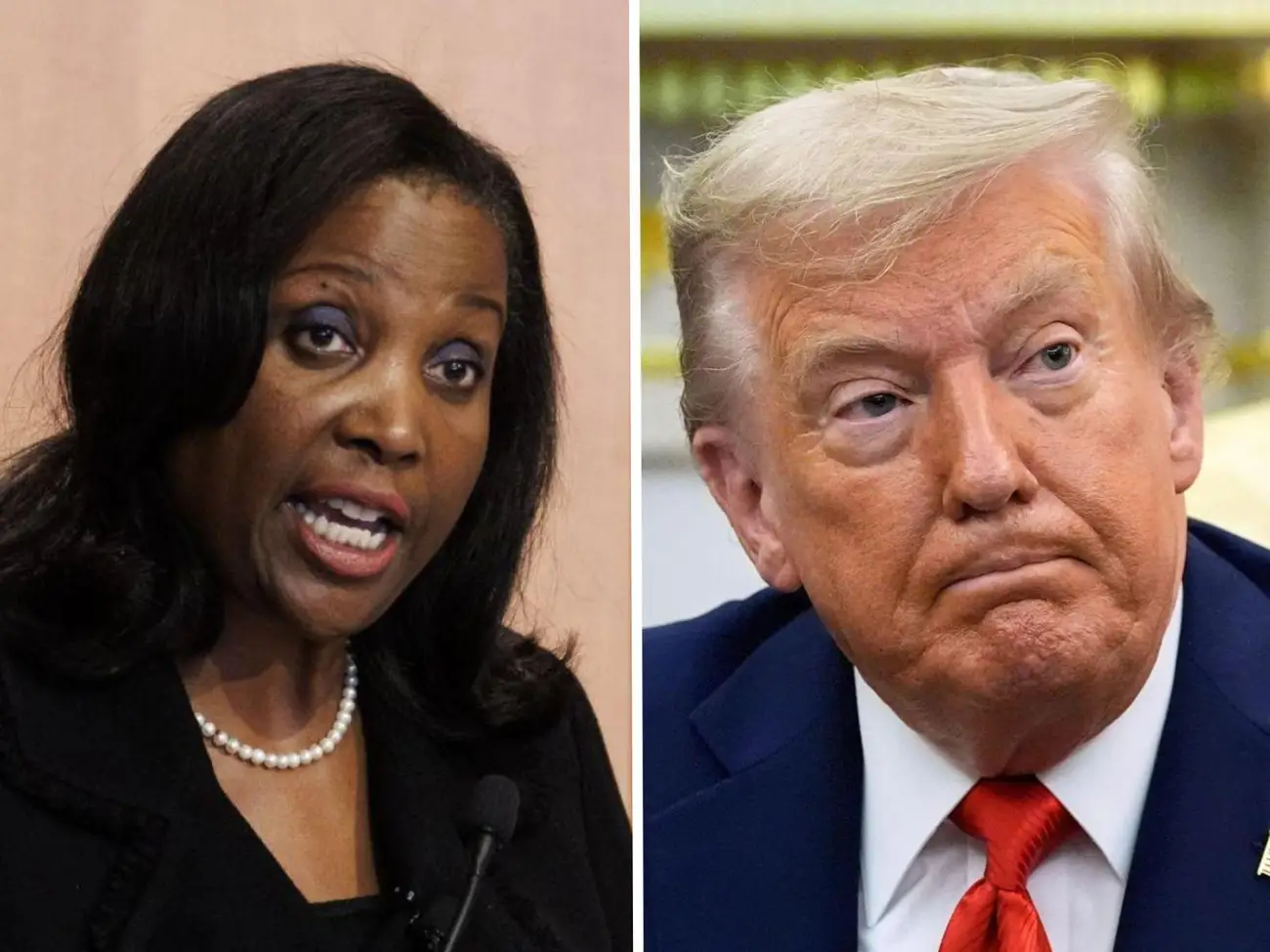

Lisa Cook is suing over President Donald Trump’s attempt to remove her from the Federal Reserve.
A top Justice Department lawyer questioned Lisa Cook on Friday as a federal judge considered whether she could stay at the Federal Reserve during ongoing legal proceedings.
“Is there some material factual dispute?” Justice Department attorney Yaakov Roth asked during the hearing. “I think if there was, we would have heard it by now.”
Roth argued that U.S. District Judge Jia M. Cobb could not deeply review President Trump’s reasons for firing Cook over alleged inconsistencies in her mortgage documents from before she joined the central bank. He said any review must respect the president’s authority.
“I don’t see why a very senior financial official making contradictory statements on financial documents should count as valid grounds for removal,” Roth said.
Cobb is considering whether to issue a temporary order to let Cook continue in her role while the case progresses. Friday’s hearing ended without a decision. The judge asked both the Justice Department and Cook’s lawyers to work together to clarify the sequence of events.
Meanwhile, Cook’s future remains uncertain. The Fed has not taken a position on whether Trump’s action should stand.
“At this time, the Board merely expresses (1) its interest in a prompt ruling by this Court to remove the existing cloud of uncertainty; and (2) its intent to follow any order this Court issues,” Joshua P. Chadwick, assistant general counsel for the Fed, said in a court filing.
DOJ lawyers argued that Trump had no obligation to give Cook more chances to defend herself.
“Incredibly, Dr. Cook even now offers no explanation for her conduct and points to nothing she could say or prove that would change the President’s determination that the perception of financial misconduct is unacceptable,” DOJ lawyers wrote.
During the hearing, Roth noted that Cook had not offered any explanation, such as claiming the signature on the mortgage documents was not hers or that she was advised by a lawyer that everything was correct.
Cobb offered few hints on how she might rule, but seemed skeptical of Roth’s claim that Cook knew she only had a short time to respond.
“How did she know that she had five days to respond?” the judge asked.
Trump posted a letter on Truth Social Tuesday night saying he was firing Cook from the Federal Reserve board for “cause.” He cited a criminal referral by Federal Housing Finance Agency Director Bill Pulte, who alleged she lied on mortgage documents by claiming two different homes as her primary residence at the same time.
Roth argued that Cook was unlikely to succeed with more litigation, so Cobb should not stop Trump from firing her.
“Is there some material factual dispute?” Roth asked. “I think if there was, we would have heard it by now.”
Cook and Trump Disagree on What “Cause” Means
Cook sued Trump and the Federal Reserve on Thursday, calling the mortgage allegations “unsubstantiated” and arguing that they do not meet the legal standard for for-cause removal.
Because the Federal Reserve is independent, presidents have limited power to remove board members. Governors serve 14-year terms, and Cook’s term is set to end in 2038. Under the law, presidents can only remove board members for “cause.”
“President Trump does not have the power to unilaterally redefine ’cause’ — completely unmoored to caselaw, history, and tradition — and conclude, without evidence, that he has found it,” Cook’s lawsuit says.
Cook’s lawsuit does not address the apparent discrepancy in her mortgage filings. Her attorney, Abbe Lowell, said Trump was required to follow a process to determine whether she acted with improper intent.
“Cause may be difficult to define, but a mere allegation isn’t enough,” Lowell said. “It certainly doesn’t mean Director Pulte coming up with allegations in the middle of the night.”
The Justice Department, representing Trump, said judges should defer to the president when interpreting “cause.”
“Removal for ’cause’ is a broad standard, and Congress has given the President discretion,” DOJ lawyers wrote. “Even if it were reviewed — which case law suggests it isn’t — such review would have to be highly deferential, to respect the President’s authority over principal officers.”
The Supreme Court has mostly sided with Trump in his attempts to remove leaders of independent agencies without cause, though an unsigned May opinion said the Federal Reserve deserves special treatment, without specifying what that means.
Trump has said he wants the Federal Reserve board to lower interest rates to reshape the economy. Cook’s lawsuit emphasized the importance of an independent board free from political influence.
“An independent Federal Reserve is essential for a stable economy, as a president’s short-term interests often clash with sound monetary policy,” the lawsuit says.
Lowell argued that Trump’s interest in lowering rates was a pretext for firing Cook and shows his attempt was invalid.
“A bad motive can show that there was no real cause,” he said.
Roth said Trump’s criticism of Federal Reserve Chairman Jerome Powell does not matter for this case.
“This isn’t Chairman Powell,” Roth said. “This is Dr. Cook.”