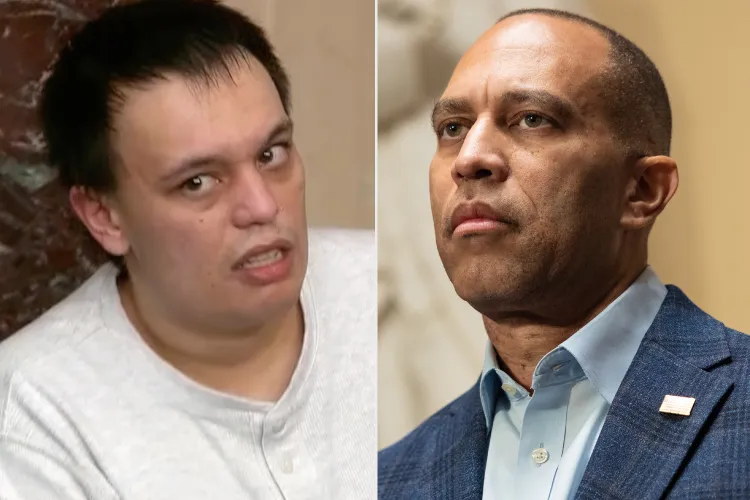

A man previously convicted for his role in the Jan. 6, 2021, attack on the U.S. Capitol — and later pardoned by former President Donald Trump — has been arrested again, this time for allegedly threatening the life of House Minority Leader Hakeem Jeffries.
According to a police report and criminal complaint, Christopher P. Moynihan, 34, sent a series of text messages on Friday, Oct. 17, that “placed the recipient in reasonable fear of the imminent murder and assassination of Hakeem Jeffries by the defendant.”
One of the messages reportedly read: “Hakeem Jeffries makes a speech in a few days in NYC. I cannot allow this terrorist to live.”
In another message, Moynihan allegedly wrote, “Even if I am hated, he must be eliminated. I will kill him for the future.”
Moynihan was arrested in Clinton, New York, and charged with one felony count of making a terroristic threat, according to New York State Police. He is scheduled to appear in Dutchess County State Supreme Court on Thursday.
:max_bytes(150000):strip_icc():focal(749x0:751x2):format(webp)/Hakeem-Jeffries-news-conference-070325-f37467fea401435c9fd90820c56e66b6.jpg)
In a statement released Tuesday, Jeffries expressed gratitude to law enforcement:
“I am grateful to state and federal law enforcement for their swift and decisive action to apprehend a dangerous individual who made a credible death threat against me with every intention to carry it out.”
He continued,
“The person arrested, along with thousands of violent felons who stormed the U.S. Capitol during the January 6th attack, was pardoned by Donald Trump on the President’s very first day in office. Since the blanket pardon that occurred earlier this year, many of the criminals released have committed additional crimes throughout the country. Unfortunately, our brave men and women in law enforcement are being forced to spend their time keeping our communities safe from these violent individuals who should never have been pardoned.”
Jeffries, who succeeded Nancy Pelosi as leader of the House Democratic Caucus in 2023, concluded:
“It is the honor of my life to serve in Congress during these challenging times. Threats of violence will not stop us from showing up, standing up, and speaking up for the American people.”
Moynihan had previously been sentenced to 21 months in prison in February 2023 for his participation in the Capitol riots. Video footage showed him entering the Senate Gallery, rifling through papers on senators’ desks, and taking photos with his phone.
Prosecutors said Moynihan remarked, “There’s got to be something in here we can f—ing use against these —-bags,” before being forcibly removed by police.
Within hours of taking office for his second presidential term on Jan. 20, Trump issued pardons and commutations for about 1,500 individuals charged in the Capitol attack, including Moynihan.
The official proclamation read:
“This proclamation ends a grave national injustice that has been perpetrated upon the American people over the last four years and begins a process of national reconciliation.”
As Jeffries noted, Moynihan is not the only pardoned rioter to face new criminal charges.
:max_bytes(150000):strip_icc():focal(999x0:1001x2):format(webp)/Christopher-Moynihan-january-6-riot-102125-af191ac4bfea456bbf99bb7dbf32d3d2.jpg)
Daniel Charles Ball had his case dismissed after the pardon, even though he was accused of throwing an explosive device at a group of Capitol Police officers. Just one day later, Ball was arrested again on firearm possession charges, though those were later dismissed in February 2025.
Andrew Taake, 36, of Houston, Texas — who had pleaded guilty to assaulting officers with a dangerous weapon before receiving a pardon — was arrested a week later for allegedly soliciting a minor online. He ultimately pleaded guilty and was sentenced to three years in prison.