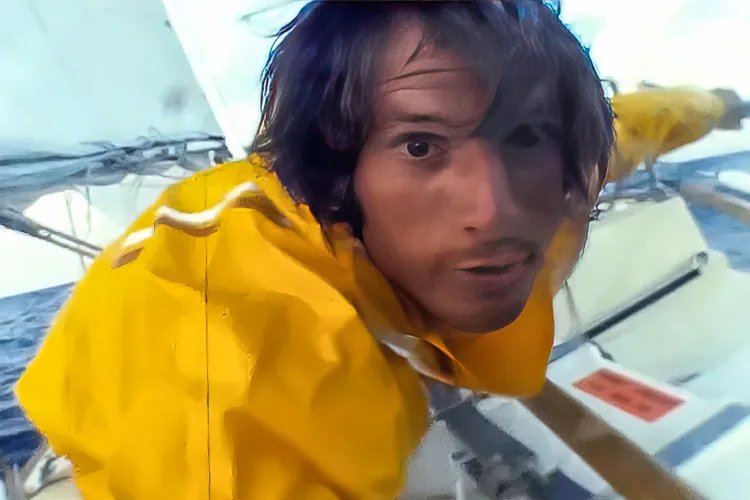

For 76 harrowing days, Steve Callahan drifted alone on a six-foot inflatable life raft in the middle of the Atlantic Ocean — with little food, almost no fresh water, and no one aware he was out there.
“It was a view of heaven from a seat in hell,” Callahan tells PEOPLE, reflecting on the ordeal four decades after his rescue.
On Jan. 29, 1982, the experienced sailor set out from the Canary Islands bound for Antigua, a 3,000-nautical-mile journey aboard Napoleon Solo, the 21-foot sloop he had designed himself. A week in, under calm skies, disaster struck. Something massive — likely a whale — slammed into the hull, tearing the boat open and sending water gushing in “like fire hoses.”
With only moments before the vessel sank, Callahan, then 29, grabbed what he could, jumped into his life raft, and watched his boat disappear beneath the waves. Clad only in a t-shirt, he began what he would later describe as “two and a half months learning to live like an aquatic caveman.”
:max_bytes(150000):strip_icc():focal(809x0:811x2):format(webp)/Steve-Callahan-080525-dde79c5b7a5e4f4e922cafe59ceb9d98.jpg)
His supplies were meager: a small stash of nuts, raisins, eggs, baked beans, cabbage, canned meat, and just eight ounces of water. The first two weeks were consumed by what he calls “recoil” — the crushing mental weight that follows surviving the initial disaster.
“Well, basically your whole life has been flushed down the toilet,” he recalls. “You’re clinging to anything you can just to make sense of it.”
Determined to keep going, Callahan reframed his ordeal as a continuation of his voyage. He logged his days, navigated using the North Star and the horizon with a makeshift sextant fashioned from pencils, and set small, achievable goals. “Prioritize the most critical problem, work on that, and keep stacking the steps,” he says.
Despite sending up flares, passing ships never spotted him. Salt sores spread across his body, his weight plummeted, and on Day 43, a hole ripped through the raft’s bottom. It took ten days of painstaking work to fix it — the lowest point of the journey.
Survival meant innovation. Callahan learned to produce fresh water with WWII-era solar stills included in the raft’s gear. As barnacles grew beneath him, schools of mahi-mahi gathered, providing a crucial food source. Using a spear salvaged from his boat, he learned to fish — and even grew attached to some of the fish, recognizing individuals. “They became a sort of spiritual center for me,” he says. “They were emblematic of the magic and mystery of the ocean.”
:max_bytes(150000):strip_icc():focal(749x0:751x2):format(webp)/Steve-Callahan-080525-1-2f4d152187004cfe8437272a594b4c03.jpg)
By mid-April, the signs of land were clear — changing bird life, a lighthouse’s glow in the distance, and finally, an airplane overhead. On April 20, after drifting roughly 1,800 miles, two fishermen off Marie Galante spotted seabirds circling his raft, hoping for fish. Instead, they found Callahan, gaunt at just 100 pounds and wearing only a makeshift diaper fashioned from a bandage.
“The fish literally brought my salvation,” he says.
After being taken to a hospital, he parted ways with the t-shirt that had been his only clothing. “I never saw it again,” he laughs.
Today, the raft that kept him alive rests at the Peabody Essex Museum in Salem, Massachusetts. Callahan chronicled his ordeal in his 1986 memoir Adrift: Seventy-six Days Lost at Sea, and served as a consultant to director Ang Lee for Life of Pi.
Lee, who wanted “the ocean to be a character,” later executive-produced 76 Days, a 2024 documentary based on Callahan’s book, now in select theaters.