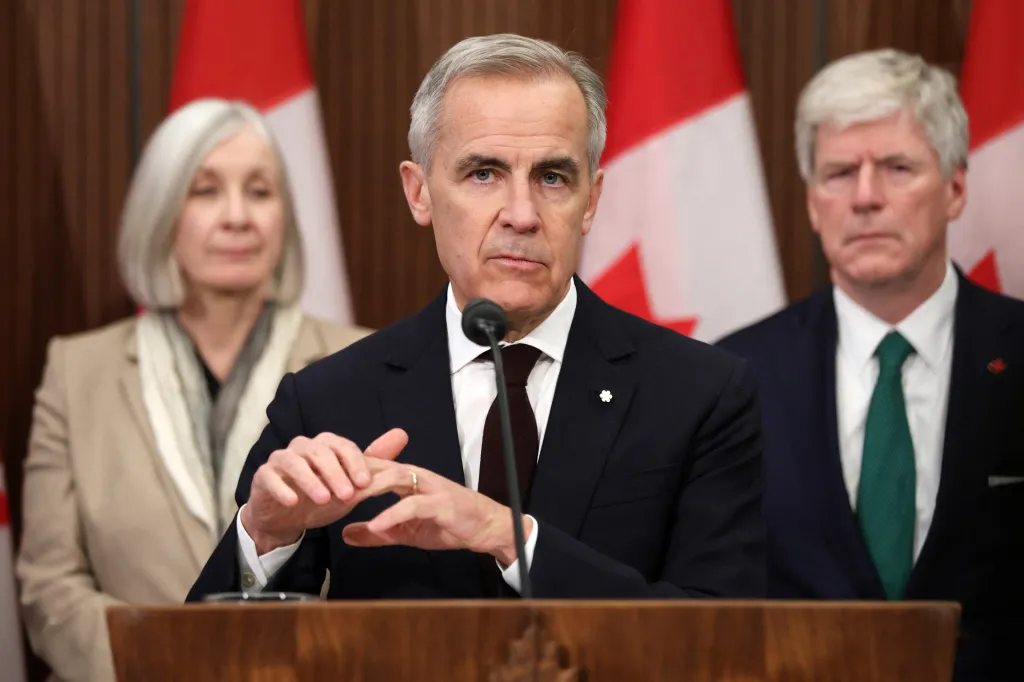

Canadian Prime Minister Mark Carney and Alberta Premier Danielle Smith have signed a memorandum of understanding to work toward a new pipeline linking Alberta’s oil fields to Canada’s Pacific Coast, aiming to reduce the country’s heavy reliance on the United States for energy exports.
The framework agreement envisions loosening an existing oil tanker ban along parts of the British Columbia coastline if the pipeline ultimately moves forward.
Carney has set an ambition for Canada to double its non-U.S. exports over the next decade, arguing that escalating American tariffs are cooling investor confidence and exposing the country’s economic vulnerabilities.
Smith said the plan could eventually move more than 1 million barrels of oil per day, largely to Asian buyers, helping ensure “our province and our country are no longer dependent on just one customer to buy our most valuable resource.”
Carney noted that the deep integration with the U.S. energy market, long seen as a strength, now poses a strategic risk.
“More than 95% of all our energy exports go to the United States,” he said, adding that such tight interdependence, once beneficial, has become a liability. A pipeline to the Pacific, he argued, could also narrow the discount Canadian crude currently faces in U.S. markets.
He described the agreement as an opening step rather than a final decision.
“We’ve put some of the necessary conditions in place, but there is still a great deal of work ahead,” Carney said, stressing that without a willing private-sector backer, the project will not proceed.
Under the deal, the federal government and Alberta will seek to bring British Columbia into discussions, despite fierce local opposition to oil tankers along the coast, and will frame the pipeline as a way to support B.C.’s broader economic interests.
In 2016, former Prime Minister Justin Trudeau approved a controversial pipeline expansion from Alberta’s oil sands to the British Columbia coast, but the federal government ultimately had to take over and complete construction amid strong resistance from environmental organizations and Indigenous communities. At the same time, Trudeau rejected the Northern Gateway pipeline proposal to northwest British Columbia, which would have crossed the Great Bear Rainforest and carried up to 525,000 barrels of oil per day from Alberta to the Pacific, primarily to supply Asian markets including China.
Northern Alberta contains one of the world’s largest oil deposits, with an estimated 164 billion barrels of proven reserves.
Carney’s announcement follows a sharp rebuke from British Columbia Premier David Eby, who warned that loosening the tanker ban could undermine projects already underway and upset carefully negotiated agreements with coastal First Nations.
He emphasized that there is currently no company championing the new pipeline.
“The proposal doesn’t have a project proponent,” Eby said. “It has no permits, and it doesn’t even have a defined route.”
Eby called the agreement a “distraction” from real, advanced projects and said it lacks support from coastal First Nations.
“We have zero interest in co-ownership or economic benefits from a project that risks destroying our way of life and everything we have built on the coast,” said Coastal First Nations President Marilyn Slett.
The agreement also links the potential pipeline to a proposed carbon capture initiative, with officials insisting the two developments must move forward together.
Under the terms of the deal, Ottawa and Alberta will work with companies to identify new emissions-reduction projects by April 1, with implementation slated to begin in 2027.