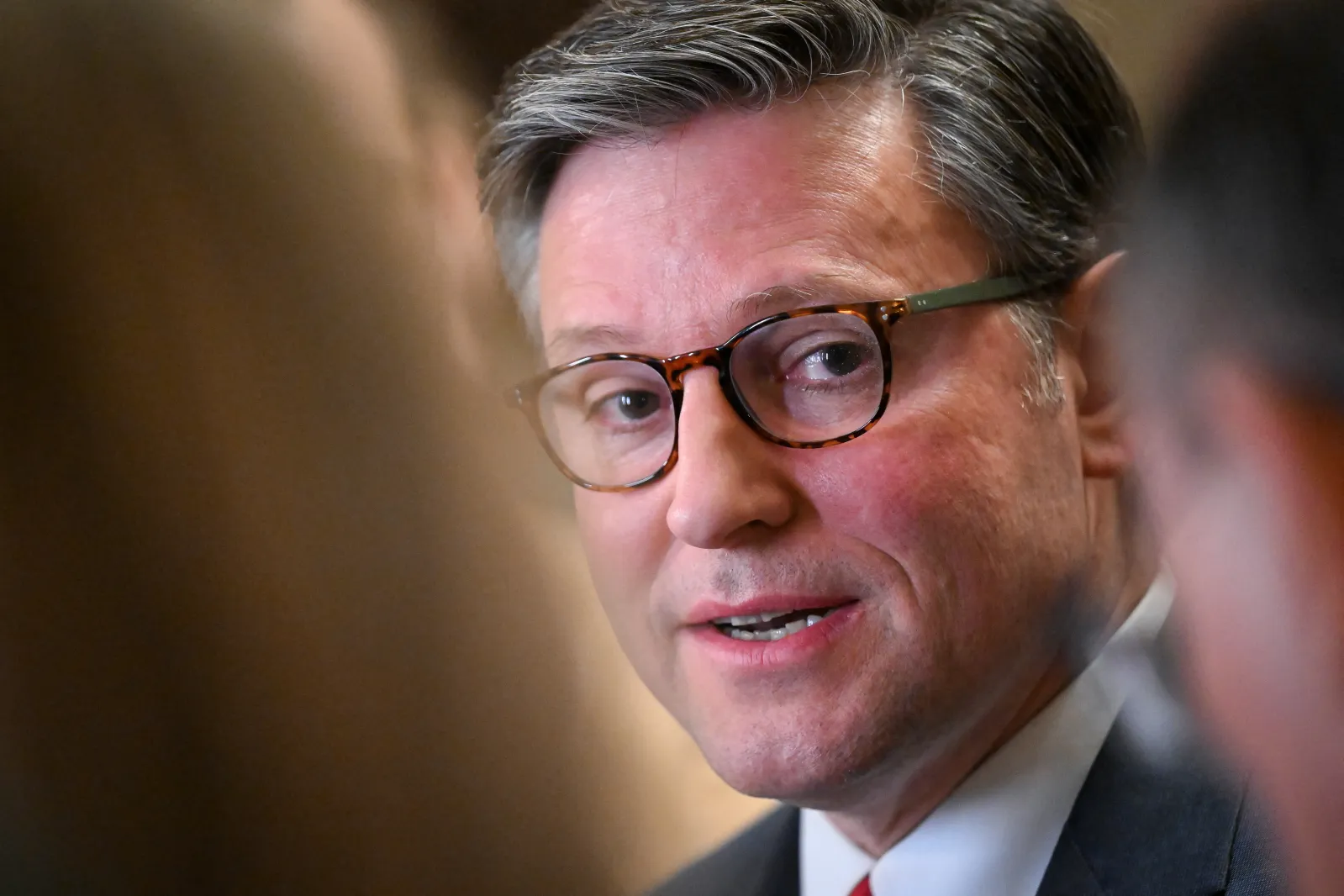

House Speaker Mike Johnson said Tuesday he could not substantiate allegations that election fraud cost Republicans races after polls closed, even as President Donald Trump renewed calls to shift control of elections away from states and toward a national body.
The Louisiana Republican was asked about Trump’s comments this week urging the federal government to “nationalize” elections—an idea the president has framed around long-debunked fraud claims from the 2020 presidential contest.
“We had three Republican candidates who were ahead on Election Day in last cycle, and every time a new tranche of ballots came in they just magically whittled away until their leads were lost,” Johnson said. “It looks on its face to be fraudulent. Can I prove that? No.”
Why It Matters
Trump and many Republicans have intensified their push to change how elections are run in the United States. But the president does not have unilateral authority to rewrite election rules; major changes would require action by Congress. Under the Constitution, states hold primary power over administering elections—an arrangement that has fueled ongoing disputes over mail-in voting, ballot counting timelines, and voting technology.
Johnson has also been closely tied to efforts following the 2020 election to challenge results. He played a central role in the January 6, 2021, effort to send certified election results back to several states in an ultimately unsuccessful attempt to block Joe Biden’s presidency.
What To Know
Trump’s latest remarks came during an appearance Monday on The Dan Bongino Show, where he told podcaster Dan Bongino, his former FBI deputy director, that elections were corrupt and that power should be removed from the states and transferred to a national entity Republicans should establish.
“The Republicans should say, ‘We want to take over. We should take over the voting in at least 15 places.’ The Republicans ought to nationalize the voting,” Trump said.
The comments triggered swift alarm from Democrats and some state officials. Senate Minority Leader Chuck Schumer, a New York Democrat, called the concept “outlandishly illegal.”
White House Press Secretary Karoline Leavitt sought the clarify the president’s remarks on Tuesday, saying Trump was referring to the SAVE Act moving through Congress. The bill proposes changes including voter ID requirements.
Johnson’s fraud allegations, however, reflect a broader pattern among Trump and GOP allies: raising suspicions about vote counting without presenting evidence. While isolated instances of voter fraud do occur and the Department of Justice has obtained convictions in various cases, Trump’s sweeping claims about the 2020 and 2024 elections have repeatedly failed to hold up under scrutiny.
The Trump administration has also recently restarted an investigation into potential voter fraud in Fulton County, Georgia—where Trump has long claimed he won in 2020 but that ballots were stolen or altered, shifting the state to Biden.
What People Are Saying
Wisconsin Republican Representative Bryan Steil, chair of the House Administration Committee, said in a statement: “Americans should be confident their elections are being run with integrity—including commonsense voter ID requirements, clean voter rolls, and citizenship verification. These reforms will improve voter confidence, bolster election integrity, and make it easy to vote, but hard to cheat.”
Senate Majority Leader John Thune, a South Dakota Republican, told reporters Tuesday: “I’m supportive of only citizens voting and showing ID at polling places. I think that makes sense.…But I’m not in favor of federalizing elections, no. I think that’s a constitutional issue.”
Representative Don Bacon, a Nebraska Republican, wrote on X: “I opposed nationalizing elections when [House] Speaker [Nancy] Pelosi wanted major changes to elections in all 50 states. I’ll oppose this now as well. I work w/the NE Gov & Unicameral to ensure we have secure elections where every citizen’s vote counts. This is what the Constitution calls for.”
What Happens Next
Johnson said he wants more uniformity nationwide in how elections are conducted, including greater consistency in counting procedures. He also urged lawmakers from both parties to work toward agreement on reforms—though sharp constitutional and political divisions remain over any move to centralize election authority.