
A new poll suggests most Americans—and even a majority of President Donald Trump’s own 2024 voters—oppose the idea of using military force to seize Greenland.
In response, White House spokesperson Anna Kelly defended Trump’s posture in a statement to Newsweek, calling him a “visionary leader” who is “generating creative ideas to bolster US national security.”
Why It Matters
Trump has intensified his push for the United States to acquire Greenland, a semi-autonomous territory within the Kingdom of Denmark. He argues the Arctic island is strategically essential as competition with Russia and China grows—and the White House has declined to rule out military action as a way to obtain it.
The idea has faced blowback both overseas and at home. European leaders have sharply criticized Trump’s rhetoric, and Greenlandic officials have repeatedly said the territory is “not for sale.” Multiple polls also indicate that military action would be overwhelmingly unpopular with U.S. voters.
What To Know
Most Americans would oppose taking Greenland by military force, according to a YouGov and The Economist poll—including those who voted for Trump in 2024.
Overall, 72% of respondents said they opposed using military force to take Greenland, while 9% supported it. Among 2024 Trump voters, 54% opposed military action and 22% supported it.
Americans were more receptive to the idea of purchasing Greenland from Denmark—though support still didn’t reach a majority. 51% opposed a purchase, compared with 29% in favor. Among Trump voters, 61% supported a purchase as the way to acquire Greenland.
The poll surveyed 1,722 U.S. adults from January 16 to January 19 and reported a margin of error of ±3.2 percentage points.
A separate CBS News and YouGov poll conducted January 14 to January 16 found even stronger resistance: 86% of Americans opposed using military force against Greenland. In that poll, 70% of Republican respondents said they opposed deploying the military.
Republican Pushback—and Political Risk
Representative Don Bacon, a Nebraska Republican, dismissed the notion of military force as “utter buffoonery,” warning it could even spark bipartisan impeachment efforts in the House.
Grant Davis Reeher, a political science professor at Syracuse University, told Newsweek that attempting military action could be the “end of his presidency,” calling it incompatible with “any definition of the American ethos and American identity.” He also suggested actual support might be even lower than polls show, citing “expressive bias”—where some respondents may answer as a proxy for broader feelings about Trump.
Reeher argued there are no real political benefits to pushing the idea and said Trump would “do well” to move on.
Why Trump Wants Greenland
Trump has framed Greenland as a national security priority tied to U.S. access and influence in the Arctic.
As climate change accelerates ice melt, new Arctic shipping routes have become more viable, increasing the region’s strategic importance. Supporters of a U.S. acquisition cite both security and economic motives for a larger American footprint.
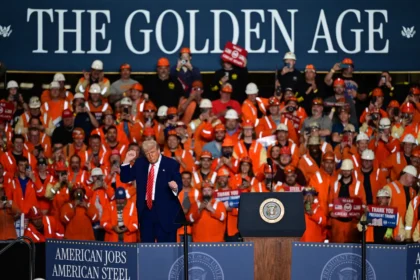
Trump has also linked Greenland to his “Golden Dome” project, which he says is designed to protect the U.S. from threats like ballistic, cruise, and hypersonic missiles. Experts have said the Pituffik Space Base on Greenland’s northwestern coast could help monitor for such threats.
How World Leaders Are Responding
Trump’s rhetoric has strained ties with European allies, with leaders gathering in Davos, Switzerland, for the World Economic Forum. Several European countries have sent troops to Greenland, and Trump has threatened tariffs on countries opposing U.S. efforts to take control of the territory.
During his World Economic Forum address, French President Emanuel Macron warned that “the only law that seems to matter is that of the strongest and imperial ambitions are resurfacing.”
British Prime Minister Keir Starmer wrote on X that Greenland’s future is for Greenland and Denmark to decide, adding that Arctic security is a NATO-wide concern. He criticized the idea of tariffs against allies “pursuing the collective security of NATO allies” and said the U.K. would raise the issue directly with the U.S. administration.
Greenland Prime Minister Jens-Frederik Nielsen said Tuesday he does not believe military action is likely, though officials have been reviewing preparedness. Earlier in January, Nielsen reiterated that Greenland is “not for sale,” adding: “Greenland does not want to be owned by the United States… governed from the United States… [or] be part of the United States.”
What People Are Saying
Anna Kelly, in a statement to Newsweek: “President Trump was not elected to preserve the status quo–he is a visionary leader who is always generating creative ideas to bolster US national security… As the President said, NATO becomes far more formidable and effective with Greenland in the hands of the United States…”
Trump, on Truth Social last week: “The United States needs Greenland for the purpose of National Security… IF WE DON’T, RUSSIA OR CHINA WILL…”
European Union High Representative for Foreign Affairs Kaja Kallas, on X: “Greenland belongs to its people. No threat or tariffs will change that. Our response must be to remain calm, hold our ground and act in unity.”
What Happens Next
The Trump administration has not ruled out military force—but it also has not taken concrete steps to acquire Greenland. Meanwhile, tensions with allies remain elevated amid repeated threats. Kalshi betting odds currently put the U.S. at a 46% chance of acquiring Greenland before the end of Trump’s second term.