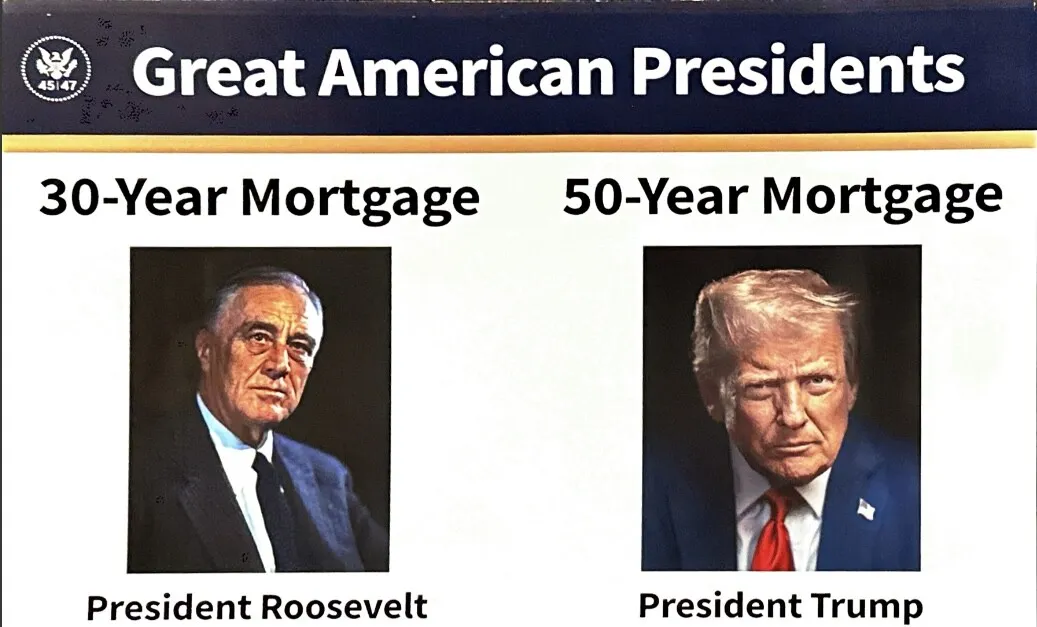

The Trump administration is moving ahead with a plan to introduce a 50-year fixed-rate mortgage, a proposal officials argue could expand access to homeownership at a time when affordability is under intense pressure.
Federal Housing Finance Agency Director Bill Pulte announced the effort on social media, calling the concept “a complete game changer” and crediting President Trump for pushing it forward.
The announcement followed Trump’s online post highlighting how his plan compares with the 30-year mortgage structure first widely adopted during the New Deal era.
Mortgage rates have remained above 6% for more than three years, creating a cost burden that has sidelined many prospective buyers. Recent Redfin estimates indicate that the typical U.S. household is spending about 39% of monthly income on mortgage payments, a level that exceeds traditional affordability thresholds.
Adding to the challenge, millions of existing homeowners are holding onto mortgages locked in at much lower rates before 2022. That reluctance to sell has restricted inventory and intensified competition, particularly for younger buyers attempting to enter the market.
Adjustable-rate mortgages have seen renewed interest as borrowers look for alternatives. They now account for at least 10% of applications, according to the Mortgage Bankers Association—one of the highest shares in several years.
Pulte has criticized Federal Reserve Chair Jerome Powell for maintaining restrictive monetary policy longer than needed, arguing that interest rates are still “artificially high.” He also emphasized that the administration’s focus is on giving young Americans more opportunities to buy homes, calling the 50-year mortgage one tool in a broader strategy.
How a 50-Year Fixed Loan Could Change Homebuying
The basic premise is straightforward: extend the amortization schedule to lower required monthly payments. For example, according to Fannie Mae’s calculations, a $400,000 home purchased with a 20% down payment and a 6.575% rate would result in:
- 30-year mortgage: $2,788 monthly principal and interest
- 40-year mortgage: $2,640
- 50-year mortgage: $2,572
While that reduction could help more buyers qualify, experts warn the long-term costs are steep. Spreading payments over five decades significantly increases total interest paid and slows equity accumulation—making it harder for homeowners to build wealth over time.
Economist Tyler Cowen examined the concept using GPT-5 and concluded that a government-backed 50-year loan would likely reduce monthly payments but also:
- Push up home prices
- Delay equity growth
- Increase default risk during downturns
- Add vulnerability to the broader financial system due to heightened rate exposure
The benefits, at least initially, may flow more toward sellers than first-time buyers.
That concern comes as the typical age of a first-time buyer continues to rise. A National Association of Realtors analysis shows it reached 40 years old in 2025, the highest ever recorded. As noted by ResiClub’s Lance Lambert, that places newcomers to homeownership nearly as close to retirement age as to their high school graduation.
Additional Moves: Equity Stakes for Fannie Mae and Freddie Mac
The mortgage proposal arrives as Pulte also teased another potential shift for the housing finance giants. While speaking at ResiDay, a conference hosted by ResiClub, he suggested that Fannie Mae and Freddie Mac could begin taking equity positions in private companies.
He drew parallels to the recent arrangement involving Intel, saying the agencies “hold all the cards” due to their unique role in housing finance. Under the envisioned structures, businesses could offer stock in exchange for new forms of strategic collaboration.
Fannie and Freddie have remained under federal conservatorship since the 2008 financial crisis, and such a move would represent a notable expansion of their operational scope.