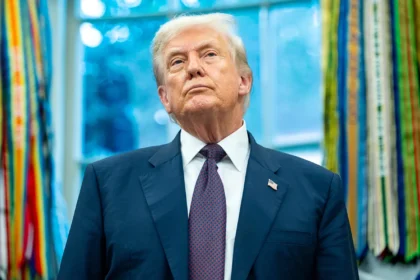
President Donald Trump on Friday fielded questions about U.S. strategic priorities, arguing that Greenland remains a top national security objective and suggesting the U.S. is already discussing the issue with NATO.
Asked whether he would consider withdrawing from NATO if the alliance did not help the United States acquire Greenland, Trump said, “NATO has been dealing with us on Greenland,” and reiterated his long-running claim that U.S. control of the Arctic territory is essential.
“We need Greenland. We don’t have it. We have a big hole in national security, especially when it comes to what we are doing in terms of the Golden Dome and all of the other things, and we have a lot of investments in the military,” Trump said. “We have the strongest military in the world, and it is only getting stronger. You saw that with Venezuela and you saw that with the attack on Iran, where we knocked down their nuclear capabilities. So, yeah, we are talking to NATO.”
Greenland, Denmark, and the NATO Tension
Trump’s remarks come as his administration continues to press the idea of expanding U.S. control over Greenland, a vast Arctic territory that is part of the Kingdom of Denmark. He has argued that Greenland’s location and growing great-power competition in the Arctic make the island critical to U.S. defense planning, particularly as Russia and China expand their regional footprints.
Danish and Greenlandic leaders have repeatedly rejected any proposal involving a transfer of sovereignty. Some officials within NATO have also cautioned that pushing the issue too aggressively could deepen rifts inside the alliance, especially as broader questions about unity and burden-sharing remain unresolved.
Trump’s statement that NATO has been “dealing with” the U.S. on Greenland also lands amid wider diplomatic strain, including his public pressure campaigns and tariff threats toward countries that resist U.S. priorities related to the territory.
Venezuela Operation Cited as Proof of Strength
In the same exchange, Trump pointed to U.S. actions abroad as evidence of American military power, specifically referencing recent operations in Venezuela. He cited a large-scale mission that he said resulted in the capture of Venezuelan President Nicolás Maduro—an operation that drew intense attention and fueled legal and political debate in Washington, including efforts in Congress to curb further military action through war powers measures.
Trump framed the Venezuela mission as part of a broader message: the U.S. will respond forcefully when it believes its interests are at stake.
Strikes on Iran’s Nuclear Facilities
Trump also referenced U.S. military action targeting Iran’s nuclear program. In June 2025, he ordered precision strikes on three major nuclear sites—Fordow, Natanz, and Isfahan—in an operation the White House said significantly degraded Tehran’s ability to produce enriched uranium that could be used for weapons.
The strikes intensified U.S. involvement in the wider Israel–Iran confrontation, with Trump arguing the operation was necessary to prevent Iran from obtaining a nuclear weapon and to protect regional stability. Iranian officials did not immediately confirm the extent of damage, and outside assessments differed on how lasting the impact would be.
A Linked Strategy: Alliances, Force, and Territory
Taken together, Trump’s comments underscore how his administration is tying alliances, military action, and territorial strategy into a single foreign-policy message. By invoking NATO discussions over Greenland alongside the Venezuela mission and strikes in Iran, Trump portrayed an approach centered on maximum leverage—combining diplomatic pressure with hard-power demonstrations in pursuit of what he describes as U.S. security goals.
With Arctic security and NATO cohesion already under strain, the renewed focus on Greenland is likely to remain a flashpoint in transatlantic politics through 2026 and beyond.