

President Trump said the Navy will build a new “Trump-class” battleship as the centerpiece of his proposed “Golden Fleet,” and he also announced a new class of aircraft carrier—though he provided no additional details about the carrier program.
Trump said the first Trump-class battleship will be the USS Defiant. Construction would begin “almost immediately,” he said, and the build would take roughly 2½ years.
The announcement comes after the Navy said last week it plans to commission a new class of frigates. Trump has long pushed for a major overhaul of the U.S. surface fleet, often criticizing existing ships as “terrible-looking” and plagued by rust.
During his first term, Trump pressed for a return to steam-powered catapults to launch jets from aircraft carriers—an effort that did not succeed—and he publicly complained about the look of the Navy’s destroyers. He has also taken a personal interest in shaping the Golden Fleet concept, according to prior reporting by The Wall Street Journal.
“We’re desperately in need of ships,” Trump said. “Some of them have gotten old and tired and obsolete and we’re going to go the exact opposite direction.”
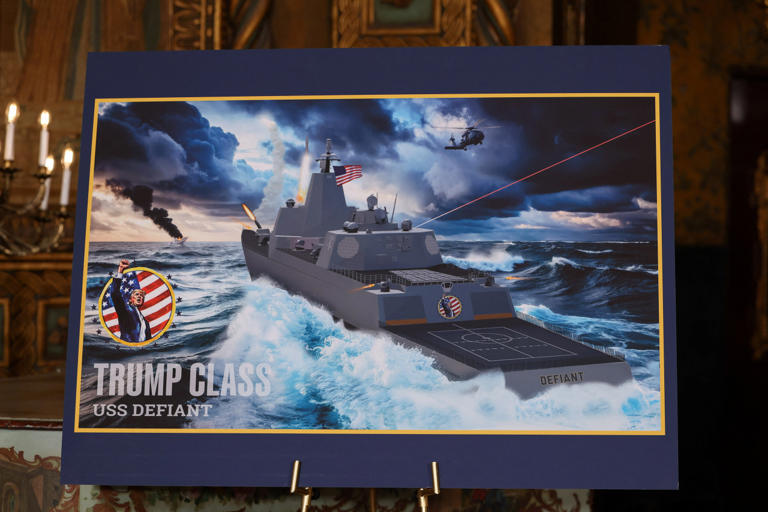
Trump claimed the new battleships will be “100 times more powerful than any battleship ever built” and faster than existing ships. He said the Navy could ultimately purchase 20 to 25 of the new vessels.
A new “battleship,” built on next-generation surface combatant plans
According to a U.S. official and another person familiar with the discussions, the ship is intended as a major upgrade from the Navy’s Arleigh Burke-class destroyers—the workhorses of today’s fleet and a class Trump has previously compared unfavorably to foreign counterparts. While the “battleship” label evokes the heavily gunned vessels of the 20th century, the new ships would feature a next-generation design.
Trump made the announcement alongside Defense Secretary Pete Hegseth and Navy Secretary John Phelan.
An industry official said the new ship draws on work already underway by the Navy and shipbuilders on an early-stage “large surface combatant” destroyer program.
Critics question cost and strategic fit
Mark Montgomery, a former rear admiral and senior director at the Foundation for Defense of Democracies, criticized the Golden Fleet plan as “exactly what we don’t need,” estimating each new battleship could cost at least $5 billion.
Montgomery argued the initiative is not sufficiently optimized for deterrence against China. He also criticized the Navy’s newly announced frigate concept, saying it would have “zero tactical use” if it lacks a vertical launch system or the Aegis ballistic missile defense system.
“That is not what these are focused on—they are focused on the president’s visual that a battleship is a cool-looking ship,” he said.
Size, weapons, and future capabilities
Over the past few months, a Navy team developed and approved requirements for a new “large surface combatant,” according to a U.S. official. Trump said the ship would displace roughly 30,000 to 40,000 tons—larger than current destroyers—and that it would carry nuclear cruise missiles. One person familiar with the discussions said the ships would also be designed with growth capacity for future weapons, including rail guns and directed-energy systems.
Earlier this year, a White House and Navy team began planning a fleet posture intended to better counter China, strengthen Western Hemisphere coverage, and respond to other threats, the Journal previously reported. The Navy proposed the name “Golden Fleet,” echoing other branded initiatives from Trump’s return to office, such as the “Golden Dome” missile defense project.
Under the concept, the Golden Fleet would include a mix of larger warships equipped with more powerful long-range missiles—potentially including hypersonic weapons—alongside a larger number of smaller frigates. The new frigate program would be based on the Coast Guard’s Legend-class National Security Cutter, built by HII’s Ingalls Shipbuilding division in Pascagoula, Mississippi, and would replace the Constellation-class frigate program, which the Navy canceled last month after years of delays.
The Navy currently lists 287 ships in its inventory, including destroyers, cruisers, aircraft carriers, amphibious ships, and submarines.
Why battleships mattered—and what “more firepower” means today
Bryan Clark, a naval expert at the Hudson Institute, said battleships of the 20th century were heavily armored and built around large guns intended to strike ships and shore targets from beyond an enemy’s effective range. They were prominent in both world wars and served as the core of fleet formations—similar to the central role aircraft carriers play today.
“The idea was the battleship had big enough guns they could shoot far enough that it generally was able to shoot from outside the range of most of its opponents,” Clark said.
Clark said modern warships rely on long-range missiles rather than big guns, because missiles can travel farther and hit with greater accuracy. But he added that the Navy’s future challenge is achieving substantially greater magazine depth—more launch cells—and the ability to carry advanced weapons like hypersonic missiles, especially to help protect aircraft carriers that are increasingly vulnerable.
“You need something like two-to-three times the size of an [Arleigh Burke-class destroyer],” Clark said. “You need some ships with that type of size so that you can have the defenses to protect the carrier, and the reach to be able to attack targets from a place where you can be survivable.”
Shipbuilders welcome the push for more large warships
HII’s Ingalls Shipbuilding and General Dynamics’ Bath Iron Works currently build the Navy’s Arleigh Burke-class destroyers. Over the past 30 years, the two yards have delivered more than 70 of the destroyers.
Shipbuilders praised the move toward a new class of large surface combatants. HII President and CEO Chris Kastner said the company has improved labor performance and throughput and expects further gains in 2026, citing expanded capacity through a distributed shipbuilding network.
General Dynamics Bath Iron Works President Charles F. Krugh said the yard has the “capacity, capability and engineering expertise” to design and build advanced warships.
Clark noted that while the Navy has explored bringing additional shipyards into the mix to accelerate deliveries, a warship of this size could still take a new yard up to a decade to deliver.