

A new batch of images tied to Jeffrey Epstein is reigniting public anger—and deepening questions about what the U.S. government is (and isn’t) releasing about the late financier’s sex-trafficking case.
The photos, published online by Democrats on the House Oversight Committee, include multiple close-up shots of a person’s body with handwritten excerpts referencing Lolita—Vladimir Nabokov’s novel about an adult man’s fixation on a 12-year-old girl. (ABC)
What the newly released images show
According to reporting on the release, four of the images show parts of a person’s body with handwritten lines connected to Lolita, including at least one photo where the book itself appears in the background. (ABC)
The same batch also includes:
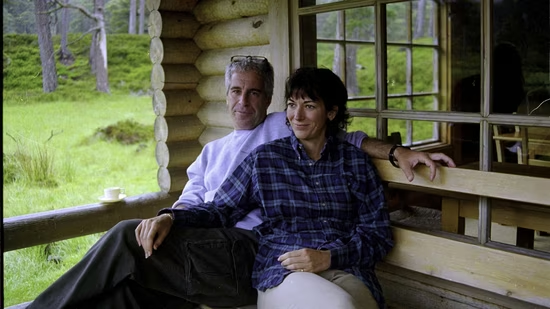
- Photos of Epstein with high-profile men, released without context about when or where they were taken (ABC)
- A map linked to Epstein’s island property and a screenshot of a WhatsApp conversation (ABC)
- Passports and ID cards from multiple countries—described by Rep. Robert Garcia (the committee’s top Democrat) as belonging to “women whom Jeffrey Epstein and his co-conspirators were engaging,” with identifying details redacted (ABC)
The imagery’s most unsettling element, critics say, isn’t just the “Lolita” references—it’s the sense of possession and objectification conveyed by writing on a woman’s body, packaged alongside documents that appear to track and identify women.
Why these photos were released now
House Oversight Democrats have been releasing material in periodic “drops” as they review a larger archive of images obtained from Epstein’s estate, saying they are redacting personal details before publishing anything publicly. (ABC)
This latest release landed right before a legal deadline for the Justice Department to make investigative records available under a recently passed transparency law. (ABC)
The DOJ’s release, redactions—and growing backlash
The Justice Department began posting records in mid-December, but multiple outlets report that the initial disclosures were heavily redacted and incomplete, fueling criticism that the public still isn’t getting the full picture. (TIME)
On top of that, the rollout has been clouded by confusion: the Associated Press reported that at least 16 files disappeared from the DOJ’s public webpage less than a day after they were posted, without clear explanation. (AP News) The DOJ said materials would continue to be reviewed and redacted “in an abundance of caution,” while lawmakers publicly demanded answers about what was removed and why. (AP News)
Meanwhile, officials have argued that privacy protections—especially for survivors—require time-consuming review. Live updates from CBS News cite DOJ leadership saying the “volume of materials” means records will be released “on a rolling basis,” despite the law’s deadline. (CBS News)
What the photos do—and don’t—prove
It’s important to separate shock from evidence.
The body-marking images and the “Lolita” references are disturbing in their own right, and they reinforce the broader, well-documented pattern of exploitation tied to Epstein’s operation. But major outlets covering the photo drops have also emphasized a key point: the presence of well-known figures in released photos is not, by itself, proof of criminal wrongdoing, and many images arrive without context. (ABC)
That lack of context is part of why the releases keep sparking fresh outrage: the public sees fragments—photos, passports, snippets of messages—without the investigative framework that would clarify who did what, when, and whether prosecutors believed a given piece of material mattered.
The bigger question behind the horror
The images have landed like a gut punch online, but the political fight surrounding them points to an even larger issue: whether the government’s disclosures will meaningfully advance accountability—or simply prolong the same cycle of partial information, speculation, and unanswered questions.
As one overview of the newly released materials put it, the initial government releases offered little in the way of major new revelations about Epstein’s crimes or others involved, even as they introduced new documents and photographs and validated long-standing claims that warnings were raised years earlier. (TIME)
For many observers, the “Lolita” body-marking photos feel like the clearest symbol yet of the cruelty at the center of the case—while the disappearing files and rolling disclosures keep feeding suspicion that the public still isn’t seeing everything.


