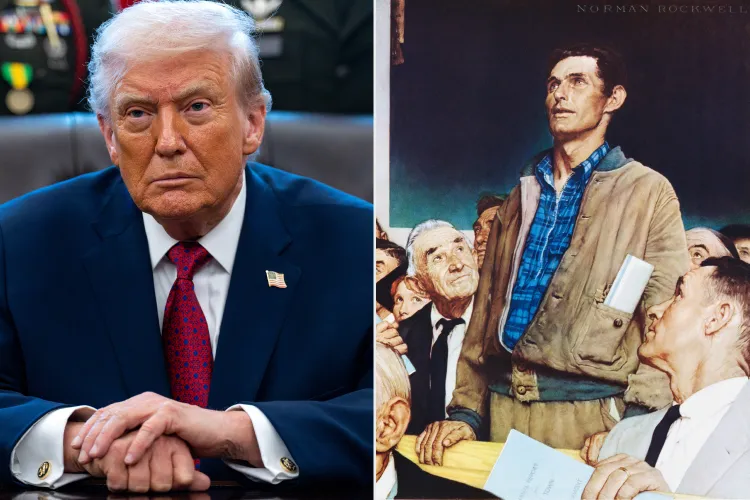

Norman Rockwell’s family is again speaking out against the Trump administration’s use of his artwork, arguing that the painter’s values stand in direct opposition to the politics his images have been used to promote.
“Norman Rockwell was antifa,” the artist’s granddaughter, Daisy Rockwell, said in a recent interview with The Bulwark, using the broad term associated with anti-fascist ideology.
The phrase “antifa” refers to a decentralized political movement, though President Donald Trump has repeatedly characterized it as a “terrorist organization” during his second term, tying it to events ranging from the 2020 Black Lives Matter protests to the September 2025 assassination of conservative activist Charlie Kirk.
While touring the Norman Rockwell Museum in Stockbridge, Massachusetts, with writer Catherine Rampell, Daisy Rockwell addressed her family’s concerns over the Department of Homeland Security using her grandfather’s paintings in official social media posts.
In one instance, Rockwell’s Salute the Flag appeared alongside a DHS message urging followers to “Protect our American way of life.” In another, Working on the Statue of Liberty was paired with a recruitment message reading, “Protect your homeland. Defend your culture.”
“They used the paintings as though his work aligned with their values,” Daisy said, describing what she called a “segregationist vision of America.”
She added that the family found the posts especially troubling because Rockwell was “very clearly anti-segregationist.”
Rockwell, who died in 1978, is sometimes criticized for presenting an idealized, largely white portrayal of American life. During his 47 years illustrating covers for The Saturday Evening Post, the magazine’s editorial rules limited how people of color could be depicted, often relegating them to background or subservient roles.
That changed after his final Post cover in 1963. Over the next decade, while working for Look magazine, Rockwell began directly confronting issues of racism, segregation, and civil rights.
“I was born a White Protestant with some prejudices that I am continuously trying to eradicate,” Rockwell said in a 1962 interview. “I am angry at unjust prejudices, in other people and in myself.”
One of his most famous later works, The Problem We All Live With (1964), was inspired by Ruby Bridges, the six-year-old Black girl who required U.S. Marshals’ protection while attending a newly desegregated school in New Orleans amid threats and violence.
Earlier this year, Daisy Rockwell and other family members published an op-ed condemning the administration’s use of the artist’s work and reaffirming that he stood for “compassion, inclusiveness and justice for all.”
“If Norman Rockwell were alive today, he would be devastated to see that not only does the problem Ruby Bridges confronted 65 years ago still plague us as a society, but that his own work has been marshalled for the cause of persecution toward immigrant communities and people of color,” they wrote.
The controversy is not the only recent instance in which members of the Trump administration have been accused of misinterpreting cultural figures. On Dec. 26, Deputy Chief of Staff Stephen Miller posted on X about watching a Dean Martin and Frank Sinatra Christmas special with his children, adding, “Imagine watching that and thinking America needed infinity migrants from the third world.”
Critics quickly pointed out that both Martin and Sinatra were children of Italian immigrants, at a time when Italy was often disparaged as impoverished and undesirable by American standards.
Sinatra, in particular, was vocal throughout his career about racism and anti-immigration sentiment. In a 1991 Los Angeles Times op-ed titled “The Haters and Bigots Will Be Judged: Some words from a ‘saloon singer’ to those who still haven’t figured out the whole point of America,” he forcefully defended the country’s immigrant roots.
“Who in the name of God are these people anyway, the ones who elevate themselves above others? America is an immigrant country,” Sinatra wrote. “Those weren’t tourists on the Mayflower—they were your families and mine, following dreams that turned out to be possible dreams.”
He concluded with a warning for those he viewed as driven by hate: “I don’t envy their trials in the next world, where their thoughts and words and actions will be judged by a jury of One.”