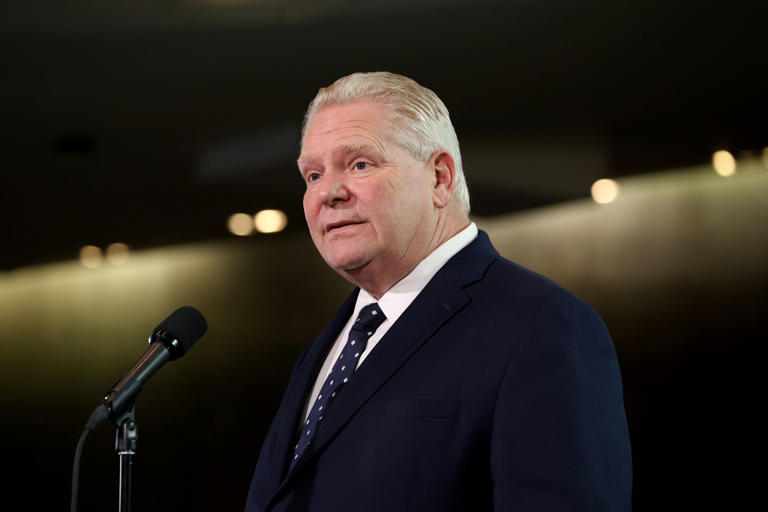

Ontario Premier Doug Ford is calling on Canadians to “buy Canadian-made everything” in a show of economic strength as pressure mounts ahead of a looming U.S. tariff deadline.
Speaking Monday at the annual premiers’ meeting in Ontario’s Muskoka region, Ford said Canada should use its status as the United States’ largest customer to push for a fair trade agreement. Prime Minister Mark Carney is expected to join the summit Tuesday, while his trade minister, Dominic LeBlanc, heads to Washington this week for high-stakes negotiations with President Donald Trump’s administration.
Trump has threatened to impose a 35% tariff on select Canadian goods if no agreement is reached by August 1. But his administration has sent mixed signals, leaving uncertainty about whether the White House wants a negotiated deal or plans to move forward with unilateral tariffs.
“We’re urging every province and territory — buy Canadian vehicles, buy Canadian everything. That will hit hardest where it matters,” Ford said outside the Deerhurst Resort. “We’re their number one customer — more than Japan, China, Korea, the UK and France combined.”
A new Bank of Canada survey shows Canadians are responding. Roughly 63% of households said they’re cutting back on American products, and 55% are spending less on U.S. travel.
Trump already raised tariffs on foreign steel and aluminum to 50% in June, leading to job cuts and reduced shipments in Canada’s steel sector. In response, Carney’s government introduced import controls to protect domestic producers — a move some in the industry say doesn’t go far enough.
Ontario has pledged C$1.3 billion ($950 million USD) to support manufacturers, including tax incentives for Ontario-made goods. Manufacturing represents about 10% of the province’s workforce, employing around 830,000 people.
As the premiers gather, trade and infrastructure are top of the agenda — particularly ways to reduce reliance on the U.S. by improving domestic supply chains and interprovincial commerce.
Despite calls for unity, some leaders appeared resigned to the possibility of new tariffs. Alberta Premier Danielle Smith said she hopes any levies are narrowly focused, while Quebec Premier François Legault warned it’s still unclear what kind of deal will emerge.
“The ideal outcome is no tariffs,” Legault said. “But whatever happens, we need long-term certainty — three or five years minimum — so companies can plan ahead with confidence.”
Prime Minister Carney has acknowledged there’s little indication Trump is willing to sign a deal that fully eliminates tariffs, despite the existing North American trade agreement signed during his first term.