
The president is justifying taking over local law enforcement by calling it an “emergency.” Sound familiar?
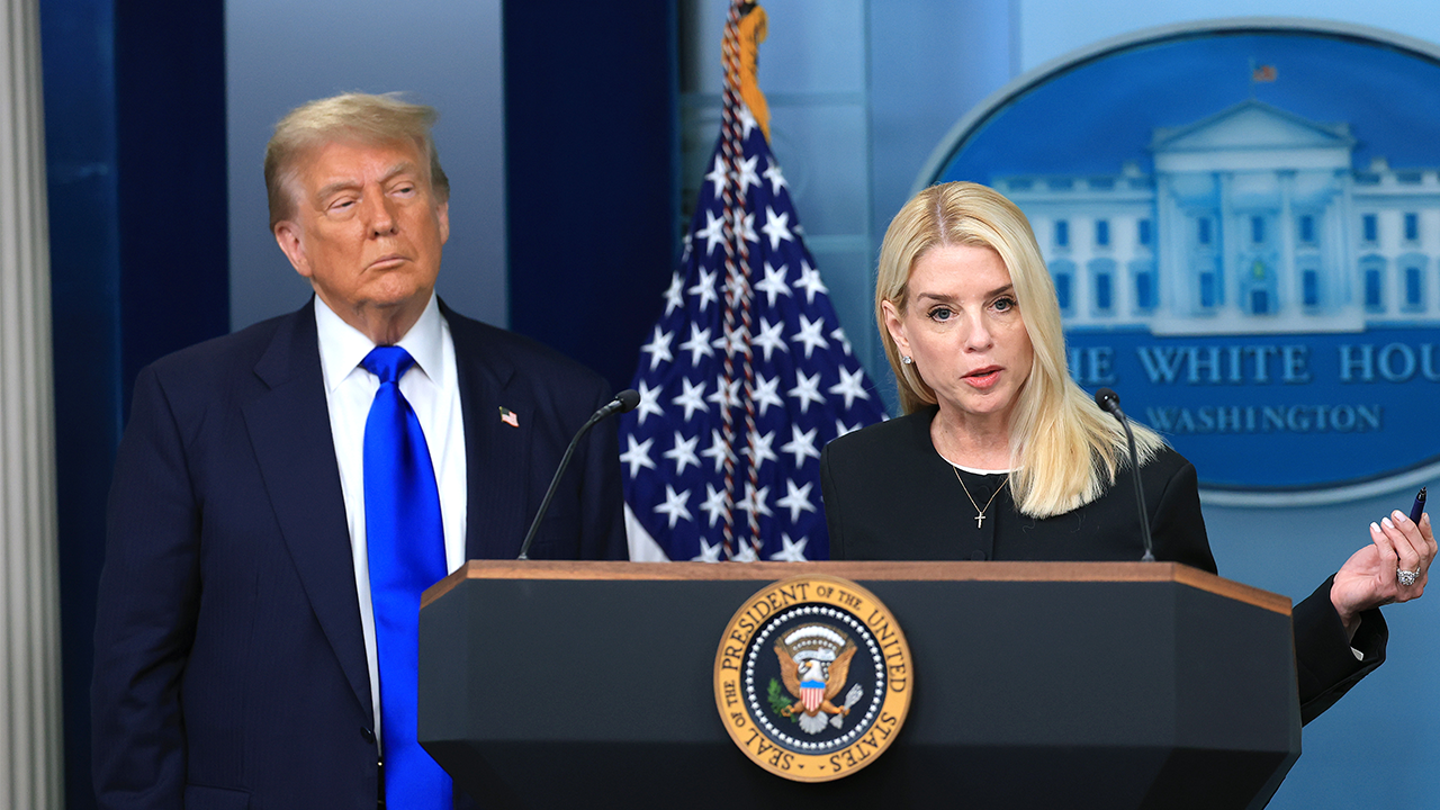
President Donald Trump with Secretary of Defense Pete Hegseth and Attorney General Pam Bondi at the White House on Monday.Andrew Caballero-Reynolds / AFP via Getty Images
The president says the country is in an emergency. Using a few examples and weak statistics, he claims new powers and challenges Congress and the courts to stop him. If he succeeds, he may go further.
This week, the “emergency” was a rise in youth crime in Washington, D.C. The solution? Sending 800 National Guard troops to the city and putting the Metropolitan Police Department under federal control.
It’s too early to see how this will end, but it probably won’t stop here.
I have lived in D.C. for ten years. My husband leads the restaurant association and was once the city’s first “night mayor,” connecting city officials with nightlife businesses. We own a home in D.C. and chose to raise our family here. Public safety isn’t just a topic—it’s personal.
Since January, Trump has claimed broad powers based on exaggerated emergencies about the economy, immigration, and more. In every case, the facts he uses are not strong enough to justify his actions.
This matters to me personally. D.C. is not the war zone Trump describes. Even his own Justice Department reports show violent crime is at some of the lowest levels in decades.
Sound familiar? On immigration, Trump turned solvable border problems into a supposed “invasion” to justify raids and mass detention. In Califohttps://www.msnbc.com/opinion/msnbc-opinion/trump-takeover-washington-personal-fighting-rcna224877rnia, this led to immigration agents using tear gas and flash bangs in Latino neighborhoods.
Now that his actions in Los Angeles have slowed, Trump is focusing on his own backyard.
In a recent “The Weeknight” segment, MSNBC legal analyst Lisa Rubin said D.C. is the “perfect lab” for Trump’s experiments because Congress and the president have special powers over the city. D.C. is also a big city with many Black residents, making it a target.
The history is serious. From the Red Summer of 1919 to unrest after Martin Luther King Jr.’s assassination, federal forces have often been sent into cities under the idea of restoring “order,” usually in Black communities.
In the 1980s and ’90s, false ideas about young Black “superpredators” led to harsh sentencing laws that hurt Black families without making neighborhoods safer.
White leaders have often used these moments to question the ability of locally elected Black leaders to govern, similar to old colonial ideas used to take control of other countries.
Trump didn’t invent this idea. He’s just using it in the age of social media.
Trump says his goal is safety. But more officers, especially in military gear, don’t always make people feel safer. In some neighborhoods, they can make people feel more afraid.
D.C. may be an easy target now, but Trump could try this in other big cities. He has mentioned Baltimore and Chicago, two Democratic cities with many Black residents.
The plan is the same each time: show a false picture of urban “chaos,” question local Black leaders, and push for federal control that removes local authority. It’s political theater with racial undertones meant to challenge not just the city, but the idea that diverse, Democratic-led cities can govern themselves.
If Trump can federalize policing in D.C. on weak grounds, he could do it in Philadelphia, Milwaukee, and Oakland, California too.
If he succeeds, Trump would overturn local elections, taking powers meant for elected leaders who oppose him. That is the real threat to the public—and it’s spreading.