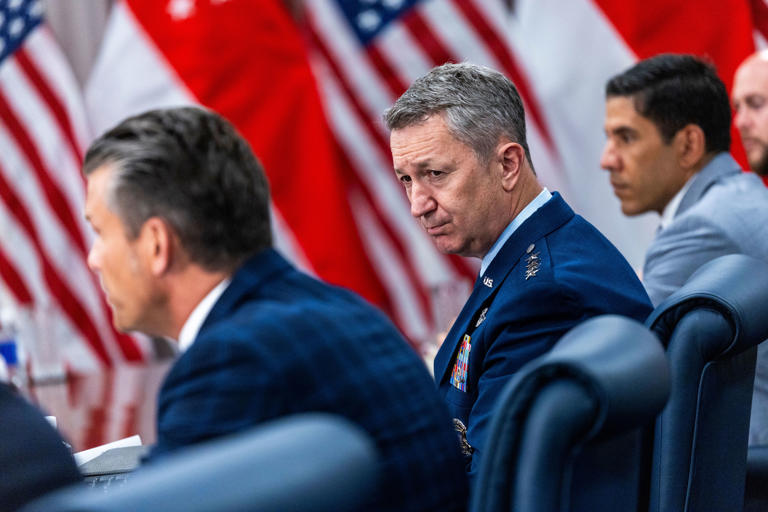

Military leaders are voicing significant concerns over the Trump administration’s upcoming defense strategy, highlighting tensions between the Pentagon’s uniformed officers and political leadership. Defense Secretary Pete Hegseth is convening top generals and admirals for an unusual summit in Virginia on Tuesday, according to eight current and former officials.
Criticism from senior officers, including Gen. Dan Caine, chairman of the Joint Chiefs of Staff, comes as Hegseth reshapes U.S. military priorities. The proposed strategy emphasizes perceived threats to the homeland, narrows focus on competition with China, and reduces America’s engagement in Europe and Africa.
President Donald Trump is expected to attend the gathering at Marine Corps Base Quantico, where Hegseth will deliver remarks on military standards and the “warrior ethos.” Uniformed leaders, however, are concerned about potential mass firings or a major reorganization of combatant commands and the military hierarchy.
The debate over the National Defense Strategy — the Pentagon’s roadmap for allocating resources and deploying forces globally — underscores the challenges senior officers face in navigating the administration’s unconventional approach to defense policy.
Officials familiar with the editing process, speaking on the condition of anonymity, described frustration over what they see as a narrow and potentially misguided plan, shaped by the president’s personal and sometimes contradictory foreign policy priorities.
Pentagon spokesperson Sean Parnell declined to comment on the classified document or internal concerns. He said in a statement, “Secretary Hegseth has tasked the development of a National Defense Strategy that is laser focused on advancing President Trump’s commonsense America First, Peace Through Strength agenda. This process is still ongoing.”
Political appointees within the Pentagon’s policy office, including officials who have criticized longstanding American commitments to Europe and the Middle East, drafted the strategy, which is now in its final edits.
The draft has been circulated among military leaders from global combatant commands to the Joint Chiefs of Staff. Some questioned what its priorities would mean for a force built to respond to crises worldwide, according to three people familiar with the matter.
While dissent during drafting is normal, sources say the scale and intensity of criticism for this strategy are unusual.
Gen. Caine recently shared his concerns with senior Pentagon officials, according to two sources. “He gave Hegseth very frank feedback,” one said, noting that Pentagon policy chief Elbridge Colby was included in the discussions. “I don’t know if Hegseth even understands the magnitude of the NDS, which is why Caine tried so hard.”
Caine has pushed for a strategy that keeps the military focused on deterring and, if necessary, defeating China in a potential conflict.
Hegseth and his policy team have indicated plans to withdraw some forces from Europe and consolidate commands, alarming U.S. allies amid Russia’s ongoing war with Ukraine and repeated incursions into NATO airspace. For decades, Pentagon strategy has relied on strong alliances abroad as the cornerstone of national defense.
Critics within the administration argue that such commitments have drawn the U.S. into costly overseas conflicts at the expense of domestic security. Trump has largely prioritized domestic missions, including urging allies to increase their defense spending while directing U.S. forces to focus closer to home.
This year, the Pentagon has targeted alleged drug traffickers in the Caribbean Sea, deployed troops and weapons to the southern border, and sent the National Guard and Marines to U.S. cities to assist with deportation efforts and reduce urban crime. Some domestic deployments have faced legal challenges.
Over the weekend, Trump ordered troops to Portland, Oregon, allowing them to use “full force” to protect Immigration and Customs Enforcement agents amid local protests. Hegseth issued a memo directing the federalization of roughly 200 National Guard members for the mission.
Much of the criticism centers on the strategy’s focus on homeland threats, even as China continues rapid military expansion in the Pacific. While parts of the document address China, they primarily focus on Taiwan rather than broader global competition, according to multiple sources. Colby has repeatedly warned that the U.S. is unprepared for a potential Chinese invasion and has called for increased attention and resources.
“There’s a concern that it’s just not very well thought out,” a former official said.
The draft also adopts a markedly partisan tone, citing the Biden administration’s alleged erosion of America’s military, echoing Hegseth’s speeches, according to two sources.
Meanwhile, Hegseth is pursuing a broad military overhaul, aiming to cut the roughly 800 generals and admirals by 20 percent and redraw combatant command lines. He has already relieved senior officers, including Chairman of the Joint Chiefs Gen. Charles Q. Brown Jr. and Chief of Naval Operations Adm. Lisa Franchetti, with women disproportionately affected by the firings.
The Pentagon’s interim defense strategy, first reported in March by The Washington Post, also emphasized Taiwan and homeland defense and urged leaders to “assume risk” in other global regions to meet these priorities.
The interim document also hinted at using military personnel more assertively at home, directing efforts to “seal our borders, repel forms of invasion including unlawful mass migration, narcotics trafficking, human smuggling and trafficking, and other criminal activities, and deport illegal aliens in coordination with the Department of Homeland Security,” according to the report.