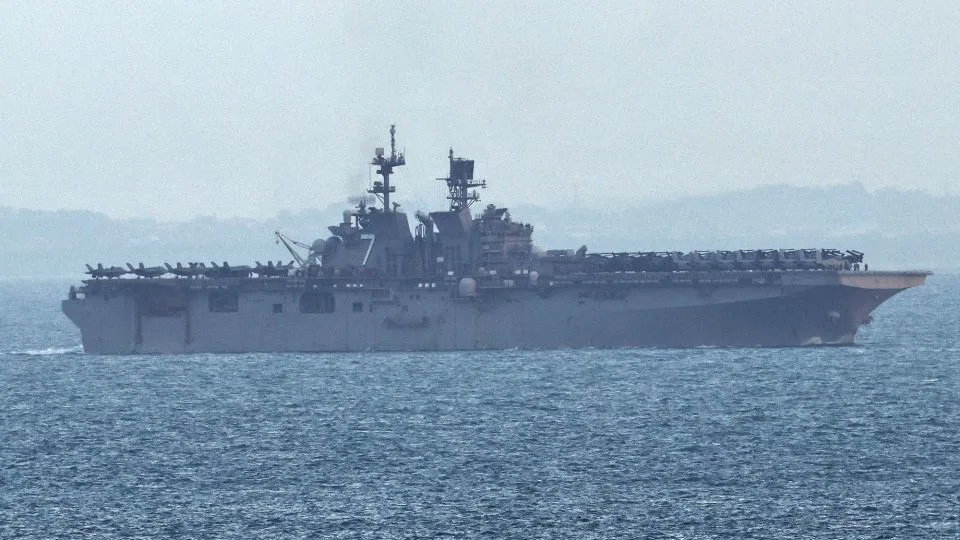

A 45,000-ton U.S. Navy powerhouse was tracked entering the Malacca Strait on Tuesday, signaling a significant escalation of American combat power toward the Middle East. The amphibious assault ship USS Tripoli (LHA-7) is transporting the elite 31st Marine Expeditionary Unit (MEU) to the region, according to maritime data and defense officials, as the three-week-old war with Iran enters a volatile new phase.
The deployment of the 2,200-member rapid-response force, typically based in Okinawa, Japan, provides the Pentagon with a “floating base” capable of launching specialized raids, stealth air strikes, and complex amphibious assaults.
A “Small Carrier” on the Move
Maritime tracking data on Tuesday morning showed the Tripoli approaching Singapore at the southwestern edge of the South China Sea, maintaining a speed of approximately 22 mph. While U.S. warships frequently operate with Automatic Identification System (AIS) transponders deactivated to mask their movements, the Tripoli’s signal remained active to ensure safe navigation through some of the world’s most congested shipping lanes.
The Tripoli is not a standard transport vessel; it functions as a “lightning carrier,” equipped with:
- F-35B Lightning II stealth fighters capable of vertical takeoffs.
- MV-22 Osprey tilt-rotor transports for rapid troop insertion.
- Aviation-centric design optimized for air assaults and close air support.
Strategic Context: The 2026 Iran War
The arrival of the 31st MEU comes as the regional security environment deteriorates. The conflict, which escalated following joint U.S.-Israeli strikes in late February, has seen Iranian forces target energy infrastructure in Qatar and the United Arab Emirates.
The deployment follows several critical developments:
- The Killing of Ali Larijani: Iran’s top security official was reportedly killed in a recent U.S.-Israeli strike, prompting vows of “harsh retaliation” from Tehran.
- Strait of Hormuz Crisis: Iranian attacks have severely restricted commercial traffic in the Strait, where 20% of global oil flows.
- Budgetary Surge: The Pentagon has reportedly requested over $200 billion in emergency funding to sustain “Operation Epic Fury,” the ongoing campaign against Iranian military assets.
Mission Objectives: Raids and Deterrence
While the Pentagon has not disclosed the Tripoli’s exact destination, military analysts suggest the 31st MEU will likely be positioned to secure the Strait of Hormuz.
“The MEU provides the commander on the ground with a ‘Swiss Army knife’ of options,” noted one senior defense official. “They can execute precision raids on missile sites, secure offshore energy platforms, or conduct non-combatant evacuations if the conflict spreads to major diplomatic hubs.”
The 31st MEU recently achieved full certification during Exercise Iron Fist 2026, honing its skills in seizing contested terrain alongside Japanese forces—a capability now directly applicable to the coastal geography of the Persian Gulf.
The Growing U.S. Footprint
With the Tripoli’s arrival, the total U.S. troop presence in the Middle East is expected to exceed 52,000. Despite initial administration efforts to avoid a large-scale ground war, the intensifying strikes on global energy supplies have forced a shift in posture.
The Tripoli is the lead ship of an Amphibious Ready Group (ARG) that typically includes the USS San Diego and USS New Orleans. While those vessels were not immediately confirmed alongside the Tripoli near Singapore, they are expected to consolidate the force as it nears the North Arabian Sea.