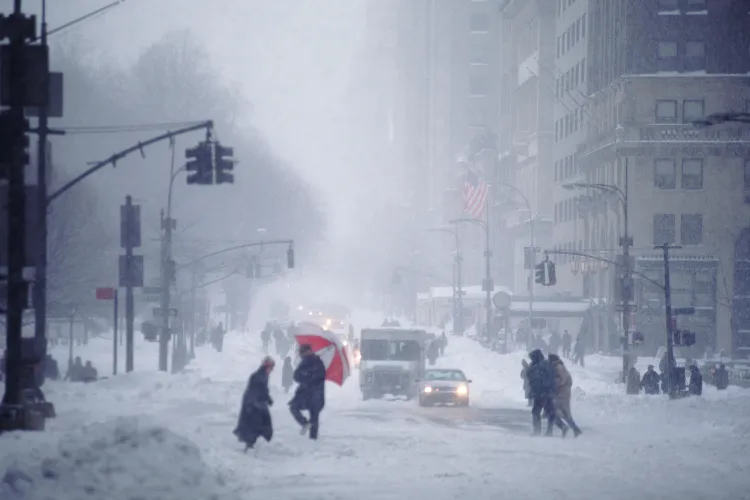

A sprawling winter storm — fueled by an arctic air mass — is expected to affect more than half of the U.S. population in the days ahead.
An Arctic cold front will deliver “frigid sub-zero and single digit temperatures” to roughly two-thirds of the country by Sunday, Jan. 25, according to the latest short-range forecast discussion from the National Weather Service (NWS). That surge of bitter air is expected to help generate “a major winter storm” stretching from the central and southern Plains to the East Coast beginning Friday, Jan. 23, and continuing into early next week.
Forecasters caution that key details are still coming into focus, including how far north the storm tracks — a factor that will heavily influence snowfall totals, especially across the mid-Atlantic and Northeast.
Snow could begin falling across parts of the South on Friday, with winter weather spreading into the Southeast by Saturday, Jan. 24, Fox Weather reports. Significant icing is also possible, potentially affecting more than a dozen states from Texas to Delaware.
:max_bytes(150000):strip_icc():focal(749x0:751x2):format(webp)/blizzard-2-012126-12ec71d50ea94ac28093e02ede88ef27.jpg)
Cold conditions are expected during and after the storm, raising risks on roads and at home — including the possibility of burst pipes in severely low temperatures — according to AccuWeather. The chill is being driven in part by a polar vortex dip that has already begun pushing into the U.S. and could linger through the end of the month.
“Potentially hundreds of thousands of people may go without electricity and heat for days,” said AccuWeather Chief Meteorologist Jonathan Porter.
Forecasts suggest portions of Texas, Oklahoma, Arkansas, Mississippi, Alabama and Georgia could see around a foot of snow, with isolated totals potentially reaching 18 inches, according to Fox Weather. Farther east, the highest snowfall totals are currently expected from Nashville through western North Carolina, with up to two feet possible in parts of the Appalachians.
Along the East Coast, the best chance for significant snowfall is currently expected in central Virginia, Maryland and southern New Jersey. But uncertainty remains for the mid-Atlantic and Northeast — and the storm’s eventual track will determine how much snow falls in the Northeast through the afternoon of Monday, Jan. 26. A more northern track would likely bring higher totals to that region.
Strong winds are also expected as the arctic blast moves in. The NWS warned of “dangerous wind chills” that could plunge to -50 degrees Fahrenheit in the Northern Plains. Extreme cold watches, warnings and advisories were in effect for parts of the Northern Plains and Upper Midwest as of Wednesday, Jan. 21.
Several major metro areas could be impacted, including Dallas, Austin, Oklahoma City, Nashville, Atlanta, Charlotte, Washington, D.C., Baltimore, Philadelphia, New York City and Boston, according to AccuWeather.
Winter storm watches are currently in effect from central New Mexico to central Tennessee and northern Georgia — including much of Texas, Oklahoma and Arkansas — the NWS said. Fox Weather estimates the system could affect around 175 million Americans.