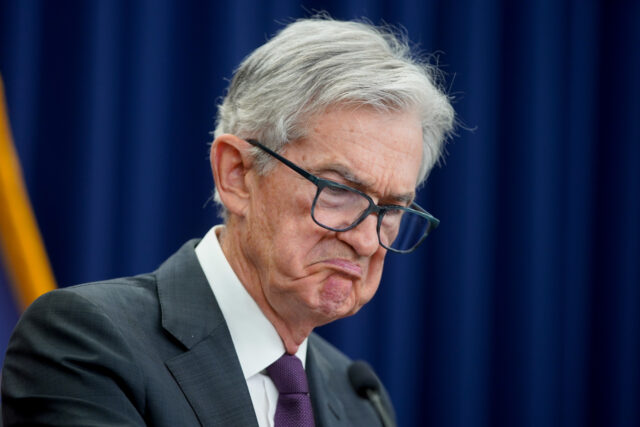

Federal Reserve Chair Jerome Powell held interest rates steady this week, reinforcing a cautious stance on policy changes and subtly opening the door to a potential rate hike—an outcome few expected, and one likely to frustrate President Donald Trump once again.
While markets had largely priced in no change to the federal funds rate, which remains at 4.25% to 4.5%, Powell’s comments suggested that even a hike wasn’t off the table. Despite acknowledging inflation driven by tariffs, he stressed the need for more data before making any moves.
The decision didn’t come without dissent. Two members of the Federal Open Market Committee (FOMC) voted against the move—marking the most internal disagreement the Fed has seen in over three decades.
Still, Powell downplayed the idea of a rate cut in the near term, which many analysts had previously expected might come in September. He noted that while tariffs are starting to push prices higher, it’s unclear whether the inflationary effects will persist.
“Higher tariffs have begun to show through more clearly to prices of some goods, but their overall effects on economic activity and inflation remain to be seen,” Powell told reporters. “A reasonable base case is that the effects on inflation could be short-lived… But it is also possible that the inflationary effects could instead be more persistent.”
Powell explained that the Fed is trying not to let temporary price distortions cloud its view of the broader economy, saying that keeping rates steady reflects this measured approach.
“A bit looking through goods inflation by not raising rates,” he noted.
That said, Powell’s refusal to signal an imminent cut stood in stark contrast to the hopes of investors. His message was clear: the data needs to support any move toward easing.
“The economy is not performing as though restrictive policy were holding it back inappropriately,” he added.
Analysts at Bank of America were struck by the tone of the press conference, calling it “much more hawkish” than expected. In a note shared with Fortune, they wrote that Powell had placed the burden of proof squarely on the economic data.
“To be clear, hikes are still very unlikely,” they wrote, “but Powell argued that the ‘efficient’ way of balancing risks to the dual mandate is to stay on hold because cutting too early introduces the risk of having to raise rates again later.”
Markets reacted swiftly: equities dipped and Treasury yields rose in response to Powell’s comments.
UBS’s Paul Donovan criticized the dissenting Fed members, implying their motives might be more political than economic.
“Investors are bound to suspect that the rationale amounted to little more than an excited jumping up and down and shouting ‘pick me, pick me’ in the general direction of the White House,” Donovan wrote. “The press conference gave a slightly hawkish tone in anticipating the trade tax inflation yet to come.”
September Still in Play
Despite Powell’s hawkish posture, many analysts are holding out hope for a rate cut at the next FOMC meeting in September.
Powell did acknowledge labor market risks, saying: “We are also attentive to risks on the employment side of our mandate.”
Elyse Ausenbaugh, Head of Investment Strategy at J.P. Morgan Wealth Management, noted: “The expectation for this meeting wasn’t a rate cut… The data, as it stands today, isn’t yet calling for one, and a lot could change between now and the FOMC’s next decision point in September.”
Goldman Sachs’s chief U.S. economist David Mericle echoed that sentiment in a client note seen by Fortune, pointing out that Powell neither endorsed nor dismissed the possibility of a September move.
“Powell acknowledged but declined to endorse [the two-cut baseline from June], saying that he would not want to substitute his own judgment for the views of other participants,” Mericle wrote.
Goldman still forecasts three cuts in 2025—in September, October, and December—and expects two additional cuts in 2026, bringing rates to 3% to 3.25%.
“Powell’s comments today suggest to us that a September cut is certainly still up for debate,” Mericle added, “but not that labor market softening over the next two months is necessarily required, and we continue to see multiple paths to a cut.”
UBS’s global wealth management CIO Mark Haefele also sees a September cut as plausible. He cited recent data from the Job Openings and Labor Turnover Survey (JOLTS), showing declines in openings, hires, and a lower quits rate.
Meanwhile, The Conference Board’s consumer confidence survey found 18.9% of respondents felt jobs were hard to get in July—potentially an early warning signal of labor market weakness.
“We continue to expect Fed to resume policy easing in September, cutting rates by 100 basis points over the next 12 months,” Haefele wrote. “Investors should consider medium-duration high grade and investment grade bonds for more durable portfolio income.”