Federal judges in New Jersey voted not to extend Alina Habba’s stint as the state’s top federal prosecutor—a move squarely within their legal authority. But that didn’t stop Attorney General Pam Bondi and Trump administration allies from denouncing the decision as political sabotage.
Habba, who rose to prominence as a combative legal defender for Donald Trump during his many legal battles—including his New York civil fraud trial and the E. Jean Carroll defamation case—was appointed by Bondi as acting U.S. Attorney for the District of New Jersey nearly 120 days ago, the legal maximum for interim appointments under 28 U.S. Code § 546.
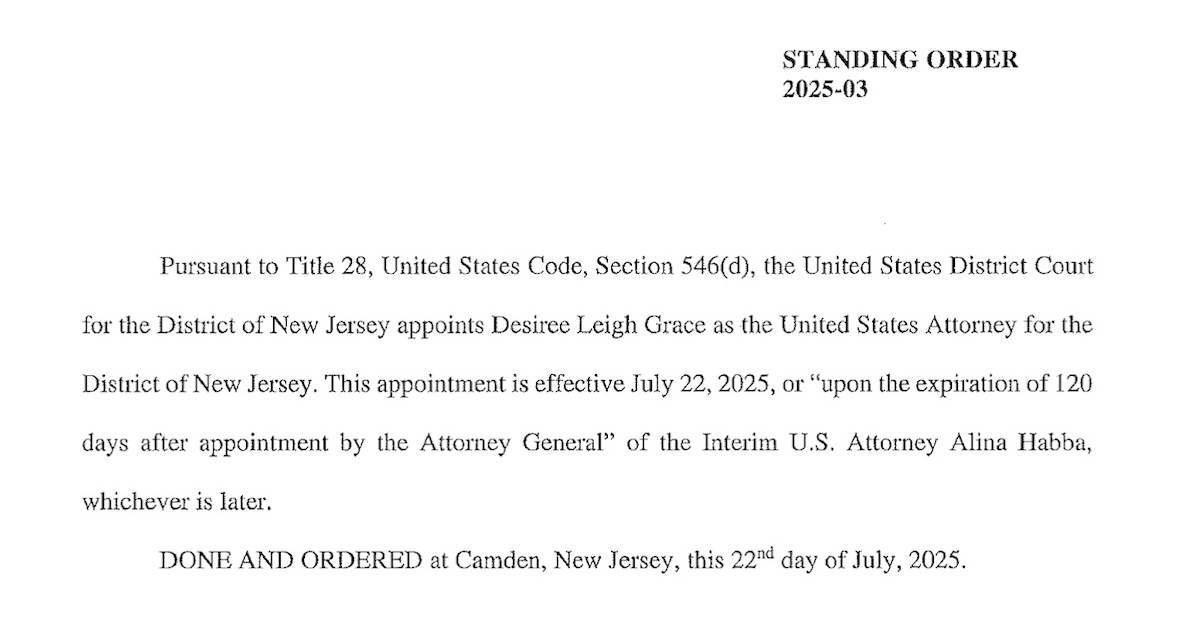
With that time limit expiring, the judges exercised their statutory power to appoint a new U.S. attorney until the vacancy is permanently filled. Their pick: Habba’s own deputy, First Assistant U.S. Attorney Desiree Grace.
That decision, however, was immediately met with fury from Trump’s DOJ. Bondi took to social media to claim Grace had been removed and suggested the judges had no right to interfere with what she characterized as a presidential prerogative.
“@USAttyHabba has been doing a great job in making NJ safe again,” Bondi posted. “Nonetheless, politically minded judges refused to allow her to continue in her position, replacing Alina with the First Assistant… This Department of Justice does not tolerate rogue judges—especially when they threaten the President’s core Article II powers.”
Deputy Attorney General Todd Blanche echoed the outrage, accusing the court of colluding with New Jersey’s U.S. senators and attempting to override Trump’s authority.
“This was never about law—it was about politics,” Blanche said. “They forced out President Trump’s pick, then installed her deputy. It won’t work. Pursuant to the President’s authority, we have removed that deputy, effective immediately.”
Legal Authority in Focus
Despite the fiery rhetoric, the court appears to be on solid legal ground.
Under 28 U.S. Code § 546, if a presidential nominee for U.S. attorney has not been confirmed within 120 days of an interim appointment, the district court has the power to select a replacement to serve until the vacancy is filled. The judges opted to install Grace rather than continue Habba’s tenure.
The court’s standing order even stated the appointment would take effect either immediately or when Habba’s 120-day term expired—“whichever is later.”
Blanche, however, claimed the court acted prematurely, insisting Habba’s interim term was set to end just before midnight on Friday. “Their rush reveals what this was always about: a left-wing agenda, not the rule of law,” he said.
History Repeats?
This isn’t the first Trump-era fight over 28 U.S. Code § 546. In 2020, Attorney General Bill Barr tried to oust then-U.S. Attorney Geoffrey Berman in Manhattan—who had been appointed by a district court after his interim term expired. Berman resisted until Trump formally fired him.
Legal experts note that once a court names a U.S. attorney under § 546(d), only a Senate-confirmed nominee or the president can override that decision. Until then, the court has every right to act when an interim appointment lapses.
What’s Next for Habba?
Some observers believe Habba could follow a path similar to another Trump appointee, John Sarcone in New York, who was reinstalled through a workaround using § 515 of the U.S. Code. That provision allows the attorney general to appoint “special attorneys” to carry out U.S. attorney functions—even if not confirmed by the Senate.
Whether the DOJ will pursue a similar strategy to reinstate Habba remains to be seen.
In the meantime, the court’s decision stands. And while Bondi and Blanche decry what they call judicial overreach, legal scholars suggest the judges acted well within the bounds of federal law.
But for Habba’s allies, the optics are clear: another Trump loyalist ousted by what they see as an activist judiciary. Her legal team and supporters have vowed to continue fighting the decision, raising the prospect of further constitutional and procedural clashes between the courts and Trump’s DOJ.
As Judge Geoffrey Berman once said during his own standoff with the Trump administration: “I will step down when a presidentially appointed nominee is confirmed by the Senate. Until then, our investigations will move forward without delay or interruption.”