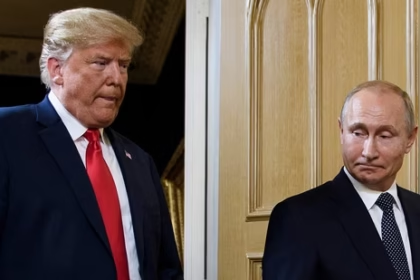
Just a week after President Donald Trump rolled out the red carpet for Vladimir Putin in Alaska, and only days after hosting an unprecedented summit of European leaders at the White House, his efforts at peace were jolted by a Russian strike on Friday.
“I’m not happy about it, and I’m not happy about anything having to do with that war,” Trump told reporters when asked about the attack on an American-owned factory in Ukraine.
For all the high-profile meetings and ceremonies of the past week, experts caution that the fundamentals of the conflict remain unchanged: Russia continues its bombing campaign, and Moscow has erected fresh obstacles to peace. A summit between Russian and Ukrainian leaders still appears distant.
The question now is whether the Alaska meeting and the Washington gathering can mark the start of a slow march toward peace, or if they were little more than political theater.
Last Friday, Trump attempted to jumpstart negotiations by meeting Putin in Alaska. On Monday, Ukrainian President Volodymyr Zelensky arrived at the White House with six European leaders.
Trump hinted he was open to offering US security guarantees for Ukraine if a peace deal could be reached—a significant shift welcomed by Kyiv and its allies. He even suggested Putin was willing to accept those terms.
In an unguarded moment, Trump was overheard telling French President Emmanuel Macron: “I think he wants to make a deal for me, you understand, as crazy as it sounds.”
European leaders, including UK Prime Minister Sir Keir Starmer, Italy’s Giorgia Meloni, Germany’s Friedrich Merz, and Finland’s Alexander Stubb, left Washington confident they had countered any advantage Putin hoped to gain, and noted Trump’s visible commitment to the process.
A senior European diplomat said Trump had “placed his hand in the mangle,” investing significant political capital in pursuing a deal.
Still, Trump later scaled back any implication that US troops would be part of a security force. Russia, meanwhile, made clear that any such guarantees would require its approval—a far murkier arrangement than Trump described after Alaska.
Russian Foreign Minister Sergey Lavrov declared: “Moscow won’t agree with collective security guarantees negotiated without Russia… Russia will accept if the security guarantees to Ukraine are provided on equal basis with the participation of countries like China, the United States, the United Kingdom and France.”
John Herbst, former US ambassador to Ukraine, argued that the administration stumbled earlier this month when it abandoned a deadline for secondary sanctions while preparing for the Alaska summit. “They pivoted from pressure on Russia to talking to Russia about their supposed flexibility right now. This was not a good look from the very beginning,” he said.
Even so, Herbst noted that the White House summit had value. “All the Europeans showing up was critical. Trump has really good relations with Stubb and Meloni, and good relations with Starmer and Macron and Merz. And so that means his friendliness to Putin is offset by this. You didn’t have it to this degree at any time in the first term. That’s an important factor.”
Still, Russia demonstrated its strength midweek, launching a rare drone and missile attack on Western Ukraine that struck multiple targets, including an American-owned electronics plant.
Trump reacted with a cryptic Truth Social post: “It is very hard, if not impossible, to win a war without attacking an invader’s country,” appearing to criticize his predecessor for restricting Ukraine’s ability to strike inside Russia.
The remark left observers uncertain whether Trump was signaling a major policy shift or simply venting frustration as momentum for peace faltered.
“It’s just an observation,” clarified Steven Cheung, the White House communications director. “Don’t read too much into it.”
A day later, Trump reverted to one of his hallmark strategies—setting a short-term timeline. “We’ll see what happens,” he said of the war. “I think over the next two weeks, we’re going to find out which way it’s going to go. And I better be very happy.”