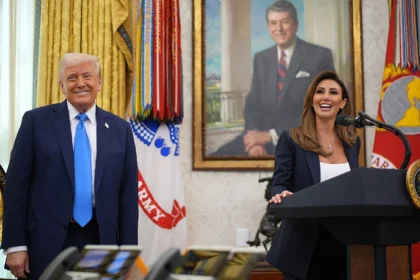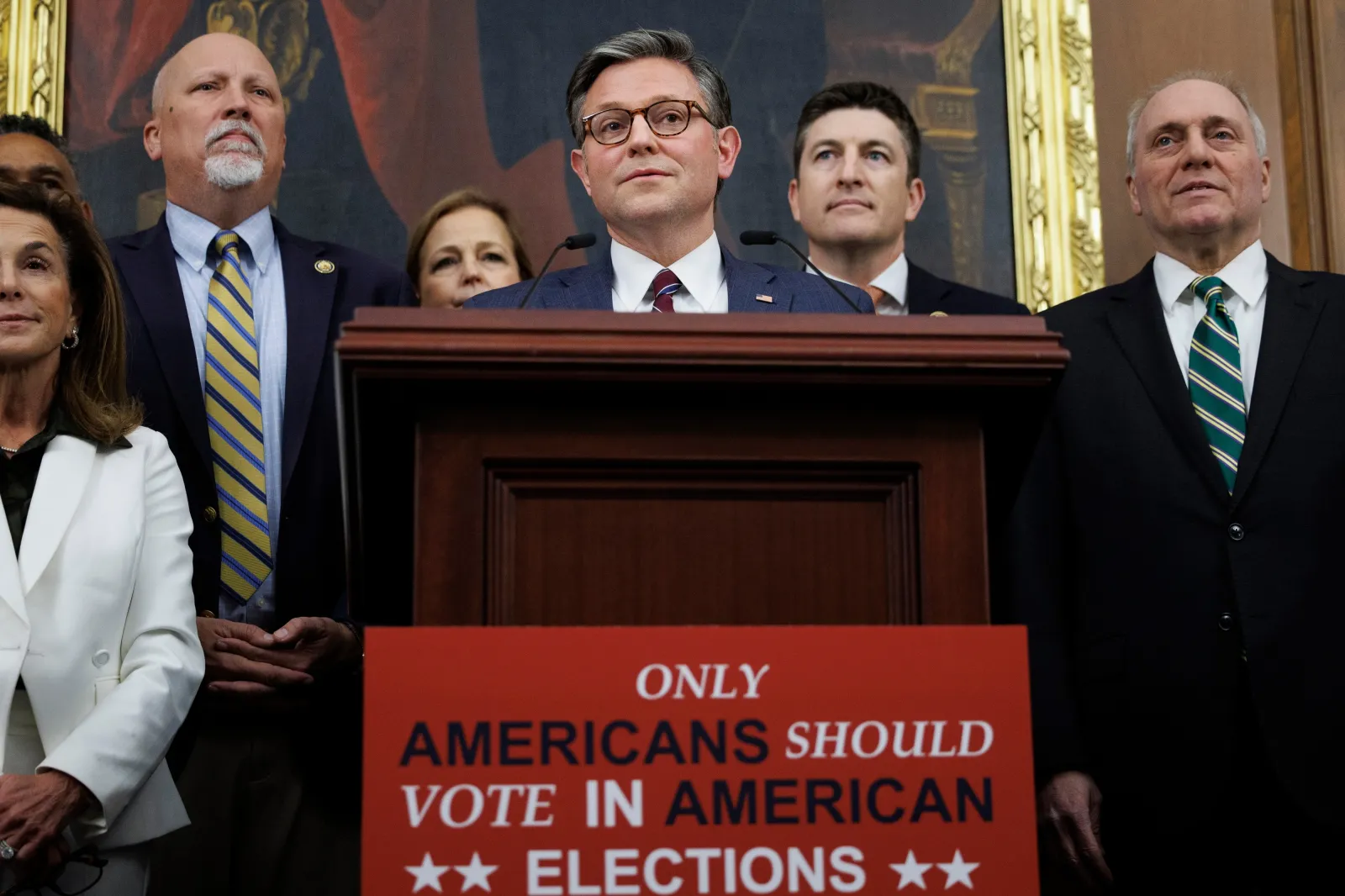

The Republican-controlled House narrowly passed the SAVE America Act, a wide-ranging election bill backed by President Donald Trump, sending it to the Senate, where it faces steep resistance.
The measure cleared the House on Wednesday, 218–213, with Republicans voting in favor and nearly all Democrats opposed. Representative Henry Cuellar of Texas was the only Democrat to support the bill.
Why it matters
The 32-page proposal would make major changes to federal election rules by requiring documentary proof of U.S. citizenship to register to vote in federal elections.
What to know
Under the bill, voters would need to present proof of citizenship in person when registering, using documents such as a U.S. passport or a birth certificate.
The legislation would also require photo identification for in-person voting and tighten rules for mail-in ballots. Voters would be required to submit a copy of an approved ID both when requesting an absentee ballot and when returning it.
House Speaker Mike Johnson of Louisiana defended the bill as a straightforward safeguard, arguing that voting should be treated like other activities that require identification.
“Americans need an ID to drive, to open a bank account, to buy cold medicine, to file government assistance,” Johnson said. “So why would voting be any different than that?”
Democrats, however, warned the bill could disenfranchise eligible voters and emphasized that voting by noncitizens is already illegal and uncommon. Current federal law requires voters to attest to their citizenship under penalty of criminal prosecution.
House Minority Leader Hakeem Jeffries of New York said the proposal was aimed more at reducing turnout than securing elections.
“This is a desperate effort by Republicans to distract,” Jeffries said. “The so-called SAVE Act is not about voter identification, it is about voter suppression,” adding that Republicans “have zero credibility on this issue.”
Democrats also raised constitutional concerns, pointing to Trump’s recent comments about “nationalizing” elections, which they argue conflicts with the Constitution’s framework that leaves election administration largely to the states. They further noted ongoing investigations linked to Trump’s continued claims of widespread fraud in the 2020 election.
Republicans say voter ID requirements are popular. A Pew Research Center survey published last year found that 83% of U.S. adults support requiring government-issued photo identification to vote, including majorities of Democrats and Black voters. The survey questioned 3,554 adults from August 4 to 10, 2025, with a margin of error of plus or minus 1.8 percentage points.
What people are saying
A spokesperson for Republican Senator Susan Collins of Maine said she supports the principle that only U.S. citizens can vote in federal elections and backs voter ID requirements, but expressed concerns about the bill’s expanded scope compared with earlier versions.
Gideon Cohn-Postar, a senior adviser for election infrastructure at the Institute for Responsive Government, said the proposal could create a misleading perception that certain states have serious election problems. He added that while proof-of-citizenship requirements may sound reasonable, obtaining the necessary documents can be difficult, and current law already requires voters to attest to citizenship under penalty of perjury.
Rebekah Caruthers, president and CEO of Fair Elections Center, said the bill should be evaluated as a whole and argued it is intended to restrict who can vote.
Trump wrote on Truth Social last week that U.S. elections are “rigged” and said the country must “fix them” to avoid future harm.
What happens next
The bill, sponsored by Representative Chip Roy of Texas and Senator Mike Lee of Utah, now moves to the Senate, where its path forward is uncertain.
Although Republicans hold a narrow majority, several GOP senators have raised concerns about imposing federal election mandates on states. The legislation also appears unlikely to reach the 60 votes needed to overcome a filibuster.
Senate Minority Leader Chuck Schumer of New York has called it “dead on arrival,” while Senate Majority Leader John Thune of South Dakota said Republicans are discussing how—or whether—to advance the bill, even as they rule out changing filibuster rules.