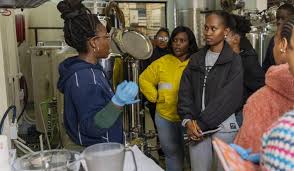

In a Johannesburg microbrewery, Apiwe Nxusani-Mawela pours a brown, grainy liquid from a large silver tank into a slender refractometer. After a quick expert glance, she nods in approval and passes it to her students, who eagerly call out their observations.
“When you’re brewing, you have to constantly test your mixture,” she tells them. “We’re looking for the right balance between sugar and grain.”
At 41, Nxusani-Mawela is not only an international beer judge and taster—she’s also believed to be the first Black woman in South Africa to own a craft brewery. In an industry long dominated by men and big corporations, she’s breaking barriers and bringing others with her.
At her Tolokazi Brewery in Johannesburg’s Wynberg suburb, she’s teaching 13 young Black graduates—most of them women—the art and science of brewing. Her goal: to open up South Africa’s multibillion-dollar beer industry to more women and people of color.
Brewing Meets Science
The students at Brewsters Academy come from scientific backgrounds, with degrees in chemical engineering, biotechnology, and analytical chemistry. They’re now adding brewing to their skillsets, hoping to break into a field traditionally closed to them.
In hairnets and lab coats, they spend six hours learning how to malt, mash, boil, ferment, and filter their way to a perfect pale ale.
“My favorite part is the mashing,” said 30-year-old chemical engineering student Lerato Banda, referring to the process where grains are mixed with hot water to extract sugars. “It’s where everything starts.”
The year-long course includes six months of classroom training, followed by another six months of hands-on experience in the industry.
From Rural Roots to Industry Pioneer
Nxusani-Mawela grew up in the small town of Butterworth, nearly 1,000 kilometers from Johannesburg. She stumbled upon brewing at a university open day and began experimenting in 2007. With a background in microbiology, she was drawn to brewing for its mix of science, artistry, and business.
“I fell in love with the combination of the technical side, the creativity, and the entrepreneurial challenge,” she said.
Now a mother of two boys, she wants to ensure she’s not the last of her kind.
“Being the first Black female to own a brewery in South Africa—I knew I couldn’t be the last. Brewsters Academy is about transforming the industry,” she said. “In five or ten years, I want to see Black people and women in brewing as the norm, not the exception.”
A $5 Billion Industry in Need of Change
South Africa’s beer industry contributes over $5.2 billion to the nation’s GDP and supports more than 200,000 jobs, according to Oxford Economics. But despite its size, the sector remains overwhelmingly male.
Lehlohonolo Makhethe, 24, one of Nxusani-Mawela’s students, sees the shift as a return to African traditions.
“Historically, women brewed beer in many African cultures,” she said. “Somewhere along the way, that changed. We’re just taking back our place.”
Brewing with an African Twist
Though Nxusani-Mawela teaches global beer styles, she’s passionate about reviving traditional African brewing. Her Wild African Soul beer, a fusion of Umqombothi (a traditional maize-and-sorghum beer) and a fruity Belgian Saison, won the 2025 African Beer Cup.
“Umqombothi is our heritage. It deserves to be preserved and celebrated,” she said. “We need to carry the past into the future with every brew.”
Her Tolokazi line features uniquely African ingredients like marula fruit and rooibos, a native South African plant typically used for tea.
“Who would’ve thought of rooibos beer?” exclaimed festivalgoer Lethabo Seipei Kekae after sampling it. “It’s so smooth—even non-beer drinkers would enjoy it.”