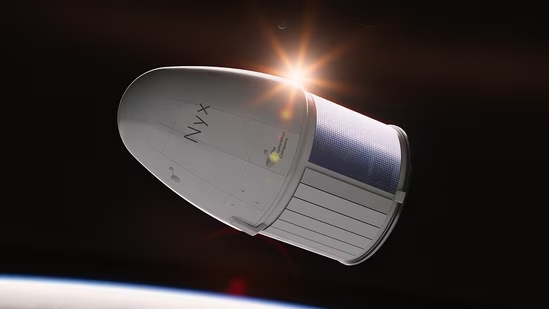

A space burial mission ended in disappointment after a capsule carrying the ashes of 166 individuals crashed into the Pacific Ocean following just two successful orbits around Earth.
The German startup The Exploration Company (TEC) had launched the Nyx capsule on June 23 as part of its ambitious “Mission Possible,” which aimed to fulfill the final wishes of people who had chosen to have their remains sent into space. Alongside the cremated remains, the capsule also carried cannabis seeds as part of experimental payloads.
Despite a smooth launch and initial success in space, the mission took a turn when the capsule re-entered Earth’s atmosphere and lost communication with ground control just moments before its planned splashdown.
‘Partial Success,’ Says Startup
In a LinkedIn post, TEC acknowledged that the mission achieved “partial success (partial failure)”, explaining that the capsule:
- Launched and orbited as planned,
- Successfully powered its onboard payloads,
- Stabilized after separation from its launcher,
- Re-entered Earth’s atmosphere, and
- Re-established communication after the typical blackout period during re-entry.
However, contact was lost again shortly before the capsule hit the ocean, and the spacecraft is now presumed lost at sea.
Investigation Underway
The company is investigating the root cause of the failure and promised to share updates soon. “We apologize to all our clients who entrusted us with their payloads,” TEC wrote. “This partial success reflects both ambition and the inherent risks of innovation.”
The company expressed gratitude to its team and emphasized that the mission broke new ground despite the setback. It also committed to re-flying the mission once lessons are learned and improvements are made.
No Recovery Possible, Says Celestis
Celestis, a Texas-based company specializing in space burials and a partner in the mission, confirmed that the ashes aboard the capsule cannot be recovered.
“We also recognize that no technical achievement replaces the profound personal meaning this service holds for our families,” said Celestis CEO Charles M. Chafer, offering condolences to the families affected by the failed recovery.
While Mission Possible didn’t go entirely as planned, both companies are treating it as a stepping stone toward more reliable space memorial services in the future.