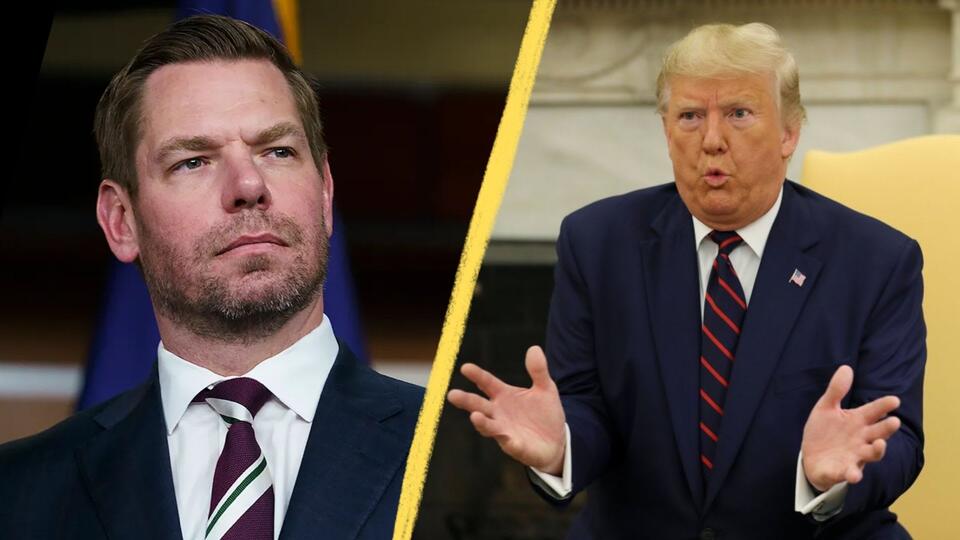

Rep. Eric Swalwell says some members of the U.S. military have privately told him they see themselves as a safeguard against any unlawful orders from President Donald Trump, intensifying an already heated debate over the military’s role in America’s constitutional system.
The California Democrat and gubernatorial candidate made the remarks during a recent appearance on CNN’s Don Lemon Tonight, where he was asked about a growing controversy over a video featuring six Democratic lawmakers urging service members not to follow “illegal orders” from the commander in chief.
Swalwell argued that the Biden-era balance of power—Congress versus the presidency and the courts—has eroded, and said some service members now believe their own oath to the Constitution effectively makes them a backstop if the political branches fail.
“What gives me hope… is that while Congress is not much of a check on the president anymore, and the Supreme Court is hardly a check, military members have told me, ‘We can be a check,’” Swalwell said, describing private conversations he claims to have had with troops.
According to Swalwell, those troops told him they would refuse to betray their oath even if pressured to carry out unlawful commands from Trump.
The Video That Sparked the Firestorm
The uproar began after a video circulated online showing six Democratic lawmakers, including Arizona Sen. Mark Kelly, a retired Navy captain and former astronaut, telling service members they have a duty to reject unlawful orders.
The clip was amplified by Trump on social media, where he attacked the lawmakers and accused them of encouraging insubordination. Trump blasted the comments as “seditious” and suggested such behavior could be “punishable by death,” language that drew sharp criticism from legal scholars and civil libertarians who said it was wildly inappropriate for a president to talk about executing political opponents.
In response to the video, the Department of Defense announced it was reviewing whether Kelly’s appearance and the broader message of the video violated any rules governing political activity or unlawful advocacy within the armed forces.
Swalwell: Administration ‘Told on Itself’
Swalwell framed the Pentagon review as a telltale sign about the Trump administration’s intentions.
“To me, the only reason you would go after Mark Kelly for saying, ‘You don’t have to follow an unlawful order’—which is true—is if you intend to give unlawful orders,” he argued.
The congressman said he believes Trump and his allies are effectively demanding that troops put loyalty to the president ahead of loyalty to the Constitution, especially in a second Trump term marked by more explicit promises of retribution against perceived enemies in government and the military.
Swalwell also claimed that his private conversations with service members show the opposite sentiment in the ranks: a determination to uphold their oath, even if it conflicts with the desires of any one president.
“They’re essentially saying, ‘We’re not going to betray our oath to the Constitution because this guy tells us to,’” he said.
Tension Over Civilian Control of the Military
The comments land in a fraught space where two core American principles meet head-on: civilian control of the military and the obligation of service members to refuse illegal orders.
Under U.S. law and long-standing military doctrine, troops are required to disobey clearly unlawful commands—such as orders to target civilians or participate in a coup. At the same time, the military is not an independent political actor and is expected to remain strictly nonpartisan, subordinate to elected civilian leadership.
Military law experts note that this dual obligation is precisely why rhetoric on both sides can be dangerous: political leaders telling troops to “resist” a specific president, or presidents framing criticism from lawmakers and officers as “treason” or “sedition,” both risk dragging the armed forces into partisan conflict.
Critics of Swalwell’s remarks argue that suggesting the military will “save us” from a lawfully elected president flirts with the idea of the armed forces as a political veto power—something the U.S. system was designed to avoid. Supporters counter that he is simply describing a reality: individual men and women in uniform take their oath seriously and may refuse participation in abuses of power.
Kelly Caught in the Crossfire
Sen. Kelly has become a focal point in the dispute. As a retired Navy officer, he has emphasized that his message to troops is rooted in the Uniform Code of Military Justice and international law: unlawful orders must be refused, regardless of who occupies the Oval Office.
Trump allies, however, accuse him and the other lawmakers in the video of encouraging mutiny against the commander in chief. They argue that the public nature of the appeal—and its focus on Trump—turns a legal principle into a partisan weapon.
The Pentagon’s review, announced on social media by the Department of Defense, will examine whether the video or Kelly’s participation ran afoul of rules restricting certain types of partisan activity or political advocacy linked to the military. Officials have not indicated when that review will be completed.
Another Democrat Warns of ‘Consequences’ for Political Targeting
Swalwell’s comments came the same day another Arizona Democrat, Sen. Ruben Gallego, delivered his own warning—this time directed at military officials who might participate in politically driven investigations of lawmakers.
“Donald Trump is going to be gone in a couple of years,” Gallego said in a separate televised interview. “If you’re part of the military that is going after sitting senators, sitting members of Congress, and part of the weaponization of government, there will be consequences, without a doubt.”
Gallego’s remark highlighted a separate but related fear among Democrats: that Trump, if returned to the White House, could pressure senior military and defense officials to carry out politically motivated campaigns against his critics, and that those who comply might later face legal or career repercussions.
A Wider Debate Over the Next Trump Term
The controversy around Swalwell’s “check on Trump” comment is the latest flashpoint in a broader debate about what a second Trump term could mean for the military’s apolitical tradition.
Trump and his allies insist they simply want a government—including the Pentagon—that is more responsive to the president’s agenda and less dominated by unelected bureaucrats. Critics say his rhetoric about “retribution,” “purging” the so-called deep state, and being a “dictator on day one” makes it essential that troops understand their duty to the Constitution above any individual.
Swalwell has positioned his remarks squarely in that debate, presenting the military rank and file as potential defenders of constitutional norms if other institutions buckle.
What remains unclear is how representative the conversations he describes really are—and whether putting troops at the center of partisan arguments will strengthen those norms, or strain them further.