

For the first time in 18 months, the growth engine of America’s small business economy has faltered. Profitability growth slipped into negative territory in November, as rising costs tied to tariffs and inflation squeezed margins—forcing many Main Street businesses to raise prices aggressively even while the holiday season provided a temporary boost.
The December edition of the Bank of America Institute’s Small Business Checkpoint shows that small business bank accounts remain positive overall, but the direction of travel is troubling. Year over year, profitability growth dipped below zero last month, coming in at -0.02%—the first negative reading for this measure in a year and a half.
BofA points to two key signs that tariffs are playing a meaningful role. The net share of owners raising average selling prices surged 13 points from October to a net 34%, the highest level since March 2023 and the largest one-month increase on record in the National Federation of Independent Business’s flagship small business survey.
That pressure shows up in sector trends as well. Using BofA small-business account data, wholesale trade posted the steepest annual profitability decline, down 1% in November. Within wholesale, the biggest drag came from durables—especially tariff-exposed categories like electronics and furniture—driving most of the deterioration in the second half of the year. But non-durables such as apparel have also slipped so far this quarter.
The signal is clear: revenue is still coming in, but costs are eroding margins faster than sales can make up the difference. For many owners, absorbing tariff-related increases no longer looks sustainable. Raising prices is becoming the only viable option.
Holiday hopes and hiring freezes
Even with profitability growth turning negative, total profits stayed positive in November, helped by the seasonal shopping calendar. Small Business Saturday—held on November 29 this year—has become a major anchor for many merchants, with owners estimating it generates 20% of annual sales.
Still, the report suggests that the holiday surge may not be strong enough to offset the broader squeeze. BofA noted that consumer momentum appeared to cool over the Black Friday weekend, raising the risk that holiday spending won’t deliver the lift many retailers were counting on.
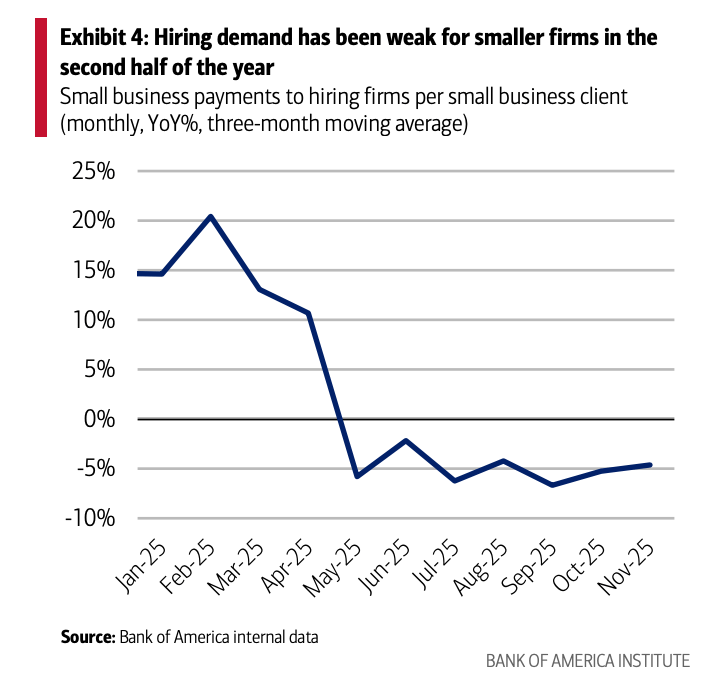
The strain is also showing up in hiring. Payments to hiring firms fell 4.6% year over year, reinforcing signs of a weakening jobs market among small businesses. BofA said that other research supports the same conclusion, pointing to the Institute’s November Employment Report and data from payroll provider ADP, both of which showed declines driven by losses at small firms. As the report notes, “With nearly half of the US workforce employed by such firms, this underscores the importance of the small business bedrock.”
The labor market, however, isn’t uniformly soft. Industries with persistent worker shortages—such as construction and restaurants—posted stronger payroll growth as they continued competing for talent. Even so, BofA observed that small businesses are both more likely to plan on increasing employment and more likely to report difficulty filling openings compared with the average of the past two decades.
Speaking earlier this week to Fortune’s Eva Roytburg about disappointing nationwide jobs numbers, Moody’s chief economist Mark Zandi said “there’s just no forward motion,” describing a labor market that is essentially “stuck in the mud.”

Looking toward 2026
Despite the squeeze, sentiment isn’t entirely bleak. Optimism about the coming year has risen, and hiring intentions over the next three months are at their highest point of the year.
Beyond that, many owners are pinning their hopes on technology to improve efficiency and reduce costs. The 2025 Bank of America Business Owner Report found that 50% plan to implement artificial intelligence over the next five years. Meanwhile, spending on tech services—including AI—rose 6.2% in November, a sign that businesses are investing in digital tools to navigate a high-cost environment.
For now, small businesses appear to be caught in a fragile balancing act: still generating profits, but carrying heavier drag from tariffs and inflation than they have faced in nearly two years.


