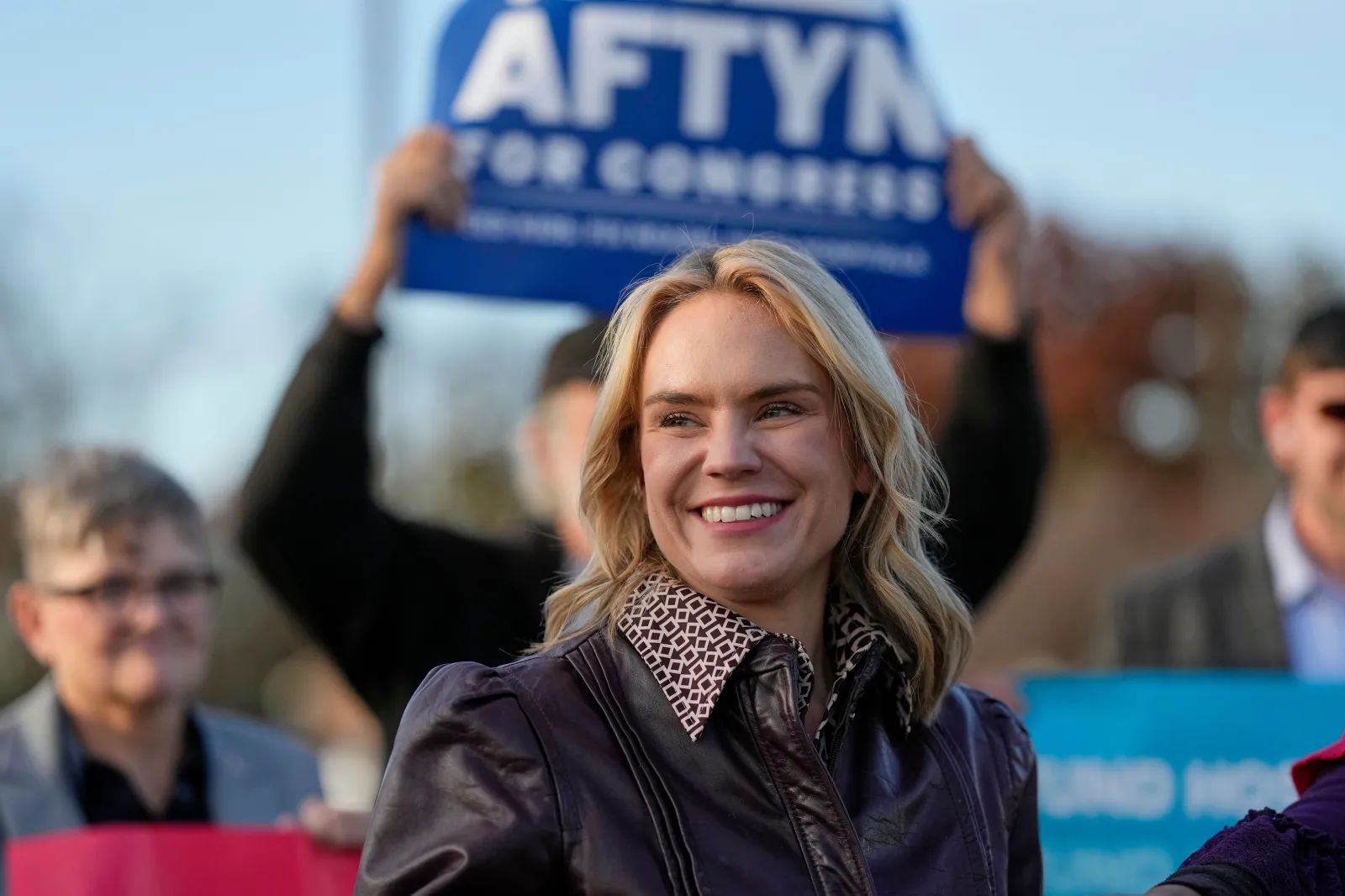

A Democratic win in Tuesday’s special election for Tennessee’s Seventh Congressional District could hand former Vice President Kamala Harris a timely political boost more than a year after her loss to President Donald Trump.
Why the Race Matters
Voters will choose between Democratic state legislator Aftyn Behn and Republican veteran Matt Van Epps in a special election to replace former Representative Mark Green, who resigned earlier this year to take a private-sector job.
The district has long been considered safely Republican—Trump carried it by about 22 points last November. Even so, Democrats are optimistic that Behn could pull off an upset, pointing to strong Democratic performances in special elections this year and recent polling that shows a tight contest.
The race has drawn national attention from both Trump and Harris. Harris has returned to the campaign trail for the first time since last year to encourage Democrats to turn out, while Trump has thrown his weight behind Van Epps. A Behn win would be a symbolic setback for Trump and a confidence boost for Harris, who is often mentioned as a potential 2028 presidential contender.
Key Details About the District
Turnout will likely decide the outcome. Tennessee’s Seventh District includes parts of Nashville, Clarksville, and a mix of rural and suburban communities in central Tennessee. Democrats are counting on strong participation in deep-blue Nashville to carry Behn over the line.
If Republican-leaning rural and suburban voters show up in larger numbers, however, Van Epps and the GOP are favored to hold the seat.
Harris, Trump, and Their Stakes
Harris hasn’t formally endorsed Behn, but she appeared at a Democratic canvassing event in Nashville last month, urging supporters to vote in the special election, according to The New York Times. Earlier that day, she spoke at Fisk University, a historically Black college.
While Harris failed to defeat Trump last November, seeing a candidate she campaigned alongside defeat a Trump-backed Republican in a conservative district would be a symbolic blow to the former president and his party.
Behn joined Harris at the canvass, calling the contest the “most competitive” race in the country. When asked why Harris did not endorse Behn by name, Behn’s campaign told The Nashville Banner that it had not organized the event.
Trump, meanwhile, has explicitly backed Van Epps. In a Truth Social post on Sunday, he urged Republicans to “GET OUT AND VOTE” for his preferred candidate, warning supporters not to take the race for granted and praising Van Epps as “one of the best Candidates we’ve ever had.”
What Analysts Are Saying
John Geer, co-director of the Vanderbilt Poll and a political science professor, told Newsweek that a Behn win would be a clear positive for Harris.
“I think it would be a boost for her for sure,” he said, adding that such a result would also represent a serious setback for Trump.
It would also be a problem for House Speaker Mike Johnson, shrinking an already narrow Republican majority in the House of Representatives. Harris’ decision to visit the district and appear at the canvass, Geer added, underscores how unexpectedly competitive the race has become.
Kent Syler, a political science professor at Middle Tennessee State University, offered a more cautious view of how much the outcome would matter for Harris personally.
He suggested that while the Behn campaign likely welcomed the attention from a former vice president, the race is ultimately about Trump and his standing with voters. Midterm-style elections, he noted, often serve as referendums on the sitting president. A tight race—or a Democratic overperformance—would be read as a warning sign for Trump heading into the midterms, when Democrats hope to regain control of both the House and Senate.
Syler said that if Behn climbs into the mid-40s in terms of vote share, it would fit into a pattern of Democrats outperforming expectations. That trend could help the party recruit strong candidates in more competitive districts next November. Anything above 45 percent, he added, would be “the cherry on top” for Democrats.
Republicans, Geer noted, appear eager to make the contest about Behn and Democratic policies rather than Trump himself.
He pointed out that Van Epps’ current ads shy away from mentioning Trump or tying the campaign to advancing Trump’s agenda. Instead, they focus on portraying Behn as too liberal and emphasizing Van Epps’ promise to tackle inflation and the rising cost of living—issues that polls show are top of mind for many voters.
In the primary, however, Van Epps leaned heavily into his alignment with Trump and the MAGA movement, Geer said.
On the Ground: Key Messages
At the Nashville canvass, Harris framed the election as a fight over power and representation, according to The Nashville Banner:
“There are some powerful forces that are trying to suggest that folks are alone and without power, powerful forces that are trying to divide us and to tell folks that they don’t matter and their needs don’t matter. Well, we need to let them hear our voice and let them know that they’re going to have to be responsive. This is a moment where we reclaim this, our country.”
Amy Walter, publisher and editor-in-chief of the Cook Political Report, highlighted the GOP’s messaging strategy in a post on X. She observed that even in a district Trump carried by 22 points, Republican ads have largely avoided mentioning him or promising to advance his agenda, focusing instead on attacking the Democrat. That dynamic, she wrote, suggests Republicans are entering 2026 in a defensive posture.
The Davidson County Democratic Party celebrated Harris’ appearance at the canvass in a November 20 post on X, while the MAGA Inc. PAC used its own social media messaging to frame Behn as a “radical liberal” and to argue that Tennessee voters will ultimately choose Van Epps.
What Comes Next
Polls in Tennessee close at 7 p.m. local time. Election forecasters still give Republicans the advantage: both the Cook Political Report and Sabato’s Crystal Ball rate the race as “Likely Republican.”
Even so, surveys suggest a close contest. An Emerson College poll of 600 likely voters conducted from November 22 to 24 showed Behn trailing by just 2 points—49 percent to 47 percent—among likely voters after undecided respondents were pushed. The poll’s margin of error was plus or minus 3.9 percentage points.
If Behn manages to win—or even significantly outperform expectations—the result could reshape how both parties view Trump’s political strength, Harris’ future prospects, and the broader landscape heading into the next election cycle.