
Moody’s Analytics chief economist Mark Zandi says the U.S. labor market is losing momentum—and he argues President Donald Trump’s tariff strategy is a meaningful part of the problem.
In a social media post Sunday, Zandi said the quickest potential catalyst for better hiring could come from the Supreme Court, which is expected to rule soon on the administration’s global tariffs. If the Court strikes down the tariffs, he believes it could ease pressure on the economy and help restart job growth.
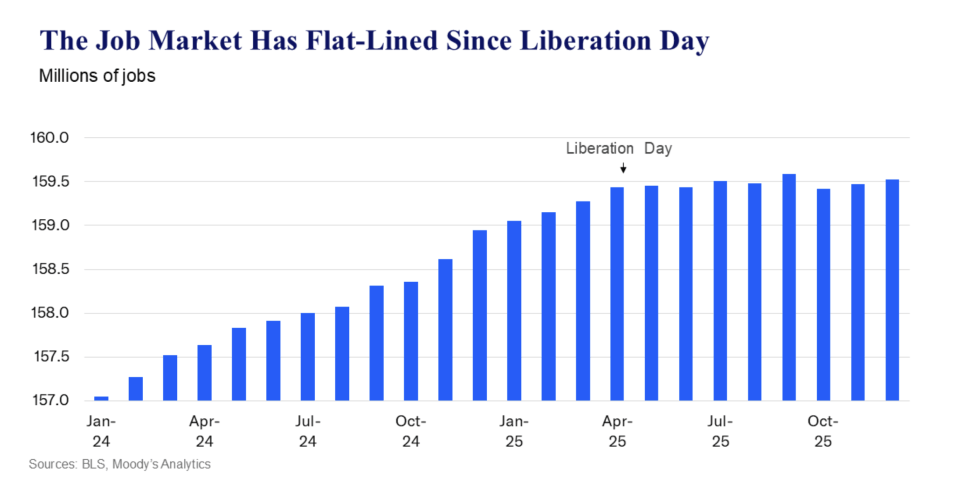
His comments follow the latest monthly jobs report showing payrolls increased by 50,000 in December, while the unemployment rate ticked down to 4.4%. Over all of 2025, employers added 584,000 jobs—down sharply from 2 million in 2024 and the weakest year outside of a recession since the early 2000s.
Zandi said the labor market has failed to grow since Trump’s “Liberation Day” tariffs rattled global markets in April. He added that future data revisions may even show overall job losses during that period.
According to Zandi, tariffs are hitting the economy in two ways: directly, by weakening activity in sectors tied to trade, and indirectly, by increasing uncertainty that makes businesses more cautious about hiring.
Trade-exposed industries have already taken visible hits. Manufacturing alone has shed 70,000 jobs since April. Mining and logging, along with warehousing, have also lost tens of thousands of positions.
By contrast, health care and social services have been among the few areas still adding workers consistently. Zandi suggested that without hiring in those two sectors, overall payrolls could have fallen for the year.
He acknowledged that other forces may be weighing on the labor market, including strict immigration policies, DOGE-related cuts, and artificial intelligence. Still, he argued the trade conflict has played a central role in the slowdown.
“The fastest way to boost the job market would be for the Supreme Court to declare the reciprocal tariffs unlawful and for lawmakers to let them become a thing of the past,” Zandi wrote.
The Supreme Court is expected to rule soon on whether Trump can impose tariffs under the International Emergency Economic Powers Act (IEEPA). The law has been used as the foundation for much of the trade policy in question, including the so-called reciprocal tariffs and fentanyl-related duties. The administration has also used IEEPA-backed tariffs as leverage in trade agreements with the European Union, Japan, South Korea, and others.
Even if the Court rules against the administration, however, that wouldn’t automatically dismantle the broader tariff regime. Some tariffs are based on other legal authorities and are not part of the case. New tariffs could also be pursued outside IEEPA, though those efforts would generally take longer to implement and, in some cases, apply only for shorter periods.
Administration officials have said they have other ways to impose tariffs if needed—but Zandi suggested Trump may not move immediately, especially as affordability concerns are front and center for lawmakers. He noted that the administration has already rolled back some duties on items like coffee and pasta and delayed tariffs on furniture.