
On a bright April day in 1965, first lady Claudia “Lady Bird” Johnson welcomed members of the Kennedy circle back to the White House for a ceremony meant to complete a project interrupted by the shock of President John F. Kennedy’s assassination.
“Only a short while ago, sometimes it seems only days, this wonderful old building was occupied by the 35th American president and his first lady,” Johnson told the gathered guests. She praised the Kennedys for bringing “the lilt of youth,” an eye for beauty, and “an infinite quality of grace” to the executive mansion.
Among the initiatives John and Jackie Kennedy had championed was reshaping portions of the White House grounds into places for “repose” and “reflection.” The couple enlisted their close friend, renowned horticulturist Bunny Mellon, to design practical green spaces beside both the West Wing and the East Wing.
The West Garden evolved into the now-famous Rose Garden—an image fixture for generations. But Johnson argued that the garden on the east side deserved a special dedication.
“There could be only one name for this garden,” she said, announcing it would be known as the “Jacqueline Kennedy Garden.”
Speaking beneath a pergola designed by architect I. M. Pei, Johnson said the space would offer enjoyment “for generations to come,” not only to those who lived in the White House but also to the thousands of visitors who passed nearby on tours.
:max_bytes(150000):strip_icc():focal(749x0:751x2):format(webp)/Jacqueline-Kennedy-Garden-3-102825-e902e1b16fca469cbe47cb52a7c176aa.jpg)
Jackie Kennedy did not attend the dedication. After her husband’s death, she largely avoided returning to the White House. Still, several members of the Kennedy family were present, including Robert F. Kennedy and his wife, Ethel, as well as Jackie’s mother, Janet Lee Auchincloss (née Bouvier).
Auchincloss, then 57, addressed the crowd, calling the garden a deeply meaningful tribute to her daughter. She said President Kennedy loved gardens and had planned the space with Jacqueline, and she believed the dedication would have made him happy. The garden, she added, would stand as a lasting reminder of the years Jackie spent at the White House.
Over time, the Jacqueline Kennedy Garden—often overlooked compared with the Rose Garden—became a secondary event space, hosting everything from award ceremonies to first ladies’ gatherings.
:max_bytes(150000):strip_icc():focal(749x0:751x2):format(webp)/Jacqueline-Kennedy-Garden-2-102825-e976f3ebc88e49e783a057b95db665d0.jpg)
During Hillary Clinton’s time as first lady, it was reimagined as a sculpture garden, featuring contemporary American works intended to highlight the role of the arts in public and private life.
For decades, the garden also served as one of the first sights many visitors encountered on public tours. Guests entering through the East Wing could look out through the large windows lining the East Colonnade and see the green space stretching alongside it.
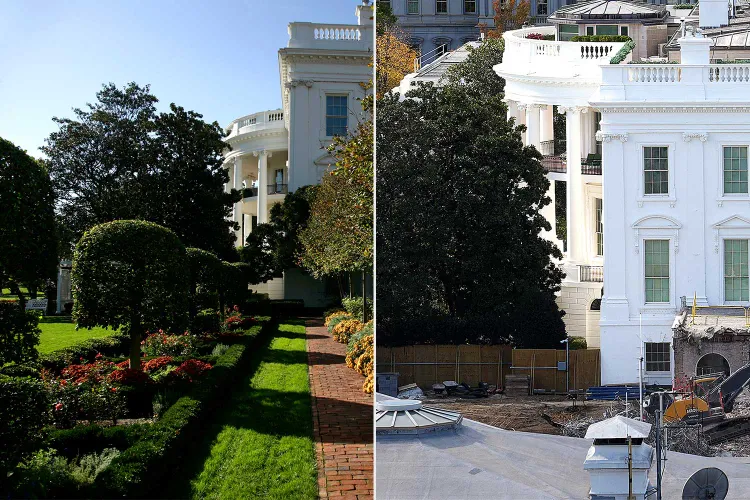
That long-running feature abruptly ended on Oct. 20, 2025—60 years after the dedication—when construction equipment tore into the historic East Wing in a surprise demolition connected to plans for President Donald Trump’s proposed 90,000-square-foot ballroom.
:max_bytes(150000):strip_icc():focal(731x0:733x2):format(webp)/Jacqueline-Kennedy-Garden-4-102825-cd1bd844952a4b4eae012c41bc2708d2.jpg)
Soon, much of the east side of the White House complex had been razed, including the East Colonnade and the Jacqueline Kennedy Garden—one of the most prominent national landmarks bearing the late first lady’s name.
After the demolition, a White House official said the plan was to rebuild the garden, while also cautioning that the ballroom project’s scope and size could change as planning continued and that additional details would be shared later.
In a Jan. 8 meeting with the National Capital Planning Commission, the ballroom’s architect presented updated renderings of the reworked East Wing plans. One aerial-view image appeared to show a garden returning along the East Colonnade after construction—but it did not specify whether the design would mirror Jackie Kennedy’s original layout or whether the space would keep her name.
The ballroom is expected to be completed by 2028.