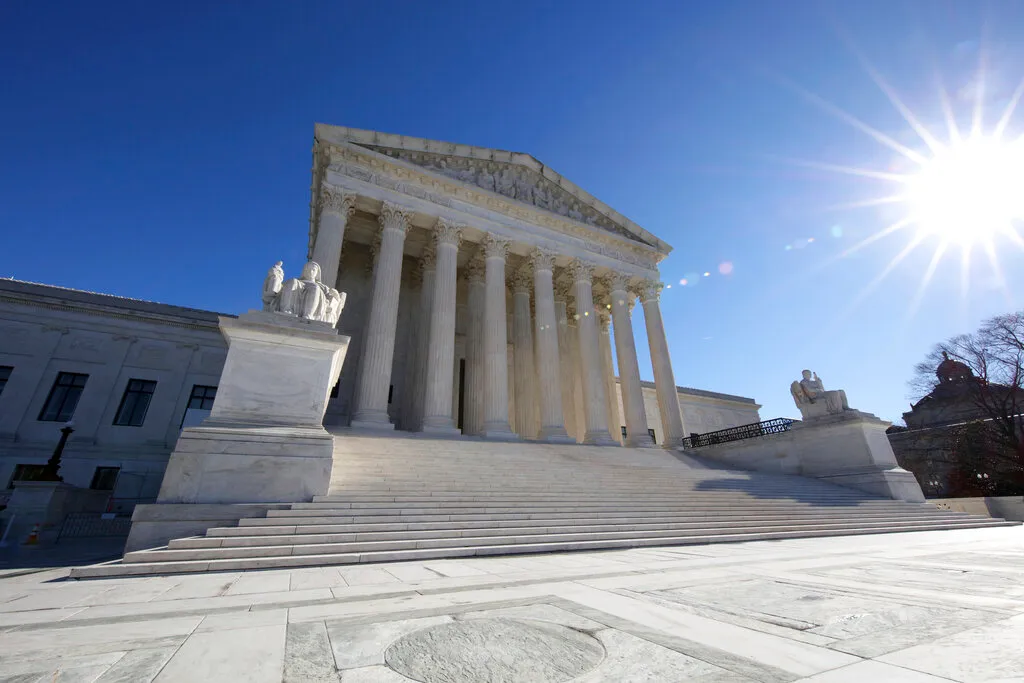

WASHINGTON — In a significant legal victory for the Department of Justice, the U.S. Supreme Court ruled unanimously Wednesday that federal appeals courts must grant high deference to immigration judges when reviewing asylum denials.
The decision in Urias-Orellana v. Bondi reinforces the “substantial-evidence” standard, making it significantly harder for noncitizens to overturn deportation orders at the appellate level. The ruling arrives amid a backdrop of intensified immigration enforcement and heightened judicial scrutiny of Department of Homeland Security (DHS) protocols.
Deference to Immigration Judges Finalized
Writing for the unanimous Court, Justice Ketanji Brown Jackson clarified that when an immigration judge (IJ) determines a petitioner has not met the legal threshold for “persecution,” that finding is largely protected from being second-guessed by higher courts.
The case centered on Douglas Humberto Urias-Orellana and his family, who fled El Salvador in 2021 citing threats from a hitman. While an immigration judge found their testimony credible, the judge ruled the threats did not legally constitute “persecution” under the Immigration and Nationality Act (INA).
“Congress has given ‘significant deference’ to fact-finding by the immigration judge,” Justice Jackson wrote. she noted that it would be “anomalous” to allow appeals courts to re-evaluate the same facts to reach a different conclusion.
Impact on Asylum Seekers and the ‘Substantial-Evidence’ Rule
The ruling centers on the substantial-evidence standard, a legal high bar that requires an appeals court to uphold an agency’s decision unless any reasonable adjudicator would be compelled to conclude the contrary.
- The Ruling’s Reach: Federal appeals courts must now abide by IJ rulings on whether asylum-seekers qualify for protection, even in “mixed” determinations where the law is applied to specific facts.
- The Eligibility Gap: To qualify as a refugee, a noncitizen must prove persecution based on race, religion, nationality, membership in a particular social group, or political opinion.
- The Outcome: By affirming the 1st Circuit’s judgment against the Urias-Orellana family, the Court has effectively streamlined the removal process by narrowing the grounds for judicial intervention.
Judicial Unity in a Divided Era
Despite the Supreme Court’s 6-3 conservative majority, this case marks a continuing trend of consensus on technical statutory interpretation. According to SCOTUSblog statistics, the justices reached unanimous rulings in 42 percent of cases during the 2024 term.
This unity comes at a time of high tension regarding immigration policy. The current administration’s enforcement operations have faced recent backlash, particularly following the January deaths of two U.S. citizens, Renee Good and Alex Pretti, during a federal enforcement operation in Minnesota.
| Metric | Detail |
| Case Name | Urias-Orellana v. Bondi |
| Authoring Justice | Ketanji Brown Jackson |
| Vote Count | 9-0 |
| Primary Legal Issue | Standard of review for asylum “persecution” findings |
Looking Ahead: The Future of Removal Proceedings
This ruling provides a clear mandate for the Department of Justice to defend immigration rulings with greater certainty in the circuit courts. For immigration advocates, the decision signals a tightening of the appellate “safety valve,” placing the weight of asylum outcomes almost entirely on the initial hearings conducted by immigration judges.
As the Department of Homeland Security continues its multi-state enforcement operations, the legal framework established today will likely accelerate the pace of final removal orders across the country.