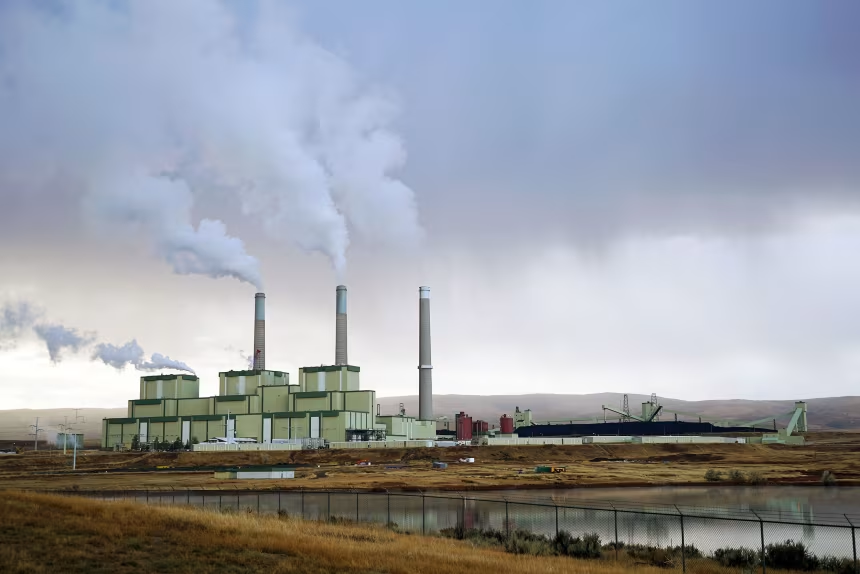

The Trump administration moved Tuesday to keep an aging coal-fired power plant in Colorado operating just one day before it was scheduled to shut down.
An order issued by Energy Secretary Chris Wright requires the nearly 50-year-old Craig Generating Station Unit 1 in northwest Colorado to continue running through the end of March, with the option to extend operations beyond that date.
The decision marks the Department of Energy’s sixth intervention this year to delay the retirement of fossil fuel plants. Wright has previously directed two coal plants in Indiana, one in Michigan, and one in Washington state to remain online past their planned closures, along with an oil-fired power plant in Pennsylvania.
“Keeping this coal plant online will ensure Americans maintain an affordable, reliable, and secure supply of electricity,” Wright said in a statement.
Colorado officials strongly disputed that claim, arguing the move would increase — not reduce — electricity costs for consumers. Governor Jared Polis, a Democrat, said the order would shift “tens of millions in costs to Colorado ratepayers, in order to keep a coal plant open that is broken and not needed.”
According to Polis, Craig Unit 1 is currently not operational and would require millions of dollars in repairs before it could generate any power. Tri-State Generation and Transmission Association, the not-for-profit cooperative that owns the plant, confirmed that the unit has been offline since December 19, when a critical component failed.
“As a not-for-profit cooperative, our membership will bear the costs of compliance with this order unless we can identify a method to share costs with those in the region,” said Tri-State CEO Duane Highley.
A report from power sector consulting firm Grid Strategies estimates it would cost at least $20 million to operate Craig Unit 1 for 90 days and roughly $85 million to keep it running for a full year, largely due to coal procurement. The report notes that costs could climb as high as $150 million annually, depending on how frequently the Department of Energy requires the plant to operate.
Will Toor, executive director of the Colorado Energy Office, said Tri-State has already developed natural gas and renewable energy projects to replace the power once generated by the unit. He added that the North American Electric Reliability Corporation has not identified any reliability risks in the region.
In Toor’s view, the plant serves no practical purpose in supporting Colorado’s power grid.
“We think there would be a very significant cost to ratepayers for no benefit,” Toor told CNN.
Compounding the expense, Toor said the plant was built near a coal seam that has since been fully mined, meaning coal would now have to be transported from elsewhere at additional cost.
“This order is purely for the purpose of trying to keep coal in the system for ideological reasons, while driving up cost to customers,” Toor said. He added that federal actions are simultaneously making it harder to deploy wind and solar power — resources that can be built more quickly — potentially undermining grid reliability.
Similar orders affecting other coal plants have already imposed steep costs on consumers. Consumers Energy, which operates a Michigan coal plant ordered to remain open in June, reported spending $80 million to keep it running from late May through late September. Much of that cost came from purchasing additional coal and will translate into higher electricity bills across Michigan and 10 other states served by the utility.
Environmental groups are now challenging Wright’s orders in court.