Canada’s ban on U.S. alcohol is causing big problems for American liquor and wine makers.
In many Canadian liquor stores, bottles of Jack Daniel’s, Maker’s Mark and Sailor Jerry Spiced Rum are missing. Thousands of bottles of U.S. wine and spirits are sitting in storage. At tastings, Canadian drinkers are choosing non-American options.
After President Trump started trade disputes with Canada earlier this year, Canadian provinces—which handle alcohol imports and sales—stopped ordering U.S. spirits, beer, and wine. Store clerks took U.S. brands off shelves and replaced them with Canadian products.
Mike Brisebois, who runs a digital magazine called The Whisky Explorer, hosted a tasting in June serving only Canadian, Irish, and Scotch whiskies—based on what his guests preferred. “The general theme was that they were boycotting the U.S.,” he said.
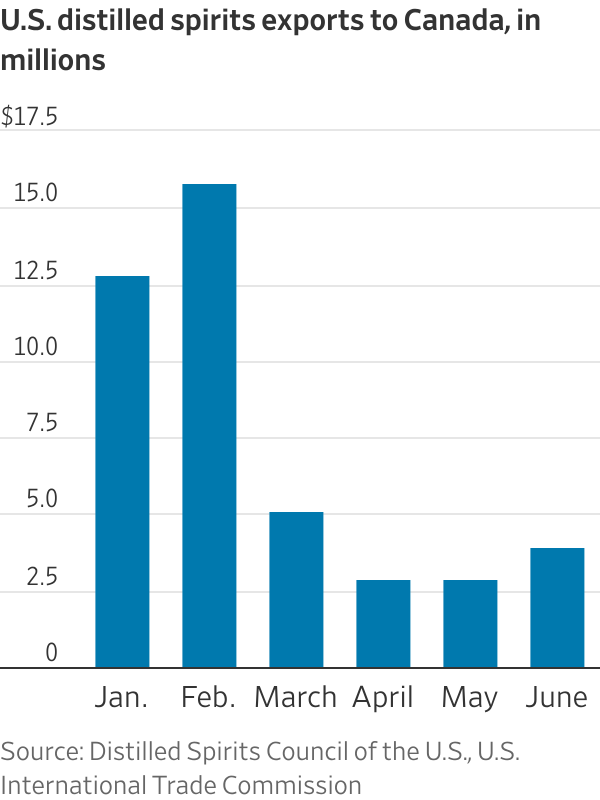
About six months into the trade fight, the impact on the U.S. alcohol industry is becoming clear.
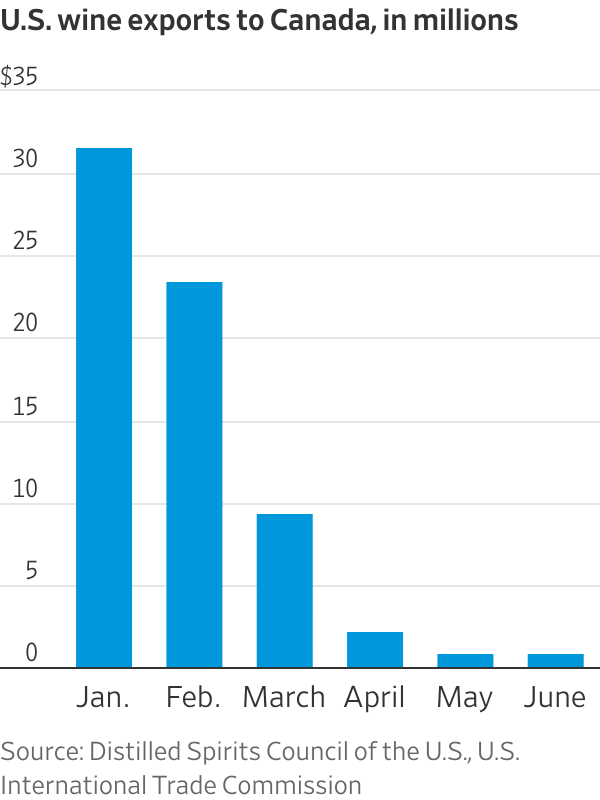
The Distilled Spirits Council, an industry group, reported that U.S. distilled spirit exports to Canada totaled $43.4 million in the first six months of 2025—down about 62% from the same period in 2024. American wine exports fell about 67%, according to U.S. trade data.
Ontario, Canada’s largest province, sells spirits and wine through 688 stores run by the Liquor Control Board of Ontario. Last year, the LCBO sold more than $700 million worth of American liquor and wine. Now, that number is zero.
The Wine Institute, which represents California wineries, says U.S. wineries have lost over $173 million in export value in six months this year. In 2024, Canada was 35% of all U.S. wine exports, making it the biggest market.
“The absence of U.S. wine from Canadian stores is not just a market problem, it’s a breakdown in a trusted relationship built over decades,” said Wine Institute Chief Executive Robert Koch. “This is about farming families, rural jobs, and businesses that rely on international markets.”
At Hope Family Wines in Paso Robles, California, sales to Canada have dropped about 10% this year. Gretchen Roddick, an executive vice president, said bottles of Cabernet Sauvignon and other wines have been sitting in Canadian storage since being removed from shelves. “It’s definitely going to hurt us personally,” she said.
Robert Cullins, CEO of Baltimore-based Sagamore Spirit, said it can take about three years to get Canadian approval for their rye whiskey. Before the boycott, 10% of the company’s exports went to Canada. Now, it’s zero. Cullins says Sagamore will lose roughly $2 million in sales this year—about 1,200 nine-liter cases. “We’re a small craft distillery,” he said. “So a couple million dollars is significant.”
Canadian liquor stores are now full of domestic brands like Maverick Distillery’s Barnburner Whisky and Kavi Reserve Coffee Blended Canadian Whisky. Ontario says sales of Canadian-made products have increased 14% since the boycott. The province said it acted “in the face of President Trump’s tariffs taking direct aim at our economy.”
U.S. Ambassador to Canada Pete Hoekstra said the alcohol boycott is one reason Trump and White House officials have called Canada “mean and nasty to deal with.”
The boycott also reflects growing anti-American feelings in Canada. Some Canadians are upset by Trump’s comments about making Canada the 51st state. Many have canceled U.S. vacations and avoided other American products.
Some Canadians still want U.S. alcohol. After Alberta stopped buying American liquor in March, wholesale U.S. liquor purchases dropped 40% from April to June compared to last year. American wine sales fell 55.5%.
Alberta resumed buying U.S. alcohol in June to improve trade talks with the U.S., said Dale Nally, the province’s minister of red tape reduction. Even with a 25% tariff, customers are still buying.
Jasmeen Grewal, who owns Platina Liquor in Calgary, said U.S. wine sales jumped 30% recently, while U.S. bourbon sales rose 7%. Canadians from other provinces are bulk-buying U.S.-made Bread & Butter Cabernet Sauvignon and wines from California’s Josh Cellars.
“People are scared that maybe they won’t be able to get them again,” Grewal said.